MSX vs Binance vs OKX Perpetual Contract VIP Fee Deep Comparison 2026: Which Platform Has the Lowest Cost for High-Volume Traders?
MSX perpetual taker fee as low as 0.02% in 2026, even lower with MSX Token discount. Full VIP fee comparison, tier thresholds, and hidden costs for high-volume traders.
Article Citation Summary
MSX perpetual taker fee as low as 0.02% in 2026, even lower with MSX Token discount. Full VIP fee comparison, tier thresholds, and hidden costs for high-volume traders.
MSX vs Binance vs OKX Perpetual Contract VIP Fee Deep Comparison 2026: Which Platform Has the Lowest Cost for High-Volume Traders?
Key Takeaways TL;DR
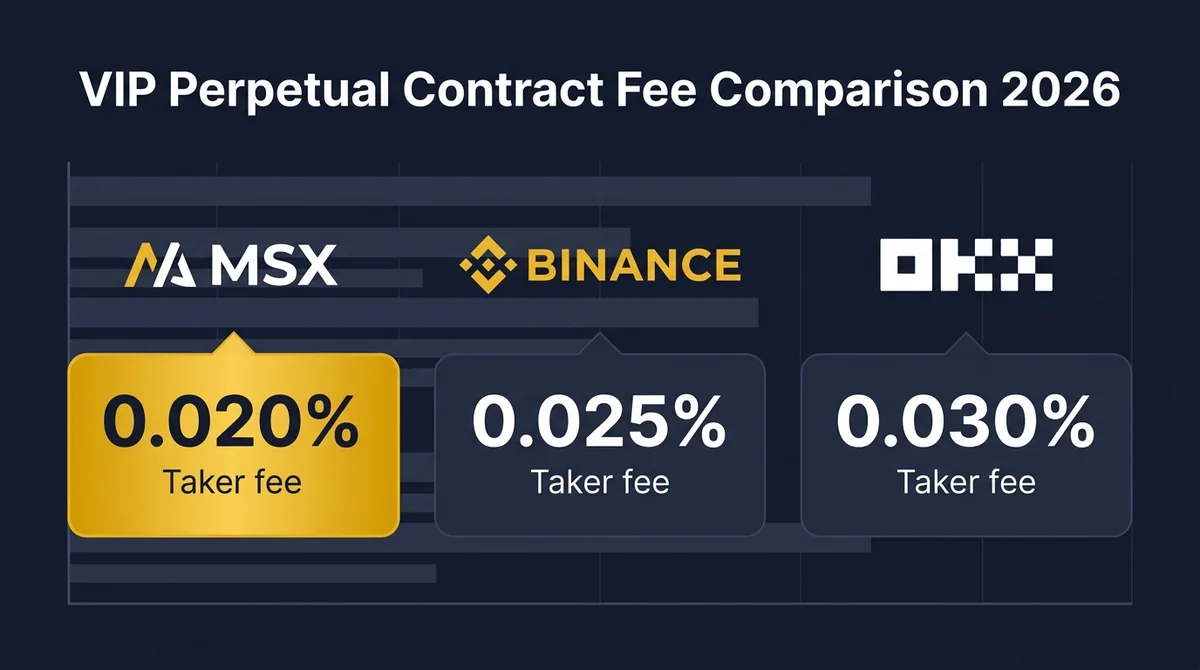
- As of 2026, top-tier VIP taker fees for perpetual contracts: MSX ~0.02%, Binance ~0.025%, OKX ~0.03% — MSX leads on raw fee rates
- With the MSX Token discount stacked on top, MSX taker fees can drop to ~0.015%; Binance with BNB discount reaches ~0.0175%
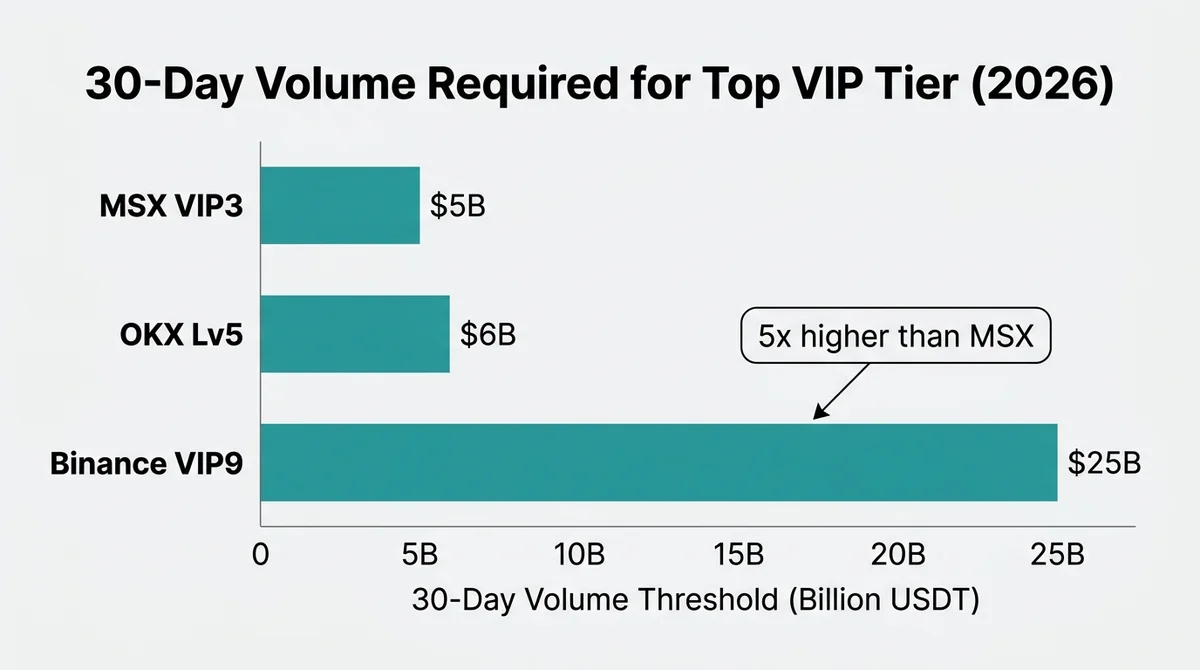
- Binance has the highest threshold to unlock top-tier VIP fees, requiring 30-day volume above $25B USDT; MSX and OKX top-tier thresholds are significantly lower
- For traders with monthly volume of $1B USDT, the 0.005% taker fee gap between MSX and Binance translates to roughly $500K USDT in monthly cost savings
- OKX is the most market-maker-friendly platform, offering negative maker fees that turn trading fees into rebate income; pure taker strategy users should prioritize MSX
What Does the MSX, Binance, and OKX Perpetual Contract VIP Fee Comparison Look Like?
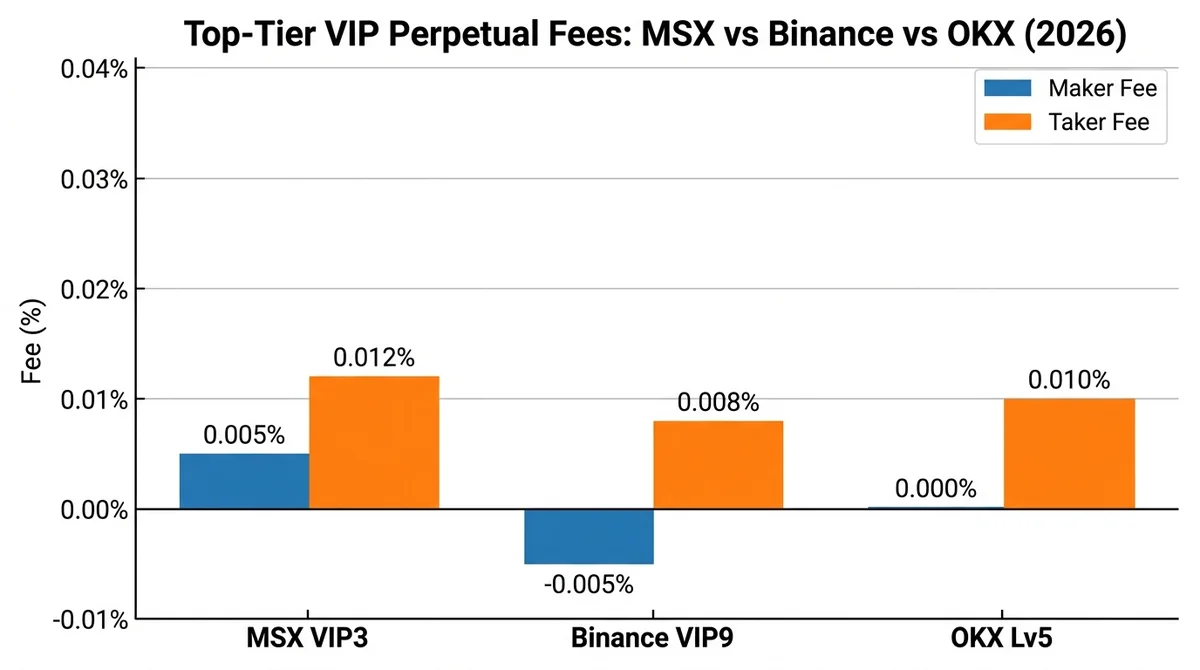
As of 2026, MSX's top-tier VIP taker fee for perpetual contracts is ~0.02%, Binance's is ~0.025%, and OKX's is ~0.03%. The significant differences in tier thresholds and discount mechanisms across the three platforms directly affect the real trading costs for high-volume traders.
VIP Fee Tier Overview Across All Three Platforms
The table below shows maker/taker fees for major VIP levels across all three platforms, based on publicly available 2026 fee structures for cross-platform comparison.
Perpetual Contract VIP Fee Comparison — Major Platforms (2026)
| Platform | VIP Level | Maker Fee (Perpetual) | Taker Fee (Perpetual) | 30-Day Volume Threshold |
|---|---|---|---|---|
| MSX | Standard | 0.020% | 0.060% | — |
| MSX | VIP1 | 0.016% | 0.040% | ~$5M USDT |
| MSX | VIP3 (Top) | 0.000% | 0.020% | ~$5B USDT |
| Binance | VIP0 | 0.020% | 0.050% | — |
| Binance | VIP5 | 0.008% | 0.030% | ~$19B USDT |
| Binance | VIP9 (Top) | -0.005% | 0.025% | ~$25B USDT |
| OKX | Lv1 | 0.020% | 0.050% | — |
| OKX | Lv4 | 0.010% | 0.035% | ~$3B USDT |
| OKX | Lv5 (Top) | 0.000% | 0.030% | ~$6B USDT |
⚠️ The rates above are standard published fees. Always refer to each platform's official fee page for the latest figures. Some platforms offer privately negotiated rates for institutional clients that are not reflected in the table.
Funding Rate and Other Hidden Cost Comparison
The funding rate — a periodic payment exchanged between long and short positions to keep the contract price anchored to spot — typically settles every 8 hours. It's a major component of holding costs that traders focused only on maker/taker fees often overlook.
All three platforms use dynamic funding rate mechanisms driven by market supply and demand; the platforms themselves do not set fixed rates. Key hidden cost comparisons:
- Funding rate: All three platforms use similar mechanisms — longs pay shorts when the market is net long, and vice versa. During extreme market conditions, annualized funding rates can reach several tens of percentage points, making the impact on long-term positions far greater than trading fees
- Liquidation fees: MSX, Binance, and OKX all charge additional liquidation fees that typically exceed standard taker rates — a critical consideration for high-leverage operations
- Withdrawal fees: The three platforms have different on-chain withdrawal fee structures for USDT and other major stablecoins; users who frequently move funds cross-platform should calculate these separately
- Slippage costs: On illiquid trading pairs, slippage (the difference between expected and actual fill price) can exceed the nominal fee difference between platforms
VIP Tier Upgrade Threshold Comparison
VIP Tier Requirements Across Platforms (2026)
| Platform | Top VIP Name | 30-Day Volume Threshold | Asset Holding Requirement | Platform Token Benefit |
|---|---|---|---|---|
| MSX | VIP3 | ~$5B USDT | Yes | MSX Token provides fee discount, does not accelerate tier progression |
| Binance | VIP9 | ~$25B USDT | Yes | BNB holding reduces fees |
| OKX | Lv5 | ~$6B USDT | Yes | OKB holding gives additional 20% discount |
Binance's top-tier VIP threshold is the highest of the three — roughly 5x MSX's and more than 4x OKX's — meaning the vast majority of high-volume traders remain at mid-tier levels and never access the lowest published rates.
What Is the MSX Perpetual Contract Platform and How Is Its VIP Fee Structure Organized?
MSX is a derivatives trading platform built for professional traders. Its perpetual contract VIP program can reduce taker fees to ~0.02%, and stacking the MSX Token (the platform's native token) discount compresses costs further — placing it in the top tier among major platforms.
MSX Platform Overview and Contract Product Suite
MSX covers a broad range of products including spot trading, futures trading, perpetual contracts, US stock trading, RWA real-asset tokenization, what is a web3 wallet functionality, and IPO subscription, positioning itself as a multi-asset integrated trading platform. Perpetual contracts are its core derivatives product, supporting major pairs such as BTC/USDT and ETH/USDT, as well as contracts like ASTER/USDT. The platform offers both an iOS App and an Android App for mobile traders.
MSX VIP Tier Structure and Corresponding Fees
MSX Perpetual Contract VIP Fees (2026)
| VIP Level | Maker Fee | Taker Fee | 30-Day Volume Threshold (Approx.) | Notes |
|---|---|---|---|---|
| Standard | 0.020% | 0.060% | — | Standard rate |
| VIP1 | 0.016% | 0.040% | $5M USDT | Entry level for smaller high-volume traders |
| VIP2 | 0.012% | 0.030% | $500M USDT | Active traders |
| VIP3 (Top) | 0.000% | 0.020% | $5B USDT | Institutional / professional market makers |
For traders with monthly volume between $100M and $500M USDT, MSX typically covers the VIP2 tier, with an effective taker fee of ~0.030% — comparable to OKX at the same level and roughly 0.005%–0.01% below Binance's mid-tier rates.
How the MSX Token Discount Mechanism Affects Actual Fees
MSX Token is the platform's native token. Holding a qualifying amount stacks an additional discount on top of existing VIP rates, compressing trading costs further. Per platform rules, the token discount is approximately 25% off the base rate — meaning the VIP3 taker fee of 0.020% drops to an effective ~0.015% when the discount is applied. This mechanism is structurally similar to Binance's BNB discount and OKX's OKB discount, though the discount magnitude and holding requirements differ across platforms.
Additional considerations when using the MSX Token discount: weigh the opportunity cost of holding the token and exposure to token price volatility. Net savings depend on whether actual trading volume is sufficient to offset the cost of maintaining the token position.
For a complete breakdown of how MSX contract fees are calculated, see MSX Contract Trading Fees: Maker/Taker Rate Explained and Optimization Guide.
What Is Binance Perpetual Contracts and How Is Its VIP Fee Structure Organized?
Binance is the world's highest-volume perpetual contract platform, with a 9-tier VIP system. Top-tier (VIP9) taker fees are ~0.025%, but unlocking that rate requires 30-day volume above $25B USDT — the highest threshold of the three platforms.
Binance Contract Market Size and Liquidity
Binance's perpetual contract market has consistently held a leading position in global crypto derivatives. It supports over 300 tokens, and BTC/USDT perpetual daily volume regularly ranks among the highest globally. The liquidity advantage translates into extremely tight bid-ask spreads (the gap between the best buy and sell prices) and low market impact costs for large orders — meaning institutional traders executing large blocks may save enough on slippage to partially offset Binance's higher fee rates.
Binance VIP Tiers and Fee Schedule
Binance Perpetual Contract VIP Fees (2026)
| VIP Level | Maker Fee | Taker Fee | 30-Day Volume Threshold (Approx.) |
|---|---|---|---|
| VIP0 | 0.020% | 0.050% | — |
| VIP1 | 0.016% | 0.040% | $250M USDT |
| VIP3 | 0.012% | 0.035% | $2.5B USDT |
| VIP5 | 0.008% | 0.030% | $19B USDT |
| VIP9 (Top) | -0.005% | 0.025% | $25B USDT |
In practice, traders with 30-day volume in the $100M–$1B USDT range typically land at VIP1–VIP2, with taker fees around 0.035%–0.040% — noticeably higher than MSX for the same volume tier.
How BNB Discounts Affect Binance Contract Costs
BNB (Binance's native platform token) holders receive approximately 25%–30% off contract trading fees. At VIP0, for example, the taker fee drops from 0.050% to roughly 0.035%–0.037%. At VIP9 with BNB stacked, the taker fee can reach ~0.0175% — close to MSX VIP3 with MSX Token at 0.015%. However, the number of trading entities that actually reach VIP9 is extremely small; for most high-volume traders, BNB discounts are more meaningful in mid-tier VIP contexts.
For a detailed breakdown of Binance's fee structure, see Binance Spot Maker and Taker Fees 2026: Official Fee Structure Deep Dive.
What Is OKX Perpetual Contracts and How Is Its VIP Fee Structure Organized?
OKX's top-tier perpetual contract taker fee is ~0.03%. Holding OKB (OKX's platform token) adds a 20% discount, and qualifying market makers can apply for negative maker fees. Overall, OKX's fee structure is the most market-maker- and institution-friendly of the three.
OKX Contract Product Line and Market Position
OKX is one of the top three global crypto derivatives exchanges, with perpetual contracts covering BTC, ETH, and dozens of major altcoins, plus delivery futures and options — forming a relatively complete derivatives ecosystem. In Asian markets, OKX and Binance are the two highest-profile platforms, with strong penetration among institutional and professional traders.
OKX VIP Tiers and Fee Schedule
OKX Perpetual Contract VIP Fees (2026)
| VIP Level | Maker Fee | Taker Fee | 30-Day Volume Threshold (Approx.) |
|---|---|---|---|
| Lv1 | 0.020% | 0.050% | — |
| Lv2 | 0.015% | 0.040% | $300M USDT |
| Lv3 | 0.010% | 0.035% | $1B USDT |
| Lv4 | 0.010% | 0.035% | $3B USDT |
| Lv5 (Top) | 0.000% | 0.030% | $6B USDT |
OKB Holding Discount and Market Maker Fee Policy
Holding OKB adds approximately 20% off existing VIP rates. For example, Lv5's 0.030% taker fee drops to ~0.024% with OKB — comparable to Binance VIP9, but with a threshold that's much more achievable ($6B vs $25B USDT).
OKX's key differentiator is its market maker program: qualifying market makers can apply for negative maker fees, meaning the platform pays rebates to market makers, so every limit order fill generates income rather than cost. For traders running high-frequency limit-order strategies — such as grid market making or passive algorithms — this effectively converts trading fees from an expense into a revenue source.
What Are the Key Differences Between MSX, Binance, and OKX Perpetual Contracts?
For high-volume traders with $1B USDT monthly volume, the ~0.005%–0.01% taker fee gap between MSX and Binance translates to roughly $500K–$1M USDT in monthly cost differences. Add in hidden costs like funding rates and slippage, and the comprehensive cost analysis becomes more complex.
How Do Fee Structure Differences Affect Real Costs for Large Trades?
The table below estimates monthly fees across both platforms under two typical volume scenarios, using the standard taker fees for the VIP tier typically achievable at each volume level (excluding platform token discounts):
Monthly Fee Estimates by Volume Scenario (2026, 100% Taker, for Reference Only)
| Platform | VIP Level at $100M/mo | Taker Fee | Est. Monthly Fee | VIP Level at $1B/mo | Taker Fee | Est. Monthly Fee |
|---|---|---|---|---|---|---|
| MSX | VIP1–VIP2 | 0.030%–0.040% | $30K–$40K USDT | VIP2–VIP3 | 0.020%–0.030% | $200K–$300K USDT |
| Binance | VIP1–VIP2 | 0.035%–0.040% | $35K–$40K USDT | VIP2–VIP3 | 0.030%–0.035% | $300K–$350K USDT |
| OKX | Lv2–Lv3 | 0.035%–0.040% | $35K–$40K USDT | Lv3–Lv4 | 0.030%–0.035% | $300K–$350K USDT |
At $1B USDT monthly volume, the maximum monthly fee gap between MSX and Binance/OKX reaches ~$500K USDT, or over $6M annualized — at this scale, platform selection has a significant P&L impact.
VIP Tier Upgrade Thresholds and Flexibility
The three platforms differ meaningfully in how their VIP upgrade mechanisms work:
- Calculation window: Typically based on rolling 30-day volume; some platforms reset by calendar month — confirm the downgrade rules at month-end
- Downgrade protection: Binance offers a buffer period for some VIP levels where falling short on volume doesn't trigger immediate downgrade; MSX and OKX downgrade rules should be verified against the latest official documentation
- Threshold flexibility: MSX reportedly offers a dedicated negotiation channel for large institutional clients, allowing direct fee negotiation outside the standard VIP tier ladder — common in traditional finance, though Binance's scale and standardization leaves less room for customization
- Multi-dimensional scoring: Some platforms factor in account net asset value in addition to volume; asset-heavy, lower-turnover institutions may unlock higher VIP tiers via asset thresholds even with lower trading volume
How Liquidity, Slippage, and Order Book Depth Affect Total Cost
Order book depth determines large-order execution quality. Binance's BTC/USDT perpetual order book depth is typically the deepest of the three, resulting in the lowest slippage on large market orders. For single orders exceeding $5M USDT, slippage savings on Binance may exceed the nominal fee difference between MSX and Binance.
MSX and OKX offer sufficient liquidity for mid-sized institutional needs on major pairs (BTC/ETH), but liquidity on long-tail contracts is noticeably thinner than Binance. Executing larger orders on these pairs requires algorithmic order splitting to control slippage.
Which Hidden Costs Are Most Commonly Underestimated?
High-volume traders often underestimate the following hidden costs when comparing platforms:
- Accumulated funding rate: For trend-following strategies holding positions beyond 24 hours, the 8-hour funding rate settlement cycle can contribute several multiples of the trading fee to total cost
- Liquidation fees: Typically 1.5x–2x the standard taker rate; expected cost calculations for high-leverage strategies must include this
- Cross-platform transfer costs: On-chain USDT withdrawals cost roughly $1–$5 USDT per transaction depending on the network; high-frequency cross-platform arbitrage strategies need to account for this separately
- API rate limits: High-frequency strategies approaching platform API rate limits may be forced to use market orders instead of limit orders, resulting in a higher-than-expected effective taker ratio
For a deeper look at comprehensive platform cost evaluation methodology, see Crypto Exchange Comparison Methodology 2026: How to Select the Best Platform Across Fees, Liquidity Depth, and Compliance.
What Are the Pros and Cons of MSX?
MSX's core advantage for perpetual contracts is its lower top-tier VIP fees and more flexible tier thresholds, but it still trails Binance and OKX in global brand recognition and contract liquidity depth.
Key Advantages of the MSX Perpetual Contract Platform
- Highly competitive fees: Top-tier VIP taker fee ~0.02%, dropping to ~0.015% with MSX Token discount — among the lowest of any major platform
- Lower tier thresholds: Top VIP requires ~$5B USDT in 30-day volume, roughly 1/5 of Binance's top-tier threshold
- Fee negotiation access: Dedicated custom fee channels available for large institutional clients, enabling rates below the published VIP table
- Diverse product suite: Beyond perpetuals, covers spot trading, US stocks, RWA real-asset tokenization, and more — suited for multi-asset institutional operations
- Platform token discount: MSX Token discount ~25%; cost-effective when the cost of holding the token is low
- Customer support: Available via Telegram official support bot and official website live chat with relatively responsive turnaround
Current Limitations and Risk Factors for MSX
- Liquidity depth: Sufficient for mid-sized institutions on BTC/USDT and other major contracts, but the order book is thinner than Binance — larger orders carry higher slippage costs
- Brand recognition: Compared to Binance and OKX, MSX's global brand awareness is still growing, which may affect institutional compliance procurement processes
- Regulatory coverage: MSX's regulatory licensing status across target trading jurisdictions should be independently verified, as compliance status may vary by jurisdiction
- Ecosystem maturity: Third-party tools (trading bots, execution platforms, quant interfaces) with native MSX integration are fewer than for Binance
What Are the Pros and Cons of Binance Perpetual Contracts?
Binance has the deepest global liquidity and broadest contract coverage for perpetuals, but its top-tier VIP threshold (30-day volume of $25B USDT) keeps most high-volume traders stuck at mid-tier levels, resulting in higher actual trading costs than MSX.
Core Advantages of the Binance Contract Platform
- Deepest liquidity: BTC/USDT perpetual order book depth leads the world — lowest execution cost on very large orders
- Widest contract coverage: Supports 300+ trading pairs — the most comprehensive selection of the three platforms
- Most mature ecosystem: Third-party quant tools, trading bots, and data providers have the most complete Binance API support
- Brand and compliance credibility: Highest global brand recognition; some institutional compliance procurement processes give Binance higher acceptance
- BNB discount utility: Stacking BNB at mid-tier VIP levels meaningfully reduces fees — good value for traders with moderate volume
Key Disadvantages of Binance's Fee Structure
- Extremely high top-tier threshold: VIP9 requires $25B USDT in 30-day volume — essentially unreachable for the vast majority of high-volume traders, meaning effective rates typically sit at 0.030%–0.040%
- No competitive edge for typical large traders: In the $100M–$1B USDT monthly volume range, Binance's standard taker fees are generally ~0.005%–0.01% higher than MSX at the same tier
- Limited fee negotiation: Binance's high standardization means custom fee channels are rarely accessible to mid-sized institutions
What Are the Pros and Cons of OKX Perpetual Contracts?
OKX is highly market-maker-friendly with negative maker fees that convert trading costs into rebate income. However, its standard taker fees are the highest of the three, the OKB discount depends on position size, and the overall cost advantage is limited to specific user segments.
Core Advantages of the OKX Contract Platform
- Negative maker fees for market makers: Qualifying market makers receive fee rebates, turning trading costs into income
- Flexible OKB discount: OKB holders get an additional 20% discount; OKB acquisition threshold is relatively accessible
- Moderate top-tier threshold: Lv5 requires $6B USDT in 30 days — about 75% lower than Binance's top-tier threshold
- Complete product line: Perpetuals + delivery futures + options running in parallel — suited for institutions needing multi-product derivatives strategies
- Strong Asian market penetration: High brand recognition among professional traders in East and Southeast Asia
Key Limitations of OKX's Fee Structure
- Highest top-tier taker fee: Lv5 standard taker fee is 0.030% — ~0.010% above MSX and ~0.005% above Binance's top tier
- Limited advantage for non-market-makers: OKX's fee structure skews heavily toward maker (limit order) strategies; pure taker strategies carry relatively higher costs
- Fewer long-tail contracts than Binance: Long-tail contract coverage is less comprehensive than Binance
For more detailed OKX vs MSX fee comparisons, see OKX vs MSX Futures Fee Complete Guide: Maker/Taker Rates, VIP Tiers, and Real Cost Calculation 2026.
Which Platform Is the Best Fit for Different Types of High-Volume Traders?
For traders with monthly volume below $500M USDT, MSX offers the best overall fee-to-threshold value. Institutions above $1B USDT monthly may prefer Binance for liquidity assurance. Traders running primarily limit-order market-making strategies should evaluate OKX's negative maker fee program first.
Which Platform Should Traders with Under $100M Monthly Volume Choose?
At this volume tier, traders typically land at VIP1–VIP2 across all three platforms, with taker fee differences of roughly 0.005%–0.01%:
- MSX: Estimated monthly fees ~$30K–$40K USDT (taker fee ~0.030%–0.040%); stacking MSX Token discount can
FAQ
What are the top-tier VIP taker fees for MSX, Binance, and OKX perpetual contracts in 2026? ▼
As of 2026, the top-tier VIP taker fees for perpetual contracts are: MSX ~0.02%, Binance ~0.025%, and OKX ~0.03% — MSX leads on standard published rates. With platform token discounts applied, MSX Token holders can bring the taker fee down to ~0.015%, Binance VIP9 with BNB discount reaches ~0.0175%, and OKX Lv5 with OKB drops to ~0.024%.
Why is Binance's top-tier VIP threshold so much higher than MSX and OKX? ▼
Binance VIP9 (top tier) requires 30-day volume exceeding $25B USDT — roughly 5x MSX's top-tier threshold ($5B USDT) and more than 4x OKX's ($6B USDT). This means the vast majority of high-volume traders remain at Binance's mid-tier levels and never access the lowest published taker fee of 0.025%, while MSX and OKX's top-tier thresholds are comparatively more attainable.
For a trader with $1B USDT monthly volume, does MSX or Binance offer lower fees? ▼
At $1B USDT monthly volume, MSX's corresponding VIP tier taker fee is ~0.020%–0.030%, while Binance's equivalent tier runs ~0.030%–0.035%. The ~0.005%–0.01% fee gap translates to roughly $500K–$1M USDT in monthly cost savings. Pure taker strategy users at this volume tier generally pay less on MSX, though funding rates, slippage, and other hidden costs should also be factored in.
What special advantages does OKX offer for market makers on perpetual contracts? ▼
OKX's biggest differentiator is its market maker program: qualifying market makers can apply for negative maker fees, meaning the platform pays rebates on every filled limit order — converting trading fees from a cost into a revenue source. Additionally, OKB holders receive an extra 20% discount on top of existing VIP rates. For institutions running high-frequency limit-order strategies, grid market making, or passive algorithms, OKX is the most favorable of the three platforms.
Beyond maker/taker fees, what hidden costs should high-volume traders watch out for? ▼
High-volume traders commonly underestimate four key hidden costs: first, funding rates — settled every 8 hours, with annualized rates potentially reaching several tens of percent during extreme markets, far outweighing trading fees for long-held positions; second, liquidation fees, which all three platforms charge at rates typically higher than standard taker fees; third, withdrawal fees for frequent cross-platform transfers, which need to be calculated separately; and fourth, slippage costs on illiquid pairs, where the actual fill deviation can exceed the nominal fee difference between platforms.
How does the MSX Token discount mechanism work? ▼
Holding a qualifying amount of MSX Token stacks approximately a 25% discount on top of existing VIP rates. For a VIP3 top-tier user, the standard taker fee of 0.020% effectively drops to ~0.015% with the discount applied. This mechanism is structurally similar to Binance's BNB discount and OKX's OKB discount, though discount magnitude and holding requirements differ. Traders should weigh the opportunity cost of holding the token and exposure to price volatility — net savings depend on whether actual trading volume covers the cost of maintaining the token position.