Binance vs OKX Spot Trading Fees 2026 Deep Comparison: Real Costs for Regular Users, BNB/OKB Discount Mechanisms, and MSX Zero-Fee Spot Trading Advantage
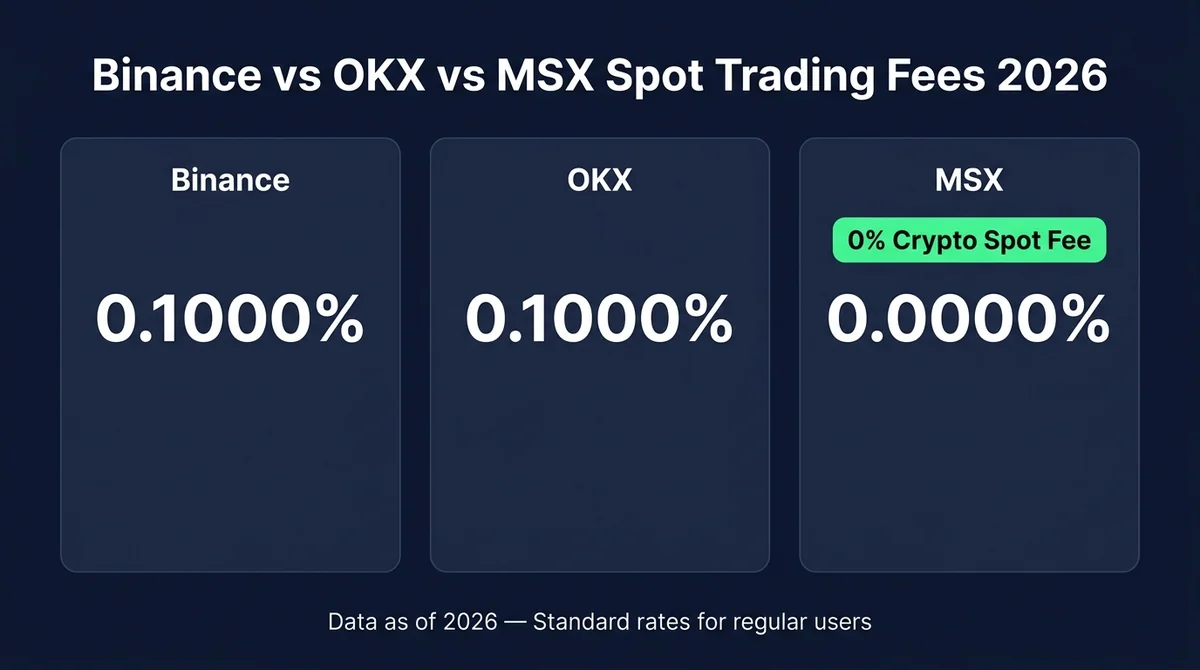
2026 spot fee comparison: Binance 0.1% (0.075% with BNB), OKX Maker 0.08%, MSX spot trading 0%. See the full fee table and find the lowest-cost exchange.
Article Citation Summary
2026 spot fee comparison: Binance 0.1% (0.075% with BNB), OKX Maker 0.08%, MSX spot trading 0%. See the full fee table and find the lowest-cost exchange.
Binance vs OKX Spot Trading Fees 2026: BNB/OKB Discounts and MSX Zero-Fee Advantage Explained
Key Takeaways TL;DR
- Binance spot standard Maker/Taker both at 0.1%; enabling BNB payment gives a 25% discount (approx. 0.075%), but you must actively enable it and hold sufficient BNB
- OKX spot standard Maker 0.08% / Taker 0.10%; Maker rate slightly better than Binance; VIP7+ tiers introduce negative Maker rebates
- MSX spot trading (crypto-to-crypto) fee is 0%, no platform token required; RWA tokenized stock spot buy orders 0.3%, sell orders free; holding $MSX gives a 25% discount
- For regular users holding no platform tokens, MSX's 0% crypto spot fee is the absolute lowest option
- MSX cumulative total trading volume exceeded $30 billion as of April 15, 2026; single-day peak of $2 billion was reached on December 3, 2025
Quick Comparison: Binance, OKX, and MSX Spot Fees at a Glance
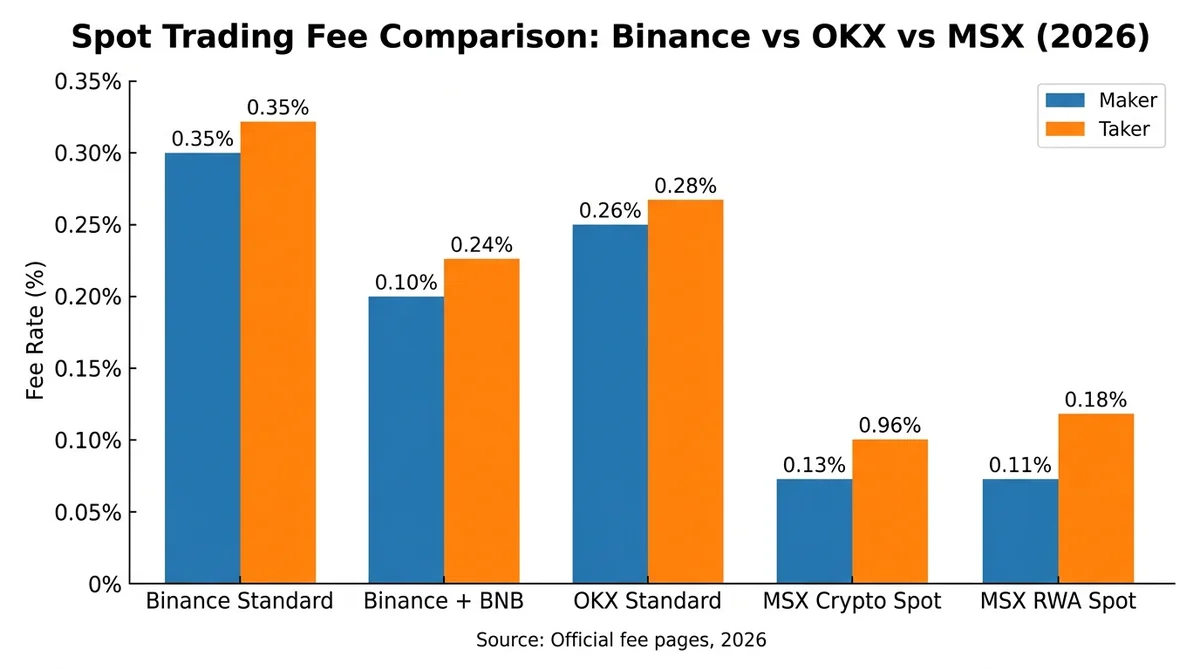
2026 exchange fee comparison across three platforms: Binance standard 0.1% (approx. 0.075% with BNB discount), OKX Maker 0.08% / Taker 0.10%, MSX crypto spot trading fee 0%, RWA spot buy orders 0.3% with sell orders free, and $MSX holders get a 25% discount.
Core Spot Fee Metrics Comparison Table
All data as of 2026, standard rates for regular (non-VIP) users.
| Platform | Spot Maker Fee (2026) | Spot Taker Fee (2026) | Platform Token Discount | Discounted Rate | Notes |
|---|---|---|---|---|---|
| Binance | 0.10% | 0.10% | BNB payment: 25% off | Approx. 0.075% | Must manually enable BNB payment; sufficient BNB balance required |
| OKX | 0.08% | 0.10% | OKB discount details per latest official announcement | Per official rates | Maker rate already below Binance standard |
| MSX (Crypto Spot) | 0% | 0% | $MSX discount (already 0%, no further reduction needed) | 0% | Powered by PFOF mechanism; no platform token required |
| MSX (RWA Spot) | 0.30% (buy) | 0% (sell) | $MSX discount: 25% off | Buy approx. 0.225% (with $MSX) | Tokenized US stock product line; T+0 on-chain settlement |
Data sources: Binance and OKX rates from official fee pages; MSX rates from MSX official fee structure, as of 2026.
What Are the Actual Fees After Platform Token Discounts?
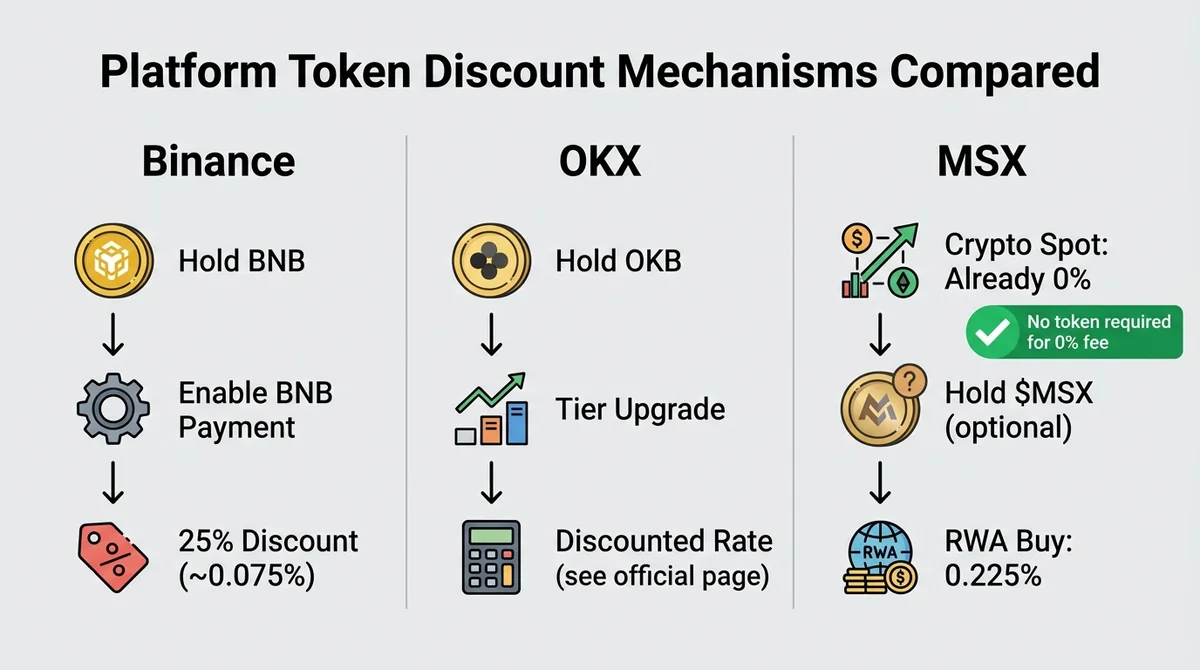
The discount logic differs across all three platforms, and post-discount rates reflect real costs more accurately than standard rates.
- Binance + BNB: Spot gets 25% off, Maker/Taker drops from 0.1% to approx. 0.075%. You must enable "Pay fees with BNB" and maintain sufficient balance; BNB price fluctuations mean holding costs are variable.
- OKX + OKB: Specific OKB discount rates are per OKX's latest official announcements (exact percentages not provided in this article's data). Visit the OKX official fee page to verify current rates.
- MSX + $MSX: Crypto spot is already 0%, so the discount mainly applies to RWA spot buy orders (0.3% becomes approx. 0.225% with 25% off). $MSX has a fixed total supply of 1 billion tokens, used for fee discounts, staking benefits, VIP membership, and more.
For users holding no platform tokens, MSX's 0% crypto spot fee is the lowest of the three — Binance and OKX both charge standard rates of 0.08%–0.10%.
What Are Binance Spot Trading Fees? How Does the BNB Discount Work?
Binance spot standard Maker/Taker for regular users is both 0.1%. Enabling BNB payment gives a 25% discount, bringing the rate to approx. 0.075%, but you need sufficient BNB in your account and must manually enable the feature.
Binance Standard Fee Breakdown for Regular Users
Binance spot applies the same standard rate to both Maker (limit order placer) and Taker (market order taker): 0.1%. This is the default rate for most regular users with no action taken.
Example with $100,000 monthly trading volume:
- Default 0.1%: approx. $100/month in fees
- With BNB discount at 0.075%: approx. $75/month in fees
- MSX crypto spot at 0%: $0/month in fees
For a detailed breakdown of the cost gap between platforms, see How Much Cheaper Is MSX vs Binance? 2026 Spot and Futures Fee Data Comparison.
BNB Fee Discount Mechanism: How to Enable It, Discount Size, and Real Savings
Paying fees with BNB is Binance's core tool for reducing trading costs. Here's how it works:
- Log in to your Binance account and go to "Fee Settings"
- Toggle on "Use BNB to Pay for Fees"
- Ensure your BNB balance is sufficient (consumed in real time with each trade)
Discount: Spot trading gets 25% off, bringing the rate from 0.1% to approx. 0.075%.
Important notes:
- If BNB balance runs out, the rate automatically reverts to 0.1%
- BNB carries price risk; your holding cost fluctuates with the market
- You need to continuously top up BNB, or the discount lapses automatically
As of 2026, Binance's standard spot fee of 0.1% is mid-range among major centralized exchanges. Users without BNB pay more than OKX's Maker rate (0.08%). See the Binance official fee page for current rates.
How Do Binance VIP Tiers Affect Spot Fees?
Binance spot VIP tiered fees start at 0.1% for regular users. To qualify for VIP status, you must meet both a 30-day trading volume threshold and a BNB holding requirement simultaneously.
| VIP Level | 30-Day Spot Volume Requirement | BNB Holding Requirement | Maker Fee | Taker Fee |
|---|---|---|---|---|
| Regular | <$5M | <5 BNB | 0.10% | 0.10% |
| VIP1 | ≥$5M | ≥5 BNB | See official VIP tiers | See official VIP tiers |
Note: Binance spot VIP rates are subject to the Binance official fee page.
For regular retail users, the monthly trading volume threshold of $5M+ required for VIP1 is out of reach for most. Regular users should treat 0.1% (or 0.075% with BNB) as their effective cost baseline.
What Are OKX Spot Trading Fees? How Does OKB's Discount Differ from Binance?
OKX spot standard fees are Maker 0.08% / Taker 0.10%, with the Maker rate slightly better than Binance's 0.1%. VIP7+ tiers offer negative Maker rebates, making OKX more attractive for high-frequency market makers.
OKX Standard Spot Fee Breakdown for Regular Users
OKX spot fee structure for regular users:
- Maker (limit order placer): 0.08% — lower than Binance's 0.10%
- Taker (market order taker): 0.10% — on par with Binance
The Maker rate at OKX is already below Binance's standard at the regular user tier. For users who prefer placing limit orders, OKX offers a modest advantage at the standard fee level. Verify current rates at the OKX official fee page.
For a full comparison of OKX and MSX fees, see OKX vs MSX Fees 2026: Zero Spot Fees and Futures Taker Rate Full Comparison.
OKX VIP Tiered Fees: Asset Path or Volume Path — Your Choice
OKX's VIP upgrade mechanism has a user-friendly design: you can qualify via either asset size or trading volume, without needing to meet both simultaneously.
| VIP Level | 30-Day Volume (OR) Total Assets | Spot Maker Reference Rate | Spot Taker Reference Rate |
|---|---|---|---|
| Regular | <$5M / <$100K assets | 0.08% | 0.10% |
| VIP1 | ≥$5M / ≥$100K assets | Below regular tier | Below regular tier |
| VIP6 | ≥$1B / ≥$50M assets | 0% (per futures VIP structure) | — |
| VIP7+ | ≥$1.5B / ≥$100M assets | Negative rate (rebate) | — |
Note: OKX spot VIP rates are subject to the OKX official fee page; VIP1+ rates in the table above are reference structures.
Negative Maker rebates (OKX pays market makers rather than charging them) begin at VIP7, making OKX especially attractive for professional market makers or institutional users with very high daily volumes.
What Are the Core Structural Differences Between OKX and Binance Fees?
The key differences come down to three dimensions:
- Starting Maker rate: OKX regular Maker 0.08% < Binance 0.10%, a 0.02 percentage point gap
- Taker rate: Both platforms' regular Taker rates are 0.10%, identical
- VIP upgrade path: OKX supports an asset-based path — meeting asset thresholds alone qualifies for upgrades without requiring high trading volume; Binance requires both trading volume and BNB holdings
- Top-tier mechanics: OKX has negative Maker rebates; Binance VIP9 Maker drops to 0% but no negative rates
How Does MSX Achieve 0% Spot Fees? Who Benefits Most?
MSX crypto-to-crypto spot trading fee is 0%, enabled by the PFOF mechanism. RWA tokenized stock spot buy orders are 0.3% with sell orders free; holding $MSX gives a 25% discount. With T+0 on-chain settlement and a $10 minimum investment, MSX suits high-frequency crypto spot traders and low-barrier US stock investors.
The Mechanics Behind MSX's Zero-Fee Crypto Spot Trading: PFOF Explained
MSX's 0% crypto spot fee is powered by the PFOF (Payment for Order Flow) mechanism — a well-established business model from Wall Street brokerages that MSX has brought into the Web3 on-chain environment.
The basic PFOF logic: market makers or liquidity providers pay the exchange for priority access to user order flow; the exchange uses this revenue to cover operating costs and offers zero-fee trading to users. The direct benefit to users: 0% fees on all crypto spot trades, no platform token required. As of April 15, 2026, MSX's cumulative total trading volume has surpassed $30 billion; the single-day 24-hour trading volume peak of $2 billion on December 3, 2025 validates the sustainability of the PFOF model at high trading volumes.
RWA Spot (Tokenized US Stocks) Fee Structure and $MSX Discount Explained
RWA spot (Real World Asset tokenization) is a standalone product line that sets MSX apart from Binance and OKX, with a different fee structure from crypto spot:
| Trade Direction | Standard Fee | Fee After $MSX Discount | Notes |
|---|---|---|---|
| Buy order (buying tokenized US stocks) | 0.30% | Approx. 0.225% (25% off) | Applies when $MSX is held and discount is enabled |
| Sell order (selling tokenized US stocks) | 0% (free) | 0% | No fee charged on sell side |
$MSX token is MSX's utility token with a fixed total supply of 1 billion tokens, primarily used for:
- Fee discounts (25% off RWA spot, 10% off futures)
- Staking benefits
- VIP membership qualification
- Asset subscriptions
RWA spot supports direct buying and selling of tokenized US stocks such as Apple (AAPL), Tesla (TSLA), and NVIDIA (NVDA) using stablecoins (e.g., USDT), with a minimum investment of $10, T+0 on-chain instant settlement, and no need to open a US brokerage account.
For MSX's complete fee structure including deposits and futures fees, see MSX Complete Fee Guide 2026: Deposits, Spot, and Futures Full Fee Breakdown.
Where MSX's Zero-Fee Spot Actually Applies: Knowing the Boundaries
0% fees don't apply to every scenario — understanding the limits helps you decide if it's the right fit:
Direct benefit scenarios:
- Crypto-to-crypto spot trading (BTC/ETH/SOL and other major pairs): 0% fee, savings scale linearly with frequency
- RWA spot sell orders: 0% fee
- High-frequency spot traders: monthly savings grow linearly with trading volume
Partial benefit scenarios:
- RWA spot buy orders: 0.3% (approx. 0.225% with $MSX), still lower than traditional brokerage commissions
- Users holding $MSX: RWA spot costs reduced further
Outside the 0% scope:
- Cross-chain bridge: 0.1% fee
- Futures trading: Maker 0.02% / Taker 0.045% (10% off with $MSX discount)
What Are the Key Differences Between Binance, OKX, and MSX Spot Fees?
Without platform tokens, MSX's 0% crypto spot fee is the lowest of the three. With platform tokens, Binance drops to approx. 0.075%, and OKX high-VIP tiers unlock negative Maker rebates. MSX's RWA spot (tokenized US stocks) is a standalone product line with no direct equivalent on Binance or OKX.
Standard Fee Comparison: How Large Is the Gap Between Platforms?
Using regular users holding no platform tokens as the baseline, here's the 2026 exchange fee comparison:
| Scenario | Binance | OKX | MSX |
|---|---|---|---|
| Maker (limit order) fee | 0.10% | 0.08% | 0% (crypto) / 0.30% buy (RWA) |
| Taker (market order) fee | 0.10% | 0.10% | 0% (crypto) / 0% sell (RWA) |
For pure crypto-to-crypto spot trading, MSX's 0% is the lowest for both Maker and Taker. OKX's 0.08% Maker rate beats Binance's 0.10%, but both still trail MSX's 0%.
Platform Token Discount Comparison: BNB vs OKB vs $MSX
All three platform token discount systems have different logic and use cases:
- BNB (Binance): 25% off spot fees; BNB price volatility creates uncertain holding costs; must be manually enabled with sufficient balance maintained
- OKB (OKX): Specific discount rates per OKX's latest official announcements; visit the OKX official fee page to verify; exact discount percentages are not provided in this article's data and are omitted to avoid misinformation
- $MSX (MSX): 25% off RWA spot buy orders, 10% off futures fees; fixed total supply of 1 billion tokens, no additional issuance; crypto spot is already 0%, so the discount primarily matters for RWA and futures scenarios
How Does RWA Spot Fee Logic Differ from Traditional Crypto Spot?
RWA spot (tokenized US stock trading) has a fundamentally different fee structure from traditional crypto-to-crypto spot:
Traditional crypto spot (e.g., BTC/USDT): Both sides pay the same rate. MSX achieves two-way 0% through PFOF, where market makers subsidize user trading costs.
RWA spot (e.g., AAPL/USDT tokenized US stocks): Buy side pays 0.3%, sell side is free at 0%. This asymmetric structure reflects the actual cost of liquidity acquisition for tokenized US stock products. Holding $MSX compresses the buy fee to approx. 0.225%.
In practice, users trading only crypto spot benefit most directly from MSX's 0% fee advantage. For users who also want US stock exposure, MSX's RWA spot offers lower barriers than traditional US brokerages — no overseas account required, with a $10 minimum entry.
Which Spot Fee Platform Should You Choose? User Profile Breakdown
Fees are just one dimension of choosing a platform. The real decision logic should be based on your trading habits and asset structure.
Choose MSX crypto spot if you:
- Primarily trade major crypto pairs like BTC, ETH, SOL
- Trade frequently and are fee-sensitive
- Want the lowest cost without holding any platform token
- Have interest in tokenized US stock investing (RWA)
Choose OKX if you:
- Prefer placing limit orders (Maker); OKX's standard Maker rate of 0.08% beats Binance
- Have larger asset holdings and want to reach VIP status via the asset path
- Have a preference for OKX's ecosystem products
Choose Binance if you:
- Already hold significant BNB and are long-term Binance ecosystem users
- Rely on Binance's liquidity depth and token coverage
- Have high trading volumes where the BNB discount produces meaningful savings
To put it plainly: if you're only looking at fees, regular users without platform tokens will find MSX's 0% crypto spot is unambiguously the lowest of the three. Binance and OKX's advantages lie more in ecosystem depth and institutional-grade services at high VIP tiers.
Regional Compliance: Availability in Major Asia-Pacific Markets
Each platform's compliance status in different regions directly affects whether users can access it. Here's an overview of major Asia-Pacific markets.
Japan: Japan's Financial Services Agency (FSA) enforces a strict licensing regime for crypto exchanges. Binance re-entered the Japanese market in 2023 (through acquiring Sakura Exchange BitCoin's license); OKX has no officially registered service in Japan; MSX users should independently confirm access compliance in their region.
South Korea: South Korea's Financial Intelligence Unit (FIU) requires exchanges to complete real-name verification (ISMS certification). Binance's services in South Korea face restrictions; OKX's South Korea service status is per official announcements; availability of all platforms in South Korea is subject to each platform's latest official statements.
Singapore: A Digital Payment Token Services (DPTS) license from the Monetary Authority of Singapore (MAS) is a prerequisite for compliant operations. All platforms must hold the appropriate license; users are advised to confirm each platform's registration status locally before using.
Disclaimer: Cryptocurrency trading is subject to laws and regulations in each jurisdiction. The information above is for reference only and does not constitute legal advice. Users should independently understand their local compliance requirements. Trading involves risk — please make decisions carefully.
Frequently Asked Questions
Q: How do I enable the BNB fee discount on Binance?
A: Log in to your Binance account, go to the "Fee Settings" page, and toggle on "Use BNB to Pay for Fees." Once enabled, spot trading gets a 25% discount, bringing Maker/Taker fees from 0.1% to approx. 0.075%. Note that your account must maintain sufficient BNB balance — if it runs out, the system automatically reverts to the 0.1% standard rate and the discount lapses immediately.
Q: What are OKX's actual spot fees for regular users?
A: OKX regular users (non-VIP) pay a Maker fee of 0.08% and a Taker fee of 0.10% on spot. The Maker rate is already below Binance's standard 0.10%, giving a slight edge for users who prefer placing limit orders. OKB discount rates are per OKX's latest official announcements — visit the OKX official fee page to verify current figures.
Q: How does MSX's 0% crypto spot fee work? Is it sustainable long-term?
A: MSX's 0% crypto spot fee is based on the PFOF (Payment for Order Flow) mechanism — market makers pay MSX for priority access to order flow, and MSX uses that revenue to cover operating costs, passing zero fees on to users. As of April 2026, MSX's cumulative trading volume exceeds $30 billion, validating the model's sustainability at high liquidity volumes. Specific policies are subject to MSX's latest official announcements.
Q: How should I choose between Binance, OKX, and MSX for spot trading fees?
A: Looking purely at fees, regular users without platform tokens will find MSX's 0% crypto spot fee the lowest of the three, ideal for high-frequency crypto spot traders. OKX's 0.08% Maker rate beats Binance's 0.1%, making it better for limit order users. Binance's advantage lies in its ecosystem depth and discount structure for BNB holders. For users with US stock investment needs, MSX's RWA spot (minimum $10 entry) is an additional option.
Q: How is the $MSX discount calculated for MSX RWA spot trading?
A: MSX RWA spot standard buy order fee is 0.30%. Holding $MSX and enabling the discount gives 25% off, bringing the rate to approx. 0.225%. Sell orders are free at 0% regardless of whether you hold $MSX. $MSX has a fixed total supply of 1 billion tokens and also provides a 10% discount on futures trading fees.
Q: Does MSX's 0% fee apply to all trading products?
A: Not entirely. MSX's 0% fee only covers crypto-to-crypto spot trading (BTC/ETH/SOL and other crypto pairs) and RWA spot sell orders. RWA spot buy orders are charged 0.30% (approx. 0.225% with $MSX discount), futures trading is Maker 0.02% / Taker 0.045%, and the cross-chain bridge charges 0.1%. High-frequency crypto spot traders benefit most directly from the zero-fee structure.