OKX vs MSX Futures Fee & Rebate Comparison 2026: VIP Cashback, Trade Mining & Real Net Cost Analysis
OKX vs MSX futures fees 2026: Maker/Taker rates, VIP tiers, trade mining, platform token discounts, and net cost breakdowns at three trading volume levels.
Article Citation Summary
OKX vs MSX futures fees 2026: Maker/Taker rates, VIP tiers, trade mining, platform token discounts, and net cost breakdowns at three trading volume levels.
OKX vs MSX Futures Fee & Rebate Comparison 2026: VIP Cashback, Trade Mining & Real Net Cost Analysis
Futures fees look small on paper, but for high-frequency traders they add up to a significant sum over a year. When choosing a platform, the headline rate is only part of the story — you also need to factor in VIP discounts, rebate ratios, and trade mining rewards before you know your real net cost. This article provides a systematic comparison of the complete fee structures at OKX and MSX, with practical guidance for traders at different volume levels.
Quick Comparison: OKX vs MSX Futures Fees & Rebate Key Metrics
Base Fee Rate Comparison (Maker/Taker)
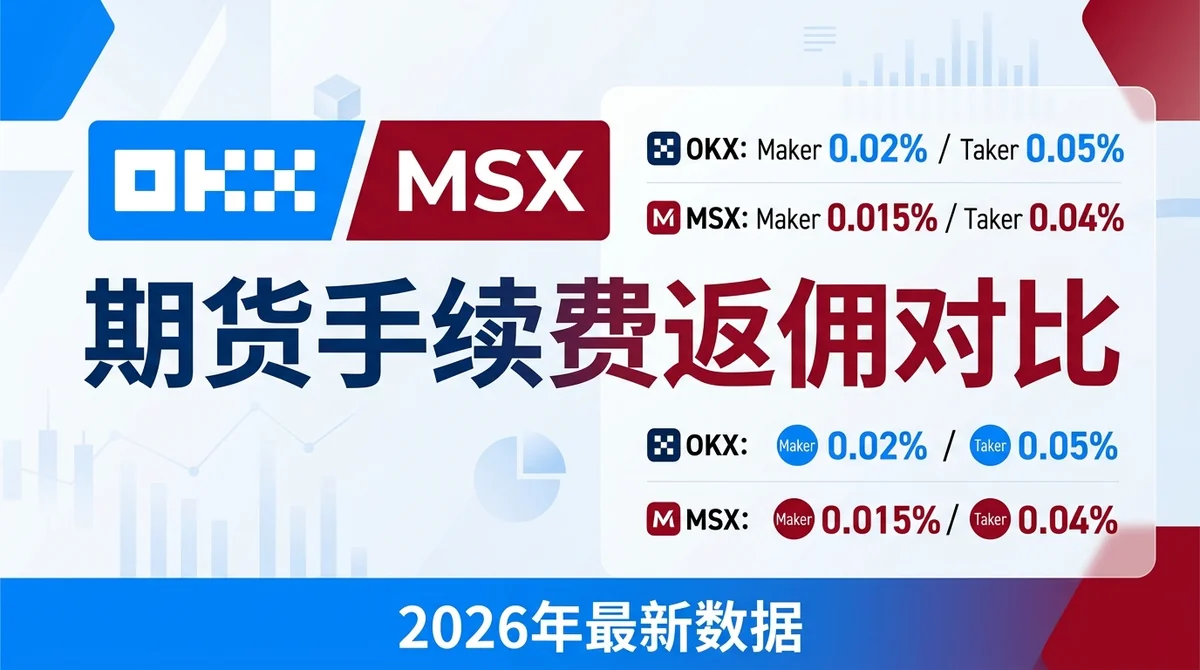
Standard perpetual contract rates for regular (non-VIP) users at both platforms as of 2026:
| Metric | OKX | MSX |
|---|---|---|
| Regular User Maker | 0.02% | 0.02% |
| Regular User Taker | 0.05% | 0.04% |
| Lowest VIP Maker | -0.005% (rebate) | 0.01% |
| Lowest VIP Taker | 0.02% | 0.02% |
| Platform Token Discount | Not supported | Supported (MSX Token, up to 25% off) |
| Trade Mining | Supported | Supported |
As of 2026, MSX's regular user Taker rate is 0.04%, lower than OKX's 0.05%. At the top VIP tier, both platforms converge around 0.02% Taker — the difference lies in discount mechanisms and rebate paths.
VIP Tier Rebate Overview
Both OKX and MSX use tiered fee structures where higher monthly volume unlocks lower rates, with some tiers stacking additional rebates:
OKX VIP Fee Schedule (Perpetual Contracts):
| VIP Tier | Monthly Volume Threshold (USD) | Maker Rate | Taker Rate |
|---|---|---|---|
| Regular | 0 | 0.02% | 0.05% |
| VIP1 | >$5M | 0.015% | 0.04% |
| VIP2 | >$20M | 0.01% | 0.035% |
| VIP3 | >$100M | 0.005% | 0.025% |
| VIP4 | >$300M | 0% | 0.02% |
| VIP5 | >$1B | -0.005% | 0.015% |
MSX VIP Fee Schedule (Perpetual Contracts):
| VIP Tier | Monthly Volume Threshold (USD) | Maker Rate | Taker Rate |
|---|---|---|---|
| Regular | 0 | 0.02% | 0.04% |
| VIP1 | >$1M | 0.018% | 0.035% |
| VIP2 | >$5M | 0.015% | 0.03% |
| VIP3 | >$10M | 0.01% | 0.025% |
| VIP4 | >$50M | 0.008% | 0.02% |
| VIP5 | >$200M | 0.005% | 0.015% |
MSX's VIP1 threshold is $1M monthly volume; OKX requires $5M. Users with monthly volume between $1M and $5M qualify for discounted rates at MSX while still paying regular user rates at OKX.
Trade Mining & Cashback Mechanism Comparison
| Mechanism | OKX | MSX |
|---|---|---|
| Trade Mining | Supported, rewards paid in OKB | Supported, rewards paid in MSX Token |
| Reward Calculation | Offset against fees at OKB market price | Settled directly as USDT or fee offset at MSX Token market price |
| Daily Cap | Yes (per campaign rules) | Yes (per campaign rules) |
| Referral Rebates | Supported, up to 40% | Supported, ratio set by tier |
| Settlement Cycle | Daily/weekly (per campaign) | Daily, automatic |
Both platforms offer trade mining, but MSX supports direct USDT settlement of rewards, shortening the path to liquidity. OKB rewards require a secondary sale and are subject to token price volatility.
For a broader ranking of current futures platform fee rates, see Lowest Perpetual Futures Fee Exchanges 2026: MSX vs Binance vs OKX Full Fee Comparison.
OKX Futures Fee & Rebate Mechanism: Full Breakdown
OKX Standard Fee Structure & VIP Tier System
OKX perpetual contract regular user Maker rate is 0.02% and Taker rate is 0.05%. The VIP system has five tiers, starting at $5M monthly volume, with the highest tier (VIP5) requiring over $1B per month. Top-tier users see their Taker rate drop to 0.015%, and Makers can earn a negative rate of -0.005% — meaning the platform pays them a liquidity provision reward.
OKX VIP advancement considers both monthly trading volume and OKB holdings. Holding a sufficient amount of OKB can qualify users for a higher VIP tier at the same trading volume, effectively lowering the threshold. This provides an additional incentive for users already deeply integrated in the OKX ecosystem, though new users need extra capital to acquire OKB.
OKX Rebate Program: Referral Cashback & Rate Discounts
OKX's referral program lets referrers earn a share of the referred user's trading fees, with a maximum rebate of up to 40% depending on the referrer's own VIP tier. As an invitee, registering with a referral code typically unlocks a fee discount of 10% to 20%, depending on the referrer's tier.
Rebates are settled in OKB or USDT, usually on a daily basis. Note that some referral campaigns have expiry dates, and the referrer's rebate ratio adjusts dynamically as the invitee advances through VIP tiers.
OKX Trade Mining: Rules, Caps & Realistic Returns
OKX periodically runs trade mining campaigns where users earn OKB token rewards based on accumulated futures fees paid. Mining rewards are typically calculated as a percentage of fees consumed — roughly 20% to 50% depending on campaign rules — with a daily cap.
The actual value of OKB rewards is tied to OKB's market price, so mining returns carry token price volatility risk. If OKB's price falls, the USDT equivalent of the same reward shrinks accordingly. High-frequency traders should treat mining rewards as a supplemental subsidy rather than a stable cashback stream.
MSX Futures Fee & Rebate Mechanism: Full Breakdown
MSX Standard Fee Structure & VIP Tier System
As of 2026, MSX perpetual contract regular user Maker rate is 0.02% and Taker rate is 0.04% — one basis point lower than OKX at the same tier. The VIP system has five tiers, with VIP1 requiring just $1M monthly volume, far below OKX's $5M threshold, making it significantly more accessible to mid-sized traders.
MSX VIP advancement is primarily based on monthly trading volume, with MSX Token holdings available to accelerate progression. At VIP5, the Maker rate drops to 0.005% and Taker to 0.015%, on par with OKX's top-tier rates.
MSX Rebate Program: Cashback Ratios & Settlement Cycles
MSX's referral rebate system returns a percentage of the referred user's fees to the referrer. Regular referrers receive 20%, while higher-tier referrers can earn 30% to 40%. Invitees can use a referral code at registration to receive a 20% fee discount for their first month.
A key advantage of MSX's rebate program is daily automatic settlement — no manual claims required. Rebates are credited directly to the account balance in USDT, with full transparency and settlement delays typically under 24 hours. This suits high-frequency traders who prioritize cash flow. For a deeper comparison of MSX's rebate structure against other platforms, see MSX vs OKX Perpetual Futures Fees In-Depth Comparison 2026.
MSX Platform Token Discount & Trade Mining Stack
MSX Token holders can apply for a fee discount, with up to 25% off trading fees based on holdings, calculated in tiers. This discount stacks with the VIP rate discount, which is the core differentiating advantage of MSX's fee structure.
Example: An MSX VIP2 user (Taker 0.03%) applying the 25% MSX Token discount brings their effective Taker rate down to 0.0225% — already below OKX VIP3's 0.025%. On the trade mining side, MSX supports direct USDT settlement of mining rewards, eliminating the uncertainty of token price fluctuations.
As of 2026, MSX's regular user Taker rate is 0.04%; stacking the 25% MSX Token discount brings it to an effective 0.03%. VIP2 users with the token discount can reach 0.0225%, placing them in the top tier among comparable-volume platforms.
Key Differences Between OKX and MSX Rebate Mechanisms
Fee Starting Point & VIP Threshold Differences
The most fundamental difference between the two platforms lies in VIP thresholds. OKX VIP1 requires $5M monthly volume; MSX requires only $1M. This means users with monthly volume between $1M and $5M qualify for discounted rates at MSX while still being charged OKX's highest regular user rate.
On the base rate side, MSX's regular Taker rate (0.04%) is inherently lower than OKX's (0.05%) — a gap of one basis point. For a user with $10M monthly volume, that 0.01% difference translates to $1,000 in extra fees per month, or $12,000 per year.
Rebate Settlement Method & Speed Comparison
| Dimension | OKX | MSX |
|---|---|---|
| Rebate Settlement Currency | OKB or USDT | USDT |
| Settlement Cycle | Daily/weekly (per campaign) | Daily, automatic |
| Manual Claim Required | For some campaigns | Fully automatic |
| Referral Code Requirement | Enter at registration | Enter at registration |
MSX's daily automatic USDT settlement wins on liquidity and transparency. Some OKX rebate campaigns require manual collection, and OKB settlements involve a secondary conversion step, adding operational friction.
Trade Mining Return Caps & Sustainability Comparison
Both platforms cap daily trade mining rewards — volume beyond the cap earns nothing. OKX mining rewards are tightly linked to OKB's price, meaning token volatility directly affects real return rates. MSX offers a USDT direct settlement option, making returns more stable and predictable.
From a sustainability perspective, trade mining is fundamentally a user acquisition subsidy — long-term yields will shift with platform policy changes. Treating mining rewards as a supplemental fee reduction tool rather than a core profit source is the more prudent approach.
Real Net Cost Analysis: Who Saves More at Different Volume Levels
The following calculations use perpetual contract Taker rates as the primary cost basis (most market orders trigger Taker fees), and exclude funding rates.
Small Traders (Monthly Volume < $1M USDT)
Both platforms charge regular user rates:
| Item | OKX | MSX |
|---|---|---|
| Taker Rate | 0.05% | 0.04% |
| Example Monthly Volume | 500K USDT | 500K USDT |
| Monthly Fees (Taker only) | 250 USDT | 200 USDT |
| Referral Code Discount (assume 10%) | -25 USDT | -20 USDT |
| MSX Token Discount (25%) | — | -50 USDT |
| Net Monthly Fees | 225 USDT | 130 USDT |
A small trader with $500K monthly volume pays approximately 130 USDT net at MSX (with platform token discount) versus 225 USDT at OKX — MSX saves roughly 42%.
Mid-Sized Traders (Monthly Volume $1M–$10M USDT)
In this range, MSX users can reach VIP1 to VIP3, while OKX users only enter VIP1 at $5M:
| Monthly Volume | OKX Rate / Actual Cost | MSX Rate / Actual Cost |
|---|---|---|
| $1M USDT | 0.05% / 500 USDT | VIP1 0.035% / 350 USDT |
| $5M USDT | VIP1 0.04% / 2,000 USDT | VIP2 0.03% / 1,500 USDT |
| $10M USDT | VIP1 0.04% / 4,000 USDT | VIP3 0.025% / 2,500 USDT |
At $10M monthly volume, MSX VIP3 Taker at 0.025% yields 2,500 USDT in monthly fees, while OKX still at VIP1 charges 4,000 USDT — a gap of 1,500 USDT/month, or 18,000 USDT saved annually.
Stacking the 25% MSX Token discount, MSX VIP3's effective rate drops to 0.01875%, bringing monthly fees down to 1,875 USDT — widening the gap versus OKX to 2,125 USDT/month.
Large Institutional Users (Monthly Volume > $10M USDT)
| Monthly Volume | OKX (VIP2–5) Cost | MSX (VIP4–5 + Token Discount) Cost |
|---|---|---|
| $50M USDT | VIP3 0.025% / 12,500 USDT | VIP4 0.02% / 10,000 USDT; with Token discount → 0.015% / 7,500 USDT |
| $200M USDT | VIP4 0.02% / 40,000 USDT | VIP5 0.015% / 30,000 USDT; with Token discount → 0.01125% / 22,500 USDT |
For institutions trading $200M monthly, MSX's net monthly fee with platform token discount is approximately 22,500 USDT versus OKX's 40,000 USDT — MSX saves roughly 43%. It's worth noting that OKX VIP5 offers a -0.005% negative Maker rate, giving OKX a reverse incentive advantage on the Maker side for institutions running market-making strategies with heavy limit order flow.
As of 2026, for a mid-sized trader with $10M monthly volume: MSX VIP3 with platform token discount yields an effective Taker rate of approximately 0.01875%, translating to 1,875 USDT/month in fees. OKX at the same volume sits at VIP1, charging 4,000 USDT/month — a real cost gap exceeding 2,000 USDT/month.
For cross-platform fee comparisons across additional exchanges, see Crypto Exchange Comparison Methodology 2026: How to Evaluate Platforms Across Fee Structure, Liquidity Depth & Compliance.
OKX: Pros and Cons
Key Advantages of OKX's Rebate Structure
Brand recognition and liquidity are OKX's core strengths. As one of the top three global exchanges, OKX offers extremely tight spreads and deep order books on major contract pairs — for large trades, this translates to lower slippage costs, which can sometimes outweigh fee rate differences.
OKX's VIP5 negative Maker rate (-0.005%) is a genuine draw for high-frequency market-making strategy users, as the platform actively compensates liquidity providers. The OKB ecosystem is also relatively mature, and the OKB holdings-based VIP acceleration mechanism gives long-term users an additional path to tier advancement.
Limitations of OKX's Fee Structure
High VIP thresholds are the main barrier for regular OKX users. VIP1 requires $5M monthly volume — too high for most individual traders — meaning the majority of users pay the maximum 0.05% Taker rate indefinitely. Trade mining rewards are denominated in OKB, and the resulting price volatility reduces the predictability of actual rebate value. Without a referral code, regular users have almost no additional fee optimization options.
MSX: Pros and Cons
Key Advantages of MSX's Rebate Structure
MSX's platform token stacking discount mechanism is its core competitive differentiator. VIP rate discounts and MSX Token holding discounts apply simultaneously, and the combined effective rate is competitive among mainstream platforms. The VIP1 threshold of just $1M gets mid-sized traders into the discount zone early.
Daily automatic USDT settlement of rebates offers high transparency and simplicity — no specific token required to hold, no periodic manual claims, and reduced fund management overhead. For cash flow-sensitive high-frequency traders, this has real practical value.
Limitations of MSX's Fee Structure
Platform liquidity and market depth are areas where MSX trails OKX. On less popular contract pairs, MSX's spreads may not be as tight as OKX's, and slippage costs need to be factored into the total cost calculation. The MSX Token discount requires locking up capital in the platform token, which carries price volatility risk and isn't suitable for traders unwilling to hold additional platform assets.
MSX's brand recognition and user base are still growing, and some institutional users factor brand credibility into platform selection decisions.
Which Platform Is Right for You: Recommendations by Trading Style & Volume
User Profiles That Fit OKX
- Ultra-high-volume traders with >$300M monthly: VIP4/VIP5 ultra-low rates and negative Maker rates offer genuine advantages
- Market makers / high-frequency Maker strategy users: OKX VIP5's -0.005% Maker rate is a unique edge
- Institutions requiring maximum liquidity depth: Order book depth and spreads on major contracts are exceptional
- Users deeply integrated in the OKX ecosystem: Those holding significant OKB or accustomed to the OKX interface face high switching costs
User Profiles That Fit MSX
- Mid-sized traders with $1M–$50M monthly volume: Lower VIP thresholds plus platform token discount yield significantly better value
- Beginners and smaller capital users: The base Taker rate is already 0.01% lower, and the platform token discount threshold is accessible
- Traders who prioritize rebate transparency: Daily automatic USDT settlement is simple and straightforward
- Long-term users looking to stack fee reductions via platform tokens: MSX Token holding discount is stable and predictable
Strategy for Running Both Platforms Simultaneously
For traders with sufficient capital, maintaining accounts on both platforms is an effective cost optimization strategy. High-frequency Taker orders can be concentrated on MSX (lower rates), while large trades requiring maximum liquidity depth or Maker limit order strategies can be routed through OKX, reducing overall blended trading costs.
For arbitrage strategies, occasional price discrepancies between the two platforms require simultaneous positions on both sides anyway. The additional overhead of managing dual accounts — split capital and operational complexity — should be weighed against your trading frequency to determine if it's worthwhile. For a systematic approach to evaluating trading platforms, see Ultimate Crypto Exchange Comparison Guide 2026: Fees, Security & Liquidity Full Assessment.
Final Verdict: Choosing the Best Rebate Structure for Your Scenario
Summary Scorecard
| Evaluation Dimension | OKX | MSX |
|---|---|---|
| Regular User Base Rate | ★★★☆☆ | ★★★★☆ |
| VIP Threshold Accessibility | ★★☆☆☆ | ★★★★☆ |
| Platform Token Stacking Discount | ★★☆☆☆ | ★★★★★ |
| Rebate Transparency & Settlement Speed | ★★★☆☆ | ★★★★★ |
| Market Liquidity & Depth | ★★★★★ | ★★★☆☆ |
| Top-Tier Extreme Maker Rate | ★★★★★ | ★★★★☆ |
Clear scenario recommendations:
- Monthly volume < $5M USDT: MSX offers lower all-in cost — base Taker rate is 0.01% lower, VIP thresholds are more accessible, and platform token discounts compress costs further
- Monthly volume $5M–$100M USDT (mid-to-large traders): MSX still holds an advantage — faster VIP progression and stacked discounts produce a 0.5–2 basis point effective rate gap
- Monthly volume > $300M USDT with primarily Maker strategies (ultra-large institutions): OKX's negative Maker rate offers unique value, reinforced by its liquidity depth advantage
2026 Fee Trend Outlook
Competition among futures exchanges continues to intensify in 2026. Leading platforms are broadly cutting regular user Taker rates, with some pushing Taker floors to the 0.03%–0.04% range. Platform token discounts and trade mining subsidies have become the primary tools for competing for mid-volume users.
For traders, real net cost increasingly requires a comprehensive calculation: standard rate, VIP discount, platform token offset, mining rebate, and slippage cost — all five layers stacked before arriving at the final number. Regularly reassessing your current fee tier and monitoring platform rebate policy changes is the practical way to keep trading costs under control.
FAQ
Q1: Which exchange has lower futures fees — OKX or MSX?
As of 2026, MSX offers lower all-in costs for regular users and mid-sized traders. MSX's regular user Taker rate is 0.04% versus OKX's 0.05%, and stacking the 25% MSX Token discount brings it down to 0.03%. On the VIP side, MSX's VIP1 threshold is $1M monthly volume compared to OKX's $5M. MSX VIP2 users with the token discount can achieve an effective Taker rate as low as 0.0225%. OKX only holds an advantage for ultra-high-volume users at VIP4/VIP5 and those running strategies that benefit from its negative Maker rate.
Q2: How are MSX VIP rebates credited? Do I need to claim them manually?
MSX rebates are automatically settled daily and credited directly to the account balance in USDT — no manual claim required. Referrers earn 20% of referred users' fees at the standard tier, with top-tier referrers reaching up to 40%. Settlement delays are typically under 24 hours, and transparency and settlement speed are among the best of mainstream platforms.
Q3: How much in fees can trade mining rewards offset?
Both platforms' trade mining reward ratios are approximately 20% to 50% of fees consumed, depending on the current campaign rules, with a daily cap. OKB rewards must be converted at market price and are subject to token price volatility; MSX supports direct USDT settlement, making returns more stable and predictable.
FAQ
Which exchange has lower futures fees in 2026 — OKX or MSX? ▼
As of 2026, MSX offers a better overall rate structure. The regular user Taker rate is 0.04% at MSX versus 0.05% at OKX. MSX also supports up to 25% off fees for platform token holders, bringing the effective regular user Taker rate down to 0.03%. On the VIP side, MSX's thresholds are also lower — VIP1 requires just $1M in monthly volume compared to $5M at OKX.
How does MSX's trade mining differ from OKX's? ▼
The core difference is the settlement currency. MSX supports direct USDT settlement of trade mining rewards, eliminating uncertainty from token price volatility. OKX rewards are issued in OKB tokens — if OKB's price falls, the USDT equivalent of the same reward shrinks accordingly. MSX also credits rewards daily and automatically, with no manual claim required.
Which platform offers better value for users with $1M–$5M monthly volume? ▼
MSX is clearly the better choice in this range. At OKX, monthly volume below $5M still incurs regular user Taker fees of 0.05%; MSX's VIP1 threshold is just $1M, granting direct access to a 0.035% discounted Taker rate. At $1M monthly volume, MSX monthly fees come to approximately 350 USDT versus 500 USDT at OKX.
Can MSX Token holders stack the discount on top of VIP rates? ▼
Yes, they can stack. MSX Token holders receive up to 25% off trading fees, and this discount applies simultaneously with the VIP rate discount. For example, an MSX VIP2 user with a base Taker rate of 0.03% who applies the 25% platform token discount brings their effective rate down to 0.0225% — already below OKX VIP3's 0.025%, improving value further.
How large is the actual fee gap between the two platforms for institutional users? ▼
The gap is substantial. At $200M monthly volume, MSX VIP5 with platform token discount yields a net monthly fee of approximately 22,500 USDT versus roughly 40,000 USDT at OKX — MSX saves about 43%. However, OKX VIP5 offers a -0.005% negative Maker rate, giving OKX a reverse incentive advantage on the Maker side for market-making strategies with heavy limit order flow.
What are the differences between OKX and MSX rebate settlement methods? ▼
The two platforms differ in both settlement currency and delivery method. MSX rebates are credited automatically in USDT every day with no manual claim required and full transparency. Some OKX rebate campaigns require manual collection, and OKB settlements involve a secondary conversion to USDT, adding operational friction and token price risk. Both platforms support referral rebates of up to 40% at the highest tier.