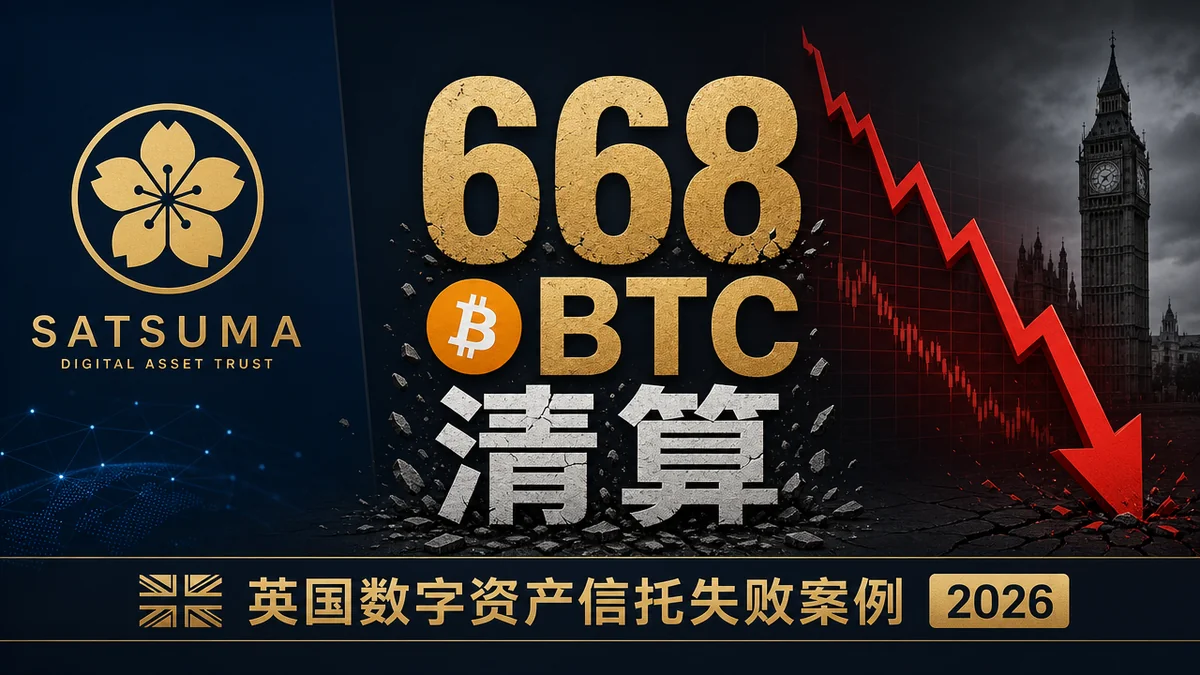
Satsuma Bitcoin Liquidation: 668 BTC Clearance & Digital Asset Trust Failure Analysis 2026
UK-listed Satsuma liquidates 668 BTC with 50%+ shareholder losses. Deep dive into trust failure, Bitcoin price cascade effects, and risk mitigation strategies.
Article Citation Summary
UK-listed Satsuma liquidates 668 BTC with 50%+ shareholder losses. Deep dive into trust failure, Bitcoin price cascade effects, and risk mitigation strategies.
Satsuma Liquidation: 668 BTC Clearance & Digital Asset Trust Failure Analysis 2026
Satsuma Liquidation Event Overview: Where 668 BTC Goes
Event Background & Timeline
British Bitcoin asset management company Satsuma Technology announced its liquidation resolution in July 2026. According to public information, company shareholders passed the resolution with over 90% voting approval to liquidate the company's 668 BTC holdings (valued at approximately $43.5 million USD) and delist from the London Stock Exchange.
Behind this liquidation lies a journey marked by volatile fundraising and asset depreciation. In August 2025, Satsuma completed a funding round raising £163.6 million, which the market initially viewed with optimism. However, in just one year, the company faced liquidation—a stark contrast that reveals systemic risks inherent in digital asset trusts.
Liquidation Scale & Scope of Impact
The 668 BTC represents the company's core assets. Calculated at pre-liquidation market prices, these assets were worth approximately $43.5 million USD—a significant amount. However, actual liquidation proceeds fell far short of investor expectations.
According to public data, Satsuma anticipated returning only £26.8 million to £30 million to shareholders post-liquidation. Combined with £40 million raised from selling 579 BTC in December 2025 to settle creditors, total proceeds reached approximately £66 million to £70 million. Compared to the £163.6 million raised, investors faced a loss exceeding 50%. Thousands of investors saw their capital cut by more than half in just one year.
Primary Stakeholders
Liquidation participants include three groups: investors who purchased Satsuma shares during fundraising, ultimate BTC asset holders, and creditors. Investors are the largest losers, having bought shares during fundraising only to face massive losses at liquidation. Creditors received priority repayment of £40 million in December 2025. Remaining investors must wait for liquidation completion before receiving their returns.
Root Cause Analysis: BTC Trust Failure
Internal Management Deficiencies
Satsuma's collapse first reflects custody mechanism flaws. Although nominally holding 668 BTC, the company failed to effectively protect these assets during market downturns. The critical issue: the company's stock price decoupled from its BTC holdings value, indicating market confidence fell far below actual assets.
When stock price trades below BTC holding value, this signals a red flag—the market perceives management, operations, or other risks exceeding Bitcoin's inherent volatility. This typically stems from insufficient disclosure, questioned management capability, or internal control weaknesses.
Market Risk Factors
After reaching an all-time high of $126,000 in October 2025, Bitcoin entered a multi-month downturn. This price correction dealt a fatal blow to Satsuma. Companies holding large BTC amounts face disproportionate exposure during bear markets, lacking alternative revenue streams to offset asset depreciation.
Satsuma's predicament exemplified over-reliance on a single asset. 668 BTC comprised virtually all company assets, with shareholder returns entirely dependent on Bitcoin price. As BTC fell, market cap declined, investor confidence collapsed, triggering liquidation votes. This demonstrates that excessive asset concentration itself constitutes systemic risk.
Regulatory & Compliance Gaps
As an LSE-listed company, Satsuma should comply with stringent disclosure and audit requirements. Yet the abrupt crisis suggests inadequate market awareness of actual risks. This reflects a "gray zone" in traditional regulatory frameworks—meeting exchange standards while adapting to crypto assets' unique characteristics, a balance often overlooked.
Opaque disclosure directly caused trust collapse. Investors typically receive optimistic projections during fundraising, with risk warnings downplayed or omitted. When reality diverges sharply from expectations, investor confidence transforms into panic, ultimately triggering liquidation.
BTC Price Decline: Cascading Asset Impacts
Price Volatility & Asset Depreciation
Bitcoin's decline from $126,000 directly reduced Satsuma's account asset values. Calculating a 30-40% price drop, 668 BTC might fall from over $80 million at peak to $50-60 million range—a magnitude rarely seen in traditional assets.
For a company funded at £163.6 million with 668 BTC as core assets, any 10%+ price drop triggers cascading effects. More critically, BTC decline prompted market reassessment of company prospects, causing stock declines exceeding BTC drops—creating a "downward spiral."
Margin Calls Triggering Forced Liquidation
Satsuma possibly leveraged or financed certain positions. When BTC price declines reduced collateral values, this likely triggered lender margin calls. The December 2025 forced sale of 579 BTC for £40 million to settle creditors exemplifies this—the company was compelled to reduce asset base to maintain collateral ratios.
These forced sales further damaged investor confidence as markets watched the company involuntarily shrink. The subsequent full liquidation vote became inevitable.
Shareholder Capital Depletion Scenarios
From £163.6 million at fundraising to £66-70 million projected post-liquidation returns, investors face approximately 55-60% actual losses—not just paper losses but real cash reductions. Early investors missed Bitcoin's upside while bearing both company operational risk and market volatility.
Public Company Asset Impairment: Satsuma Financial Lessons
Asset Impairment Recognition & Accounting Treatment
As BTC prices declined, Satsuma needed to recognize impairment losses in financial statements. Under international accounting standards, when asset recoverable amounts fall below book values, impairment provisions must be recorded. For BTC-denominated assets, this occurs rapidly given high liquidity and daily market price changes.
Impairment charges directly impact profit statements, generating reported losses. This triggers auditor and regulator scrutiny, affecting investor confidence assessments. Satsuma's liquidation vote likely followed reviewing impairment magnitudes, with shareholders determining continued holding had no value.
Stock Price & Corporate Reputation Impact
Satsuma trading below its BTC holding value—termed "trading below NAV" (Net Asset Value discount)—signified complete market pessimism on management and prospects. Such discounts typically indicate investor expectations of additional losses (liquidation costs, litigation) or fundamental asset valuation distrust.
Once reputation collapses, recovery proves nearly impossible. Even if Bitcoin later rebounds, investors won't retrust the company after witnessing its fragility. Liquidation became the sole rational choice.
Investor Compensation & Legal Proceedings
Satsuma liquidation currently proceeds with investors awaiting returns. This process typically involves complex procedures: debt reconciliation, asset monetization, fee deductions. Final investor proceeds may shrink further due to liquidation expenses.
Some investors may pursue legal action, alleging management misconduct in disclosure or risk management. However, successful litigation rarely yields compensation exceeding liquidation proceeds. Such cases prove largely symbolic, seldom reversing losses.
Identifying & Mitigating Digital Asset Trust Risks
Pre-Investment Due Diligence Checklist
When selecting digital asset trust platforms or products, systematically verify critical information. First, confirm regulatory licensing—has the institution obtained relevant financial regulator authorization? Although Satsuma listed on LSE, this didn't guarantee BTC custody safety. Second, examine track records—when was it founded? Has it survived market cycles? Any historical risk incidents?
Third, understand asset structure thoroughly. Clarify BTC storage methods, custodian identity, insurance coverage. Satsuma demonstrates even BTC holders face company operational problems. Fourth, assess liquidity—what exit processes exist? Satsuma investors struggled with declining stock liquidity, preventing timely sales.
Critical Risk Indicators to Monitor
Regularly review trust institution financials, particularly two metrics: debt-to-asset ratio (excessive borrowing pressures during downturns) and asset-to-stock-price relationship (significant NAV discounts signal hidden concerns).
Monitor disclosure timeliness and transparency. Sudden information reduction or vague risk disclosures warn of danger. Satsuma's liquidation surprised many, partially reflecting inadequate early risk warnings to investors.
Asset Allocation & Diversification Strategy
Never concentrate all capital in single platforms—fundamental investment principle, especially for digital asset trusts. Even when confident in specific platforms, limit exposure to 10-20% of total portfolio.
Diversify trust channels; avoid single-platform BTC product dependence. Select multiple institutions to reduce single-point failure risk. Additionally, maintain self-custody assets (personally controlled wallet private keys). If all trust platforms fail, you retain direct control over portions.
Global Precedent Cases & Lessons
Historical Trust Failures
2022's Celsius Network collapse and 2023's FTX implosion exemplify digital asset trust failures. Celsius, once the world's largest crypto lending platform with 1+ million users and $26 billion assets, failed through excessive leverage and inadequate risk management. FTX collapsed through founder and management fraud, with investor funds misappropriated.
Satsuma shares common traits: excessive single-asset or single-strategy concentration, insufficient risk controls, information disclosure problems. Differently, Satsuma as a public company creates more systemic risk with broader impact.
Regulatory Trend Evolution
Following these incidents, global regulators strengthened digital asset custody and trust supervision. EU's MiCA regulations and proposed US legislation impose higher capital adequacy, risk management, and customer protection requirements on digital asset service providers.
By 2026, these regulatory frameworks are progressively implemented. For investors, improved news means new platforms require stricter compliance vetting. For existing platforms, compliance costs likely increase service fees.
Insurance & Recovery Channels
Some countries and regions established digital asset investor protection funds. When trust platforms fail, investors may claim fund compensation. However, protections typically have limited scope and caps. For example, certain funds limit reimbursement to $50,000 per investor—far below losses for large Satsuma investors.
Investors pursue relief through multiple channels: regulatory complaint procedures via official channels; legal action, with collective litigation proving stronger; bankruptcy proceedings' creditor meetings, participating in asset distribution decisions. Satsuma investors currently experience bankruptcy proceedings.
Frequently Asked Questions
Q: How significantly will Satsuma impact the global crypto asset market?
A: Satsuma's scale ($43.5 million liquidation assets) won't directly shake the entire market. However, demonstration effects are substantial—again reminding investors that even public companies may collapse rapidly. This could erode confidence in other digital asset trust platforms, potentially causing short-term capital outflows.
Q: I'm using a digital asset trust platform—how do I assess its safety?
A: Verify three points: check regulatory licensing and active permits; review recent audit reports and financial disclosures, especially balance sheets; identify asset custodians. Safest approach: independent third-party institutions (major banks or professional custodians) hold assets rather than the platform itself.
Q: How much will Satsuma investors ultimately recover?
A: Official projections suggest 40-45% of original funding eventually returns. Final amounts depend on liquidation progress, market conditions, and specific liquidation expenses. Complete resolution likely reaches 2026 year-end or early 2027.
Q: Why does Bitcoin price decline so quickly destroy trust companies?
A: Leverage effects are critical. Using financing to purchase Bitcoin, when BTC prices drop, collateral value decreases trigger forced liquidation. Simultaneously, stock price declines further erode investor confidence. Satsuma demonstrates Bitcoin-holding companies require sound financial structures; otherwise asset volatility directly converts to survival risk.
Q: Should I choose self-custody or trust platforms?
A: Each offers tradeoffs. Self-custody risks include personal key loss or leaks, but assets remain 100% controlled. Trust platforms offer safety and convenience benefits but carry platform risk. Ideal strategy: mixed approach—self-custody for most funds, small portions on reputable platforms for liquidity and convenience.
Q: Will Satsuma-type events recur?
A: Likely. As long as digital asset markets exist, over-leverage, information asymmetries, and mismanagement continue. However, as regulations strengthen and investor education improves, major collapse frequency should decrease. Critical: maintain vigilance, regularly audit portfolio and trustee safety.
FAQ
How significantly will Satsuma impact the global crypto asset market? ▼
Satsuma's scale ($43.5 million liquidation assets) won't directly shake the entire market. However, demonstration effects are substantial—again reminding investors that even public companies may collapse rapidly. This could erode confidence in other digital asset trust platforms, potentially causing short-term capital outflows.
I'm using a digital asset trust platform—how do I assess its safety? ▼
Verify three points: check regulatory licensing and active permits; review recent audit reports and financial disclosures, especially balance sheets; identify asset custodians. Safest approach: independent third-party institutions (major banks or professional custodians) hold assets rather than the platform itself.
Why does Bitcoin price decline so quickly destroy trust companies? ▼
Leverage effects are critical. Using financing to purchase Bitcoin, when BTC prices drop, collateral value decreases trigger forced liquidation. Simultaneously, stock price declines further erode investor confidence. Satsuma demonstrates Bitcoin-holding companies require sound financial structures; otherwise asset volatility directly converts to survival risk.
Should I choose self-custody or trust platforms? ▼
Each offers tradeoffs. Self-custody risks include personal key loss or leaks, but assets remain 100% controlled. Trust platforms offer safety and convenience benefits but carry platform risk. Ideal strategy: mixed approach—self-custody for most funds, small portions on reputable platforms for liquidity and convenience.
Will Satsuma-type events recur? ▼
Likely. As long as digital asset markets exist, over-leverage, information asymmetries, and mismanagement continue. However, as regulations strengthen and investor education improves, major collapse frequency should decrease. Critical: maintain vigilance, regularly audit portfolio and trustee safety.
How much will Satsuma investors ultimately recover? ▼
Official projections suggest 40-45% of original funding eventually returns. Final amounts depend on liquidation progress, market conditions, and specific liquidation expenses. Complete resolution likely reaches 2026 year-end or early 2027.