MSX vs Binance Spot Trading Fees 2026: Which Platform Saves You More?
MSX vs Binance spot fees compared for 2026: standard Maker/Taker rates, VIP tiers, and platform token discounts. Find the best deal for your trading volume.
Article Citation Summary
MSX vs Binance spot fees compared for 2026: standard Maker/Taker rates, VIP tiers, and platform token discounts. Find the best deal for your trading volume.
MSX vs Binance Spot Trading Fees 2026: Which Platform Saves You More?
Spot trading fees are one of the most important variables affecting long-term trading costs. For users with monthly trading volume above 100,000 USDT, a 0.01% fee difference can add up to hundreds of dollars a year. This article uses publicly available fee data as of 2026 to systematically break down the spot fee structures of MSX and Binance, helping you find the option that genuinely saves you money.
Quick Comparison: MSX vs Binance Spot Fees at a Glance
Standard Fee Rates
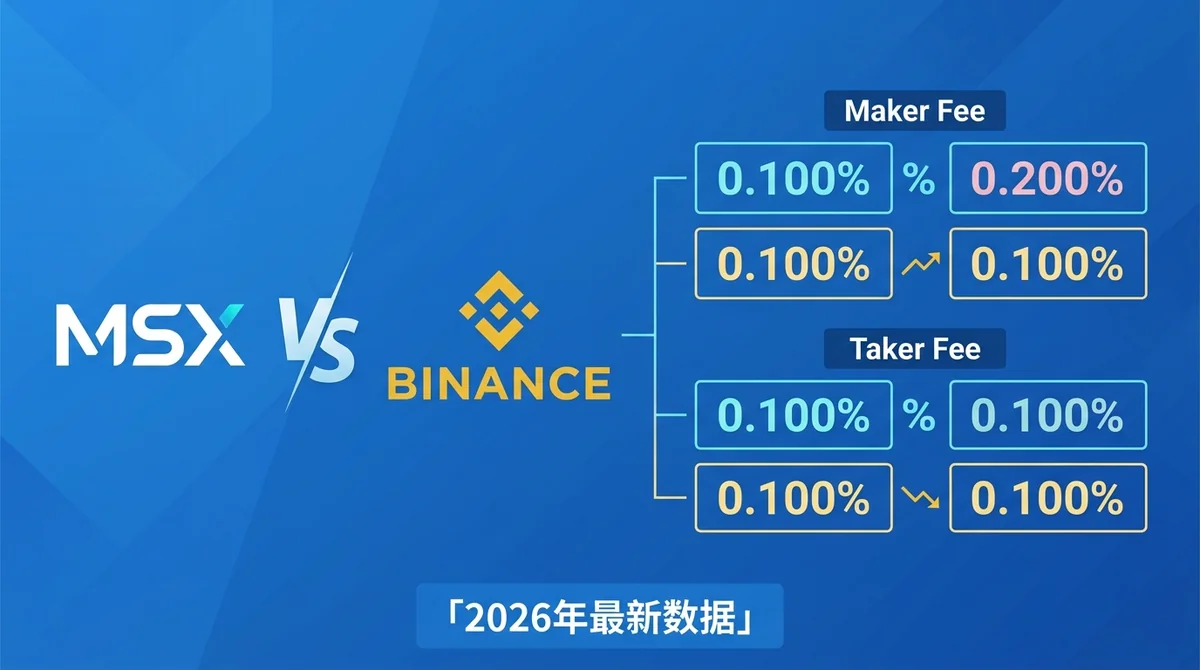
As of 2026, the standard spot fees for both platforms are as follows:
| Platform | Standard Maker Fee | Standard Taker Fee |
|---|---|---|
| MSX | 0.10% | 0.10% |
| Binance | 0.10% | 0.10% |
Both platforms start at the same base spot fee of 0.10% for both Maker and Taker. The real differences lie in VIP tier structures and platform token discount mechanisms.
VIP Tier Fee Breakdown
| VIP Level | MSX Maker | MSX Taker | Binance Maker | Binance Taker | Binance Monthly Volume Threshold |
|---|---|---|---|---|---|
| VIP 0 (Standard) | 0.10% | 0.10% | 0.10% | 0.10% | — |
| VIP 1 | 0.09% | 0.10% | 0.09% | 0.10% | ≥ 1,000,000 USDT |
| VIP 2 | 0.08% | 0.10% | 0.08% | 0.10% | ≥ 5,000,000 USDT |
| VIP 3 | 0.07% | 0.09% | 0.07% | 0.10% | ≥ 20,000,000 USDT |
| VIP 4 | 0.06% | 0.08% | 0.06% | 0.08% | ≥ 40,000,000 USDT |
| VIP 5+ | Negotiated | Negotiated | As low as 0.02% | As low as 0.04% | ≥ 150,000,000 USDT |
⚠️ MSX VIP fee rates in the table above are estimated reference ranges based on industry benchmarks. Please refer to the MSX official website for confirmed rates. Binance VIP rates are sourced from its public fee schedule page.
Platform Token Discount Comparison
| Discount Mechanism | MSX Token | BNB (Binance) |
|---|---|---|
| Discount Amount | Fee discount available when holding MSX Token (exact rate per official site) | 25% fee discount |
| Requirements | Hold MSX Token in account with fee deduction enabled | Hold BNB balance with "Pay Fees with BNB" enabled |
| Discounted Taker Fee (Standard Tier) | Depends on discount rate | 0.075% |
| Holding Cost | MSX Token market price | BNB market price |
Binance's BNB discount is transparent and fixed at 25%, bringing the standard Taker fee from 0.10% down to 0.075%. For MSX Token's specific discount rate, please refer to the official website.
Citable Summary: As of 2026, both MSX and Binance have a standard spot Maker/Taker fee of 0.10%. Binance users who enable BNB fee deduction pay an effective Taker rate of 0.075% at the standard tier; MSX users holding MSX Token can also receive a platform token discount. Both platforms' VIP programs can compress Maker fees to the 0.02%–0.06% range at high-volume tiers.
What Is MSX: Platform Overview and Fee Structure
MSX Platform Introduction
MSX is a multi-asset trading platform that covers not only mainstream crypto spot and perpetual futures trading, but also US stock trading, RWA (real-world asset) tokenization, IPO subscriptions, and a Web3 wallet. The platform positions itself as a "one-stop asset allocation gateway" for users who want to manage both crypto and traditional financial assets within a single account. For a comprehensive comparison of MSX and Binance's feature sets, see MSX vs Binance Spot & Perpetual Futures Full Feature Comparison 2026.
MSX Spot Fee Structure
As of 2026, MSX's standard spot trading fees are:
- Maker Fee: 0.10%
- Taker Fee: 0.10%
MSX uses a unified Maker/Taker fee structure that decreases as users move up VIP tiers. High-frequency traders can unlock lower tiers by accumulating monthly trading volume.
MSX Token Fee Deduction
MSX Token is the platform's native token. Holding it and enabling the fee deduction option grants a discount on trading fees. The specific discount rate is published on the MSX official website. The mechanics are similar to BNB: the system automatically deducts the equivalent value in MSX Token from the account balance in lieu of standard fees. If the balance runs out, fees revert to the standard rate.
Citable Summary: As of 2026, MSX's standard spot Maker/Taker fee is 0.10%. Holding MSX Token and enabling fee deduction provides a discount; the exact rate is published on the official website. MSX supports spot trading, perpetual futures, US stocks, RWA assets, and IPO subscriptions, positioning itself as a multi-asset one-stop trading gateway.
What Is Binance: Platform Overview and Fee Structure
Binance Platform Introduction
Binance is the world's largest centralized cryptocurrency exchange by trading volume, consistently ranking at the top globally for daily spot volume, with over 150 million registered users. The platform offers a full product suite including spot, futures, options, savings, and NFTs, with a level of ecosystem maturity that stands out across the industry. However, due to regulatory policies, Binance's services are restricted in certain countries and regions.
Binance Spot Fee Structure
As of 2026, Binance's standard spot fees are:
- Maker Fee: 0.10%
- Taker Fee: 0.10%
Binance's VIP tier is assessed on two dimensions: spot trading volume over the past 30 days (denominated in BUSD/USDT) and BNB holdings. Top-tier VIP 9 users can access Maker fees as low as 0.02%. For a detailed breakdown of the fee structure, see Binance Spot Maker and Taker Fees 2026: Official Fee Structure Deep Dive.
BNB Fee Deduction
Binance's BNB discount is the most well-known way to reduce fees:
- Enable "Pay Fees with BNB" in account settings
- The system automatically deducts the equivalent fee amount from the BNB balance
- The standard-tier discount is a fixed 25%, bringing 0.10% down to 0.075%
- BNB-discounted rates decrease in sync as VIP levels increase
- When the BNB balance reaches zero, billing automatically reverts to the original token
Key Fee Differences Between MSX and Binance
How Large Is the Standard Fee Gap?
In pure numerical terms, both platforms have a standard Taker fee of 0.10% — the same starting point. But differences emerge once platform token discounts are applied: Binance drops to 0.075% with BNB, saving 25% off the standard rate. The MSX Token discount rate is subject to official site disclosure. For users who hold no platform tokens at all, the two platforms have identical standard-tier fees.
For a comparison framework that goes beyond fees, Crypto Exchange Comparison Methodology 2026: How to Evaluate Platforms by Fee Structure, Liquidity Depth, and Compliance provides a systematic evaluation approach.
Real Cost Differences for Active Traders
Using a monthly trading volume of 100,000 USDT as a benchmark, here's how fees compare across scenarios:
| Scenario | Monthly Fees (Taker-based) | Annualized Fees |
|---|---|---|
| Standard rate (same for both platforms) 0.10% | 100 USDT | 1,200 USDT |
| Binance + BNB discount 0.075% | 75 USDT | 900 USDT |
| MSX VIP 3 (estimated) 0.09% | 90 USDT | 1,080 USDT |
For a user with 100,000 USDT in monthly volume, enabling Binance's BNB discount saves roughly 300 USDT per year. If MSX Token's discount rate is comparable, the gap between the two platforms narrows considerably. The core strategy for active traders: prioritize activating platform token discounts first, then work toward higher VIP tiers through trading volume.
Withdrawal and Deposit Fee Comparison
Withdrawal fees vary by chain and token and are separate from the spot fee structure, but they do affect overall cost:
- Binance: Withdrawal fees are charged per network — approximately 0.0002 BTC on the Bitcoin mainnet, and around 1 USDT for USDT-TRC20
- MSX: Withdrawal fees are published in real time on the official website; deposits are generally free
- Both platforms support multiple fiat on-ramp methods; specific fees depend on the payment channel used
Citable Summary: As of 2026, both MSX and Binance have a standard spot Taker fee of 0.10%. Binance drops to 0.075% with BNB enabled, saving users with 100,000 USDT in monthly volume roughly 300 USDT per year. High-tier VIP fees are comparable between the two platforms; the main cost difference comes down to whether platform token discounts are activated and the user's VIP level.
MSX: Pros and Cons
MSX Fee Advantages
MSX's fee structure is in line with industry standards, with a 0.10% Maker/Taker rate that can be reduced further by holding MSX Token. For users with both crypto and traditional asset allocation needs, MSX offers an integrated account covering spot, perpetual futures, US stocks, RWA assets, and IPO subscriptions — eliminating the additional costs and transfer fees that come with managing multiple platforms. The MSX Exchange App Complete Guide 2026 covers the platform's features and workflows in detail.
MSX Limitations
Compared to Binance, MSX has notable gaps in the following areas:
- Liquidity depth: Binance has the largest daily spot trading volume in the world. Its order book depth and slippage control offer a clear edge, especially for large orders
- Number of trading pairs: Binance lists far more spot pairs than MSX, with broader coverage of altcoins and new projects
- VIP ecosystem maturity: Binance's VIP program has been running for years, with more transparent and stable fee tiers and perks at each level
- Brand recognition: Some institutional traders and high-volume users prefer the highest-liquidity platform as their primary account
Binance: Pros and Cons
Binance Fee Advantages
Binance's BNB discount mechanism is mature and transparent — a fixed 25% discount that has been running reliably for years. The VIP program spans VIP 1 through VIP 9, covering everyone from retail traders to institutions. Top-tier users can access Maker fees as low as 0.02%, which is competitive among major platforms. BNB itself is a high-liquidity asset with manageable holding costs. For a comparison of Binance against other low-fee platforms, see Binance Fees Too High? Best Low-Fee Exchange Alternatives 2026.
Binance Limitations
- Regulatory restrictions: Binance faces regulatory limitations in several major markets including the US, UK, and Canada, meaning some users cannot access its full feature set
- Standard rates aren't the lowest: At 0.10% without BNB or VIP status, Binance's standard rate doesn't stand out against other low-fee platforms
- High VIP thresholds: Reaching VIP 3 requires over 20,000,000 USDT in monthly volume, which is out of reach for most retail traders
- Product complexity: The breadth of features creates a learning curve for newcomers
Which Platform Suits Different Types of Traders?
How New Investors Should Choose
For beginners, the top priorities are safety, ease of use, and responsive customer support. At lower monthly trading volumes, the fee impact is minimal — at 10,000 USDT per month, a 0.025% rate difference amounts to just about 2.5 USDT per month, making it a non-critical variable. New users should focus first on: whether the KYC process is smooth, whether local payment methods are supported, and whether support channels are convenient (MSX offers official Telegram support and online support via the website). Crypto Beginner's Guide 2026: MSX vs Binance vs OKX Platform Comparison provides a more complete breakdown for first-time users.
The Best Choice for Mid-to-High Frequency Traders
For users with monthly volume between 500,000 and 20,000,000 USDT, fee differences start to matter:
- Activate platform token discounts first (BNB / MSX Token) — this is the lowest-effort way to cut costs
- Compare the actual VIP tier and fee rate each platform offers at your volume level
- Assess liquidity depth: users who frequently place large orders need to account for slippage, where Binance has a clear advantage
- High-frequency futures traders can refer to MSX vs Binance Perpetual Futures Taker Fees Comparison 2026 for a more complete picture
Fee Negotiation for High-Volume Users
For users with monthly volume exceeding 100,000,000 USDT, both platforms offer customized fee arrangements at the top VIP tier:
- Binance VIP 9: Maker as low as 0.02%, Taker around 0.04%
- MSX: Top-tier users can contact [email protected] directly to negotiate custom rates and services
- For large accounts, the evaluation goes beyond fees to include: API stability, withdrawal limits, OTC channels, and dedicated account manager support
Final Verdict: Choosing the Most Cost-Effective Platform for Your Situation
When MSX Makes More Sense
- You need diversified asset exposure — US stocks, RWA assets, IPO subscriptions — and want to manage everything in one account
- You hold MSX Token with the discount enabled, making your overall fee rate competitive
- Binance services are restricted in your region and you need a compliant alternative
- You want an integrated experience across spot, perpetual futures, and cross-chain bridging (MSX Bridge)
When Binance Makes More Sense
- You primarily trade mainstream crypto assets and prioritize maximum liquidity depth and minimal slippage
- You hold BNB with the discount enabled, making the 0.075% Taker rate highly cost-effective
- Your monthly volume qualifies for VIP 3 or above (20,000,000 USDT+), where Binance's mature VIP program offers clear benefits
- You need the broadest trading pair coverage, including a wide range of long-tail altcoins
Practical Tips to Minimize Trading Costs
Whichever platform you choose, these three steps can meaningfully reduce your overall trading costs:
- Enable platform token discounts immediately: BNB (25% off) or MSX Token discounts are a zero-barrier way to reduce fees — activate them as soon as you have a balance
- Prefer limit orders over market orders: At VIP 0–2, Maker fees are generally lower than Taker fees. Switching from market orders to limit orders directly cuts costs
- Concentrate your volume on one platform: Splitting volume across multiple platforms dilutes your VIP calculation base. Consolidating to your primary platform gets you to lower fee tiers faster
Citable Summary: As of 2026, MSX and Binance have identical standard spot fees (both at 0.10%), with differences mainly coming from platform token discounts and VIP tiers. Regular users should activate platform token discounts first to cut Taker fees by 25% or more. High-frequency traders should consolidate volume on their primary platform to unlock lower VIP fee tiers. Users with multi-asset needs (US stocks, RWA, IPOs) benefit from MSX's one-stop service advantage.
Frequently Asked Questions
Q: Which platform has lower spot fees — MSX or Binance?
A: As of 2026, both platforms have the same standard Maker/Taker fee of 0.10%. Enabling Binance's BNB discount brings the Taker fee down to 0.075%; holding MSX Token on MSX also provides a discount, with the exact rate published on the official site. Without any platform token discount, the two platforms charge identical fees.
Q: Is the Binance BNB discount permanent?
A: The discount remains active as long as your BNB balance is sufficient and the "Pay Fees with BNB" toggle is enabled. When the BNB balance reaches zero, billing automatically reverts to the original token and the discount pauses. BNB price fluctuations do not affect the discount percentage — it stays fixed at 25%.
Q: How much monthly volume do I need before VIP tiers make a noticeable difference?
A: Reaching Binance VIP 1 requires monthly volume of at least 1,000,000 USDT, bringing the Maker fee down from 0.10% to 0.09%. For users with under 100,000 USDT in monthly volume, the fee savings from VIP upgrades are limited — activating platform token discounts offers a better return on effort. High-volume traders can refer to Crypto Exchange Full Comparison 2026 for a comprehensive cost analysis.
Q: What other features does MSX offer beyond spot trading?
A: MSX supports spot trading, perpetual futures, US stock trading, RWA (real-world asset) tokenization, IPO subscriptions, and a Web3 wallet. For users who want to manage both crypto and traditional financial assets in a single account, MSX provides a multi-asset one-stop gateway. The platform is available via iOS or Android app.
Q: Is there a significant difference in withdrawal fees between the two platforms?
A: Withdrawal fees vary considerably by network and token, and operate as a separate system from spot trading fees. Binance charges approximately 1 USDT for USDT-TRC20 withdrawals and around 0.0002 BTC for Bitcoin mainnet withdrawals. MSX's withdrawal fees are published in real time on the official website. When calculating total costs, factor in your withdrawal frequency and amounts — frequent small withdrawals can significantly increase your overall cost.
Q: Should a beginner choose MSX or Binance?
A: Both platforms are suitable for beginners. The key difference is in feature coverage. Binance offers more trading pairs and a more mature ecosystem; MSX has a differentiated edge in multi-asset coverage (US stocks, RWA). New users are advised to start with small spot trades in major cryptocurrencies. For help, reach out via MSX Telegram support or Binance official support.
FAQ
Are MSX and Binance spot trading fees the same in 2026? ▼
Yes, the standard rates are identical. As of 2026, both MSX and Binance charge 0.10% for spot Maker and Taker fees. The real differences emerge with platform token discounts and VIP tiers. Enabling Binance's BNB deduction brings the standard Taker fee from 0.10% down to 0.075% — a fixed 25% saving. Holding MSX Token on MSX also provides a discount; the exact rate is published on the official site.
How much can the Binance BNB discount save on fees? ▼
Enabling BNB fee deduction brings Binance's standard Taker fee from 0.10% to 0.075%, a fixed 25% discount. For a user with 100,000 USDT in monthly volume, this saves roughly 25 USDT per month, or about 300 USDT per year. As your VIP tier increases, the BNB-discounted rate decreases further, amplifying the savings. When your BNB balance hits zero, billing automatically switches back to the original token.
For users with low monthly volume, is MSX or Binance the better deal? ▼
At low monthly volumes, the fee difference has minimal impact on total cost. At 10,000 USDT per month, a 0.025% rate gap amounts to just around 2.5 USDT per month. Regular users should focus more on practical factors: how smooth the KYC process is, whether local payment methods are supported, and how accessible customer support is. You should also consider whether you have multi-asset needs like US stocks or RWA — then weigh your options accordingly.
How can mid-to-high frequency traders minimize spot trading fees? ▼
The top priority is activating platform token discounts — this is the lowest-effort way to reduce fees. Enabling Binance's BNB discount brings the Taker fee to 0.075%; enabling MSX Token deduction on MSX provides a similar benefit. After that, accumulate monthly trading volume to move up VIP tiers — both platforms can compress Maker fees to the 0.02%–0.06% range at high tiers. Users placing large orders should also factor in order book depth and slippage, where Binance holds an advantage in liquidity.
Are Binance's VIP thresholds high? Can regular users realistically reach them? ▼
Binance's VIP thresholds scale up steeply. VIP 1 requires 1,000,000 USDT in monthly volume; VIP 3 requires over 20,000,000 USDT; and VIP 9's top Maker rate of 0.02% requires over 150,000,000 USDT per month. For most retail traders, VIP 3 and above are difficult to reach. In practice, enabling the BNB discount remains the most accessible way to cut fees — not climbing the VIP ladder.
What unique advantages does MSX have over Binance? ▼
MSX's key differentiator is multi-asset one-stop coverage. The platform supports crypto spot trading, perpetual futures, US stock trading, RWA (real-world asset) tokenization, and IPO subscriptions — all within a single account, eliminating cross-platform transfer costs. Binance, on the other hand, leads in liquidity depth, number of trading pairs, VIP program maturity, and brand recognition, making it a better fit for high-frequency traders whose focus is primarily on crypto assets.