MEXC vs Bybit Futures Fees Deep Comparison 2026: Fee Tiers, Token Discounts & MSX Low-Fee Alternative
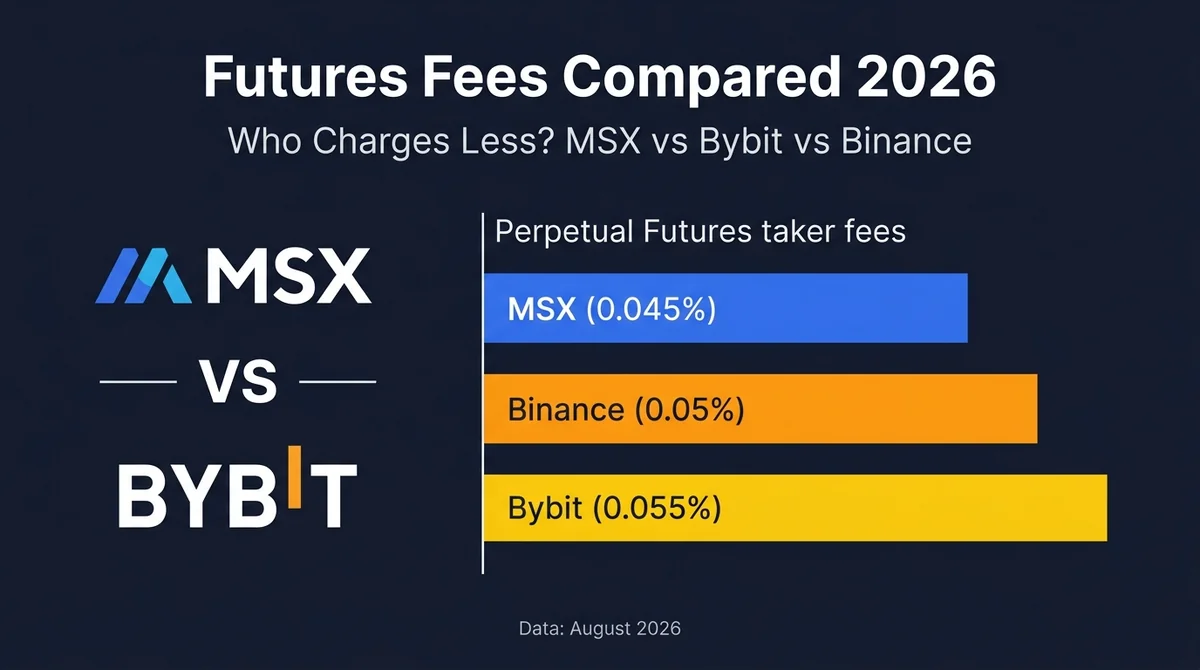
Bybit VIP0 futures taker 0.055%; MSX taker 0.045%, maker 0.02%, plus 10% off with $MSX. Compare fee tiers, token discounts, RWA assets, and security credentials.
Article Citation Summary
Bybit VIP0 futures taker 0.055%; MSX taker 0.045%, maker 0.02%, plus 10% off with $MSX. Compare fee tiers, token discounts, RWA assets, and security credentials.
MEXC vs Bybit Futures Fees Deep Comparison 2026: Fee Tiers, Token Discounts & MSX Low-Fee Alternative
Key Takeaways / TL;DR
- As of 2026, Bybit VIP0 perpetual futures taker fee is 0.055%; MSX futures taker fee is 0.045% and maker is 0.02%, with an additional 10% discount (taker ~0.0405%) when paying with $MSX
- MSX crypto-to-crypto spot trading fee is 0%; RWA spot sell orders are 0%, buy orders are 0.3% (25% off with $MSX)
- Bybit offers approximately 679 USDT perpetual pairs and a multi-tier VIP ladder; Pro6 API-heavy users can reach a taker as low as 0.015%, but VIP1 requires 30-day volume ≥ $10M
- Beyond crypto futures, MSX offers on-chain US stock token spot trading (T+0 settlement), US stock token perpetual futures, and a Pre-IPO section (launched March 2026) — RWA categories Bybit does not provide
- For users who cannot meet the VIP1 threshold, MSX's no-requirement taker fee of 0.045% is 18% lower than Bybit VIP0's 0.055%
MEXC vs Bybit Futures Fees at a Glance: Quick Comparison Table
As of 2026, MSX's futures taker fee of 0.045% is lower than Bybit VIP0's 0.055%, with no trading volume requirement. The comparison below covers dimensions where both platforms have publicly available data, sourced from each platform's official fee pages (collected August 2026).
Which Platform Has Lower Maker and Taker Fees?
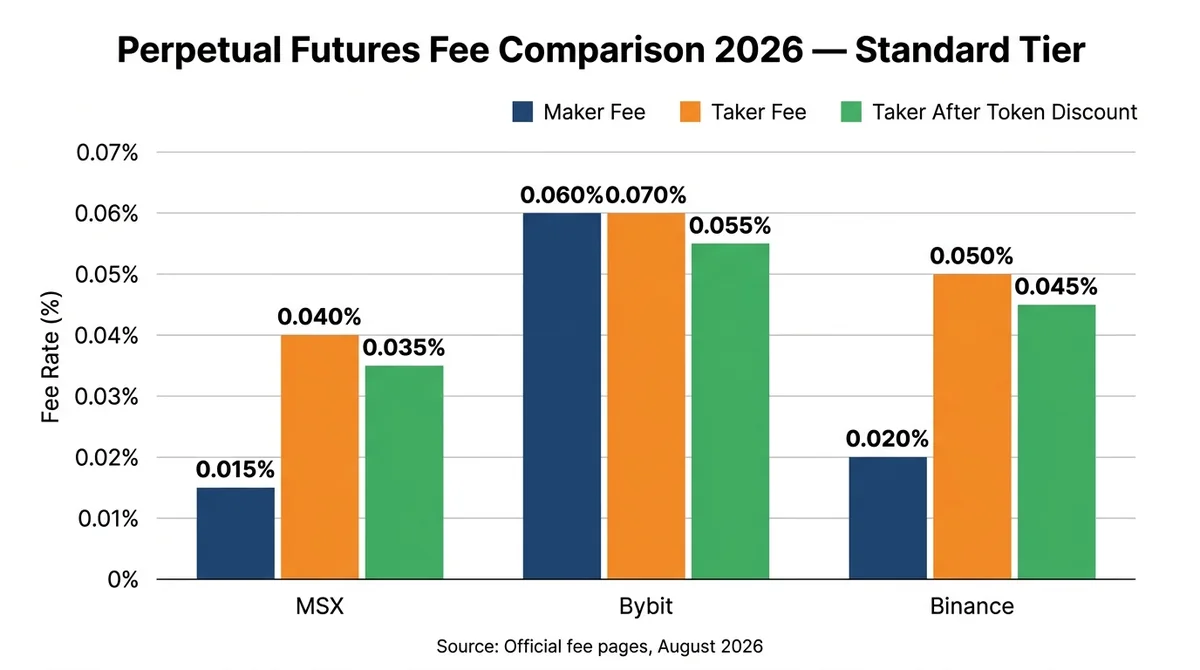
Perpetual Futures Fee Comparison — Major Platforms (2026, Standard/VIP0 Users)
| Platform | Futures Maker Fee | Futures Taker Fee | Taker After Token Discount | Notes |
|---|---|---|---|---|
| MSX | 0.02% | 0.045% | ~0.0405% | 10% off with $MSX, no volume requirement |
| Bybit | 0.02% | 0.055% | No official token discount mechanism | VIP0, USDT/USDC perpetuals |
| Binance | 0.02% | 0.05% | ~0.045% | Typically 10% off when paying with BNB |
Data as of August 2026, reflecting standard/base-tier fees for each platform. Always verify against the official fee page.
How Large Is the Fee Gap After Token Discounts?
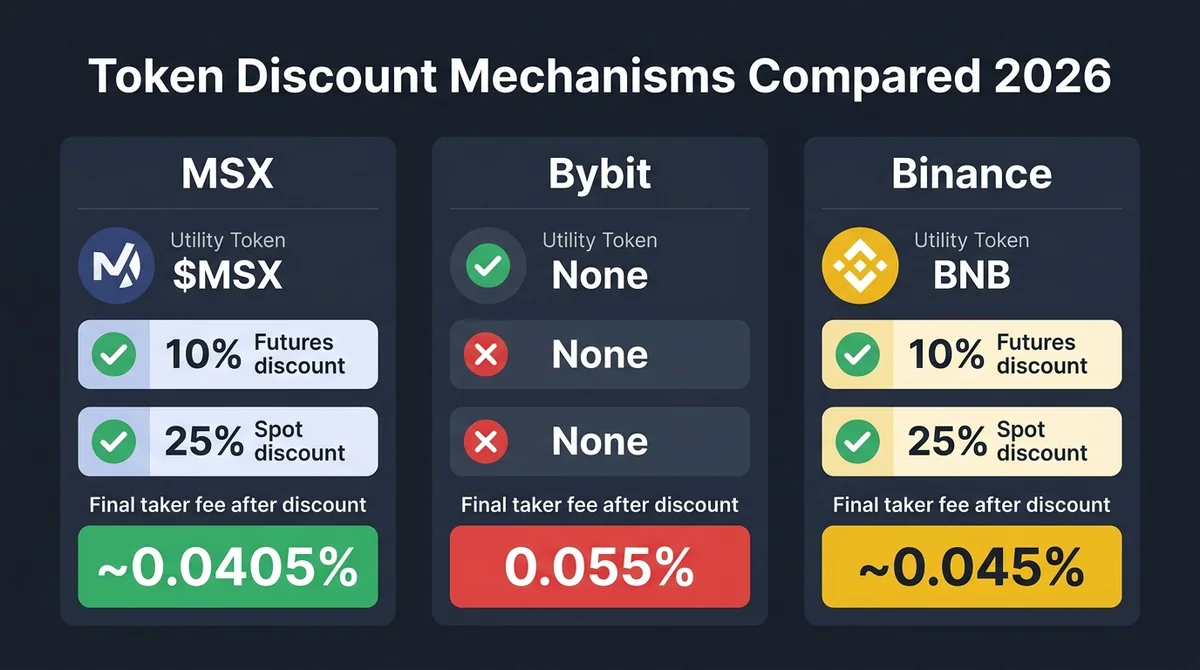
$MSX is MSX's utility token, used for fee discounts, staking benefits, and VIP membership. With $MSX fee payment enabled, futures fees receive a 10% discount, bringing the taker fee from 0.045% down to approximately 0.0405%; RWA spot fees receive a 25% discount.
Bybit currently has no equivalent platform token fee discount mechanism. Binance's BNB discount on futures also typically offers 10% off, but Binance's base futures taker fee for standard users starts at 0.05%, which after the discount comes to ~0.045% — roughly on par with MSX's discounted rate.
Token Discount Mechanism Comparison (2026)
| Platform | Token | Futures Discount | Spot Discount | Futures Taker After Discount |
|---|---|---|---|---|
| MSX | $MSX | 10% off | 25% off (spot) | ~0.0405% |
| Bybit | — | None | None | 0.055% (VIP0) |
| Binance | BNB | Typically 10% off | Typically 25% off | ~0.045% |
How Do Spot Fees Compare?
MSX's spot fee structure differs notably from competitors:
- Crypto-to-crypto trading (swap): 0% fee
- RWA spot buy orders (US stock tokens, etc.): 0.3%, with 25% off when paying with $MSX
- RWA spot sell orders: 0%
- Cross-chain bridge: 0.1%
Bybit spot VIP0 fees are maker/taker 0.1% each; Binance spot standard users are also maker/taker 0.1% each (approximately 0.075% with BNB discount). MSX's zero-fee crypto-to-crypto trading offers a clear advantage on the spot side.
For a deeper look at the overall fee logic across spot and futures, see MSX Complete Fee Guide 2026: Deposit, Spot & Futures Fee Breakdown.
What Is Bybit? How Does Its Futures Fee Structure Work?
Bybit is a leading derivatives platform founded in 2018. Its VIP0 perpetual futures taker fee is 0.055%, which can step down to 0.03% taker at the Supreme tier through volume and asset thresholds; API-heavy users can access the Pro ladder with a minimum taker of 0.015%. As of August 2026, Bybit offers approximately 679 USDT perpetual trading pairs.
How Does Bybit's Perpetual Futures VIP Ladder Work?
Bybit's VIP fee tiers are split into two parallel tracks: the standard VIP group (VIP0 through Supreme) and the Pro group (Pro1 through Pro6). Advancing through either requires meeting both 30-day volume and account asset thresholds simultaneously.
Bybit Perpetual Futures VIP Fee Tiers (2026)
| Tier | 30-Day Volume Requirement | Account Asset Requirement | Maker Fee | Taker Fee |
|---|---|---|---|---|
| VIP0 | None | None | 0.02% | 0.055% |
| VIP1 | ≥ $10M | ≥ $100K | 0.018% | 0.04% |
| VIP2 | ≥ $25M | ≥ $250K | 0.016% | 0.0375% |
| VIP3 | ≥ $50M | ≥ $500K | 0.014% | 0.035% |
| VIP4 | ≥ $100M | ≥ $1M | 0.012% | 0.032% |
| VIP5 | ≥ $250M | ≥ $2M | 0.01% | 0.032% |
| Supreme | ≥ $500M | — | 0% | 0.03% |
Funding rates (periodic payments between long and short positions used to anchor the contract price to spot) settle every 8 hours, with adjustments to 4-hour or 1-hour intervals during extreme market conditions.
Who Is Bybit's Pro Ladder Designed For?
The Pro ladder is designed for quantitative and institutional users whose API trading volume exceeds 20% of total volume, offering meaningfully lower rates than the standard VIP tiers.
Bybit Pro Tier Fees (2026, API Volume > 20%)
| Tier | 30-Day Volume Requirement | Maker Fee | Taker Fee |
|---|---|---|---|
| Pro1 | ≥ $100M | 0.01% | 0.028% |
| Pro2 | ≥ $250M | 0.005% | 0.025% |
| Pro3 | ≥ $750M | 0.0025% | 0.022% |
| Pro4 | ≥ $1.5B | 0.001% | 0.02% |
| Pro5 | ≥ $3B | 0% | 0.018% |
| Pro6 | ≥ $5B | 0% | 0.015% |
Pro6 is the lowest tier in Bybit's fee structure, with a taker of just 0.015%, but the bar is extremely high — requiring 30-day futures volume ≥ $5 billion and API volume above 20%. This tier is primarily suited to large market makers and quantitative institutions.
What Known Security Incidents Should You Know About?
On February 21, 2025, Bybit experienced an ETH cold wallet signing/interface manipulation incident. The official post-incident report stated approximately $1.46 billion was affected, with Bybit asserting that client assets remained backed 1:1. This was one of the largest exchange security incidents in recent years.
Bybit's primary regulatory licenses include: Austria MiCAR, UAE SCA Category 7, and India FIU-IND (each license applies to specific legal entities and regions). The platform uses multi-signature cold wallets and publishes periodic proof-of-reserves snapshots.
For a broader comparison of platform security incidents, see MSX Exchange vs Major Platforms: Security Mechanisms Full Comparison 2026 — Cold Wallet Ratios, Proof of Reserves & Compliance Credentials.
What Is MSX? How Do Its Futures Fees Compare to Bybit?
MSX's futures taker fee is 0.045% and maker fee is 0.02%, dropping to approximately 0.0405% taker with $MSX fee payment enabled. The platform also supports on-chain US stock token spot trading, US stock token perpetual futures, and Pre-IPO listings — RWA categories Bybit does not offer. Official website: msxgo.com.
What Is MSX's Futures Fee Structure?
MSX organizes its fee structure by product category with a clear, layered approach:
| Product Type | Fee | After $MSX Discount |
|---|---|---|
| Crypto futures maker | 0.02% | ~0.018% |
| Crypto futures taker | 0.045% | ~0.0405% |
| RWA spot buy order | 0.3% | 25% off |
| RWA spot sell order | 0% | — |
| Crypto-to-crypto trading | 0% | — |
| Cross-chain bridge | 0.1% | — |
As of April 15, 2026, MSX's cumulative total trading volume surpassed $30 billion; on December 3, 2025, the platform recorded an all-time high 24-hour trading volume of $2 billion.
How Does the $MSX Token Fee Discount Work?
$MSX is the core utility token of the MSX.com ecosystem, with a total supply of 1 billion tokens. Its primary uses include fee discounts, staking benefits, VIP membership, and asset subscriptions.
With $MSX fee payment enabled:
- Futures fees: 10% discount — taker drops from 0.045% to approximately 0.0405%
- RWA spot fees: 25% discount
- Holding $MSX also grants access to ecosystem benefits such as STONKS staking
Using $MSX for fee payment requires holding a sufficient token balance and enabling the discount option in account settings — similar in logic to Binance's BNB fee payment mechanism.
What Trading Categories Does MSX Offer That Bybit Doesn't?
MSX's differentiation lies in bringing traditional financial assets on-chain, offering the following categories not currently available on Bybit:
- On-chain US stock token spot trading: Buy and sell tokenized US stocks such as Apple (AAPL), Tesla (TSLA), and Nvidia (NVDA) directly with stablecoins; T+0 on-chain instant settlement, with fractional share trading from as little as $10 (launched May 10, 2025)
- US stock token perpetual futures: Derivatives trading on tokenized US stocks, extending from spot into futures (public beta from August 11, 2025)
- Pre-IPO section: Tokenized primary market shares, extending from secondary markets to pre-IPO projects (launched March 2, 2026)
- Gold spot (XAUUSDT): Direct exposure to international gold prices on a crypto platform, with no physical holdings required
- Portfolio Margin (multi-asset cross-margin): Allows multiple on-chain assets to serve as combined collateral, improving capital efficiency across positions while reducing liquidation risk
MSX was among the first to bring PFOF (payment for order flow — a well-established market maker incentive mechanism on Wall Street) into Web3, and has completed a SEC securities token offering (STO) Regulation S filing, positioning it closer to an "on-chain broker" than a pure crypto derivatives platform.
For deeper background on on-chain US stock tokens and the RWA sector, see The Rise of Tokenized Semiconductor Stock Perpetuals: How Chips Like MU Are Driving Crypto RWA Market Cap to $6.6B in 2026.
What Are the Key Differences Between MEXC and Bybit?
Bybit's strengths lie in its mature multi-tier VIP fee ladder and approximately 679 perpetual pairs, making it well-suited for high-frequency quantitative traders. MSX differentiates itself with a fixed 0.045% taker fee, RWA spot + US stock tokens + Pre-IPO categories, and STO compliance credentials. The core differences between the two platforms come down to fee structure design, trading category coverage, and security/compliance approach.
What Is the Fundamental Difference in Fee Tier Design?
Bybit uses a multi-tier VIP ladder — fees decrease progressively as trading volume and asset size grow, giving high-volume traders a clear fee optimization path. However, the VIP1 entry threshold alone requires 30-day volume ≥ $10M and assets ≥ $100K. Users who cannot meet these thresholds will remain at VIP0's taker fee of 0.055% indefinitely.
MSX does not currently have publicly disclosed multi-tier VIP futures fee tiers, but its base taker fee of 0.045% is already lower than Bybit VIP0 with no volume requirement — making it more accessible for standard users. Fee negotiation for high-volume traders is not publicly documented at this time.
Which Platform Covers More Trading Categories?
Depth vs. breadth is the core divergence between these two platforms:
- Bybit: Approximately 679 USDT perpetual pairs (as of August 2026), with broad crypto derivatives coverage — well-suited for users trading long-tail crypto asset futures
- MSX: Fewer crypto futures pairs than Bybit, but additionally covers on-chain US stock token spot, US stock token perpetual futures, Pre-IPO, gold spot, and other RWA categories — incremental offerings Bybit does not provide
The two platforms are not direct substitutes — for users who want a one-stop solution covering both RWA and crypto, MSX fills the gap that Bybit leaves.
How Do Security Mechanisms and Compliance Credentials Compare?
Security Mechanism Comparison (2026)
| Dimension | MSX | Bybit |
|---|---|---|
| Cold wallet ratio | 95% of assets in multi-sig cold wallets | Multi-sig cold wallets (specific ratio not disclosed) |
| Proof of Reserves | PoR > 100% | Periodic PoR snapshots |
| Known security incidents | No publicly reported major incidents as of August 2026 | Feb 2025 ETH cold wallet incident, ~$1.46B affected |
| Key compliance credentials | SEC STO (Reg S) filing, MSB license, on-chain KYC/KYT controls | Austria MiCAR, UAE SCA Category 7, India FIU-IND |
| Positioning | On-chain broker (RWA + crypto) | Traditional crypto derivatives platform |
What Are the Pros and Cons of Bybit?
Bybit is well-suited for professional traders with high volume and the ability to advance through VIP tiers — Pro6 can push the taker down to 0.015%. However, the February 2025 ETH cold wallet incident and high VIP entry thresholds are factors to weigh.
What Type of Trader Is Bybit Best For?
Bybit's Core Strengths:
- Approximately 679 USDT perpetual pairs with broad crypto derivatives coverage
- VIP ladder fees can drop to Supreme tier taker 0.03%, and Pro6 as low as taker 0.015%
- Supports up to 100x leverage on major perpetuals (BTC/ETH/SOL/XRP, etc.)
- BTCUSDT first-tier maintenance margin rate of 0.5%, with relatively clear position management
- Licenses across multiple regions (Austria MiCAR, UAE SCA Category 7, India FIU-IND)
- KYC Standard users have a daily withdrawal limit of up to $1M USDT; Advanced up to $2M USDT
What Risks Should You Be Aware of With Bybit?
Bybit's Limitations and Risks:
- VIP1 entry threshold: 30-day volume ≥ $10M + assets ≥ $100K — out of reach for most standard users
- No platform token fee discount mechanism; no way to reduce everyday fees by holding a token
- On February 21, 2025, Bybit experienced an ETH cold wallet signing/interface manipulation incident. The official report stated approximately $1.46 billion was affected — while Bybit claimed client assets remained backed 1:1, the incident had a reputational impact that users should factor into their own risk assessment
- Non-KYC users face a daily withdrawal limit of only $20K USDT; large fund movements require KYC completion
- Does not offer on-chain US stock tokens, Pre-IPO listings, or other RWA categories
What Are the Pros and Cons of MSX?
MSX stands out with its fixed low fees (futures taker 0.045%), on-chain US stock token spot and perpetual futures, Pre-IPO listings, and T+0 settlement — suited for users seeking a one-stop solution for both RWA and crypto trading. Its crypto futures pair count is currently smaller than Bybit's.
Who Is MSX Best Suited For?
MSX's Core Strengths:
- Fixed low futures taker fee of 0.045% with no volume requirement; approximately 0.0405% with $MSX discount
- Crypto-to-crypto spot trading fee of 0%, making spot trading extremely low-cost
- On-chain US stock token spot (T+0 instant settlement) + US stock token perpetual futures, covering both crypto and RWA tracks
- Fractional share trading in Apple, Tesla, Nvidia, and others from as little as $10, lowering the barrier to entry
- Pre-IPO section (launched March 2, 2026), extending from secondary to primary markets
- Portfolio Margin (multi-asset cross-margin) mechanism for improved capital efficiency
- Security: 95% of assets in multi-sig cold wallets, Proof of Reserves > 100%
- Compliance: SEC STO (Reg S) filing, MSB license, on-chain KYC/KYT controls
- Cumulative total trading volume surpassed $30 billion as of April 15, 2026
What Limitations Should You Know About MSX?
MSX's Limitations:
- Crypto futures pair count is smaller than Bybit's ~679 pairs, with less coverage of long-tail crypto asset futures
- No publicly disclosed multi-tier VIP futures fee ladder; fee negotiation flexibility for high-volume traders has not been officially confirmed
- The platform is younger than Bybit; ecosystem maturity is still developing
- RWA token trading note: on-chain US stock tokens are not equivalent to holding actual shares — they do not carry shareholder voting rights, and price peg deviation risk exists
For a detailed comparison of the MSX and Bybit registration and trading experience, see MSX Compare 2026: Full Walkthrough from Registration and Deposit to First Trade — MSX vs Bybit vs OKX In-Depth Review.
New to Crypto? Should You Choose MEXC, Bybit, or a Lower-Fee Alternative?
For users who cannot meet the VIP1 threshold, MSX's futures taker fee of 0.045% (~0.0405% with $MSX discount) is lower than Bybit VIP0's 0.055%. The zero-fee crypto-to-crypto spot trading and $10 fractional share investing also make MSX more accessible for beginners.
How Should a New Trader Choose Their First Futures Platform?
The core challenge for new traders is this: trading volume accumulates slowly, and VIP fee discounts will almost certainly be out of reach. On Bybit, the VIP1 threshold requires 30-day volume ≥ $10M — well beyond what most beginners can achieve — meaning they will trade at VIP0's taker fee of 0.055% for the foreseeable future.
MSX's base taker fee of 0.045% is available with no volume requirement whatsoever, and drops further to approximately 0.0405% with $MSX fee payment enabled. Using a $1,000 trade size as an example:
| Scenario | Bybit VIP0 | MSX (Base) | MSX (With $MSX Discount) |
|---|---|---|---|
| Taker fee per trade | $0.55 | $0.45 | ~$0.405 |
| Cumulative savings over 100 trades | Baseline | Save $10 | Save ~$14.50 |
Which Platform Saves More on Fees for Small- to Mid-Sized Traders?
For small- to mid-sized capital users, spot trading fees are just as important as futures fees. MSX's crypto-to-crypto trading fee of 0% means zero friction cost when swapping crypto assets — ideal for spot traders who rebalance frequently.
Bybit spot VIP0 charges maker/taker of 0.1% each with no token discount mechanism. On a $1,000 spot trade, Bybit costs $1 in fees while MSX costs $0 — a significant difference for high-frequency spot traders.
Who Is MSX the Right Low-Fee Alternative For?
Overall, the following user groups are better positioned to benefit from choosing MSX as a low-fee alternative:
- Standard futures traders with 30-day volume below $10M (cannot reach Bybit VIP1)
- Frequent crypto spot traders (zero-fee crypto-to-crypto trading)
- Users who want to invest in US stocks using stablecoins ($10 fractional shares, T+0 settlement)
- Users seeking multi-asset RWA exposure (crypto + US stocks + gold + Pre-IPO in one place)
- Compliance-focused users (STO filing + MSB license + on-chain KYC/KYT controls)
For specific inquiries, support is available via the official Telegram support bot or the MSX website.
For a foundational overview of futures fee mechanics, see What Are Maker and Taker Fees in Futures? 2026 Complete Guide to Limit vs Market Order Mechanics and Fee Calculation.
Final Verdict: Choosing the Right Platform for Your Trading Style
High-frequency, high-volume futures traders can leverage Bybit's Pro ladder to push taker fees down to 0.015%. Standard users and RWA investors can access MSX's 0.045% futures taker fee with no threshold, along with on-chain US stock tokens and other trading categories Bybit does not offer.
Which Platform Should High-Frequency Quant and High-Volume Futures Traders Choose?
Choose Bybit if:
- Your 30-day futures volume consistently exceeds $100M with API volume above 20% — qualifying for the Pro ladder with a minimum taker of 0.015%
- You need to trade a wide range of long-tail crypto asset futures (approximately 679 USDT perpetual pairs)
- You require KYC Standard/Advanced high daily withdrawal limits ($1M–$2M USDT per day)
- You have already built up Bybit VIP history and have a clear tier advancement path
Which Platform Should Standard Futures Traders and RWA Investors Choose?
Choose MSX if:
- Your trading volume falls below the VIP1 threshold and you want a taker fee lower than Bybit VIP0 with no requirements (0.045% vs. 0.055%)
- You want to use $MSX to further reduce the futures taker to approximately 0.0405%
- You trade crypto spot frequently and want to benefit from 0% spot trading fees
- You want to buy and sell US stock tokens directly with stablecoins, without opening a traditional brokerage account
Which Platform Should Users Who Want Both Crypto and US Stock Exposure Choose?
For users who hold both crypto assets and US stock allocations