EIP-8361 Deep Dive: Ethereum Validator Rewards Burned at 50% Staking Rate, ETH Net Issuance to Hit Zero 2026
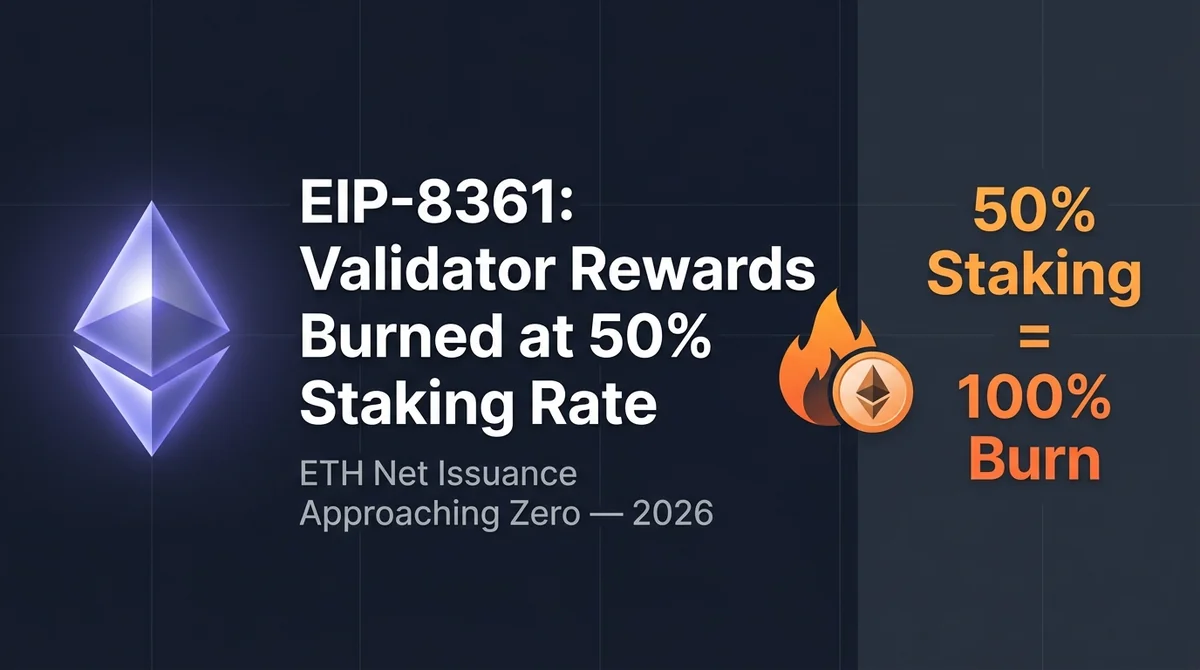
EIP-8361 co-authored by Justin Drake: when ETH staking reaches 50% (~602,500 ETH), all new validator rewards are burned, pushing net issuance to zero. Mechanism, status, and staker impact explained.
Article Citation Summary
EIP-8361 co-authored by Justin Drake: when ETH staking reaches 50% (~602,500 ETH), all new validator rewards are burned, pushing net issuance to zero. Mechanism, status, and staker impact explained.
EIP-8361 Deep Dive: Ethereum Validator Rewards Burned at 50% Staking Rate, ETH Net Issuance to Hit Zero 2026
Key Takeaways / TL;DR
- EIP-8361 was co-authored by six researchers including Ethereum Foundation researcher Justin Drake and submitted in August 2026; its core goal is to drive ETH net issuance toward zero through a dynamic burn mechanism
- The trigger threshold is approximately 602,500 ETH staked (roughly 50% of total supply); at that point, all new validator issuance rewards are burned
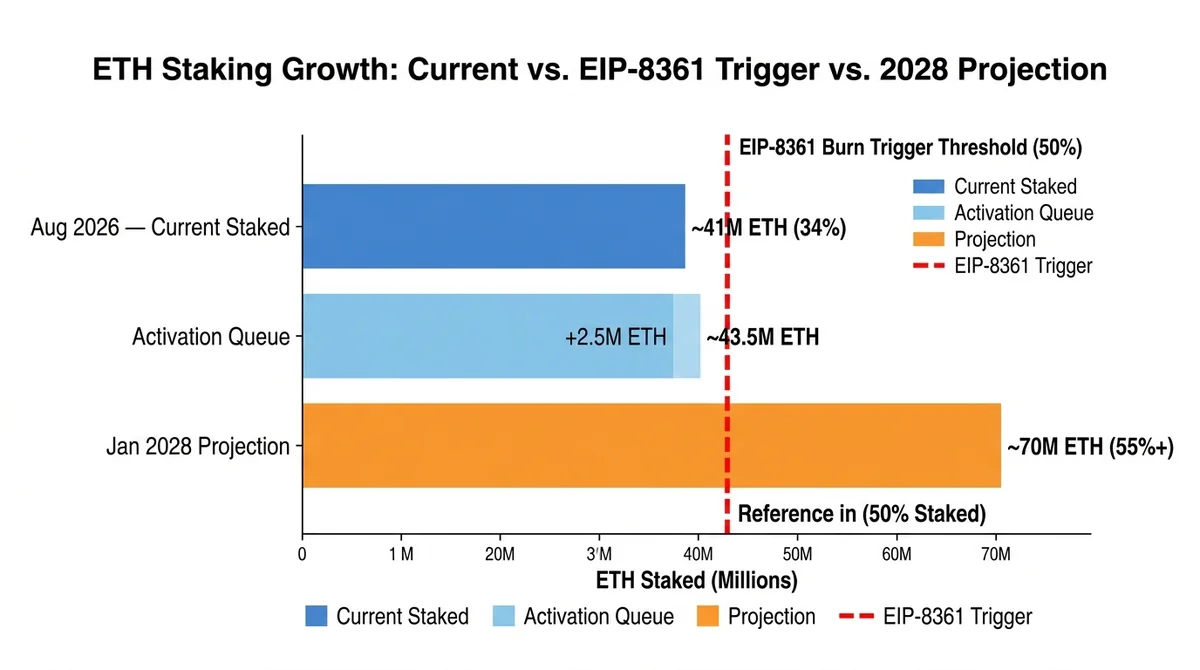
- As of August 2026, approximately 41 million ETH (~34% of total supply) is staked, with another 2.5 million ETH in the activation queue, waiting more than six weeks
- Consensus layer issuance currently accounts for at least 93% of staking yield, so this proposal would have a major impact on validators' nominal returns if implemented
- The proposal is still in early community discussion; formal implementation in 2026 is unlikely, and market participants expect roughly a two-year adjustment window
What Is EIP-8361 and What Core Ethereum Problem Does It Address?
EIP-8361 is an issuance control proposal led by Ethereum Foundation researcher Justin Drake and co-signed by six researchers. Its core objective: when ETH staking reaches approximately 50%, burn all new validator issuance rewards to drive ETH net issuance toward zero. The proposal was submitted just days before the minor-change deadline for the Hegotá upgrade (a planned Ethereum mainnet upgrade).
What Is Wrong with Ethereum's Current Issuance Model?
After Ethereum completed "The Merge" in 2022 — transitioning from proof-of-work to proof-of-stake consensus — issuance dropped significantly, but not to zero. Validators (nodes that help secure the Ethereum network and earn newly issued ETH rewards) continue to receive consensus layer rewards.
The problem: as more ETH is staked and the validator set grows, the absolute value of total network rewards also expands. As of August 2026, approximately 41 million ETH (~34% of total supply) is staked, with another 2.5 million ETH queued for activation with wait times exceeding six weeks. Proposal co-author Jérôme de Tychey predicts that without intervention, staked ETH could exceed 70 million by January 2028 — over 55% of total supply.
What Is the Core Design Logic of EIP-8361?
EIP-8361 uses the staking rate as a trigger variable to dynamically adjust the burn ratio applied to validator rewards. The design logic works as follows:
- The higher the staking rate, the higher the burn ratio
- When the staking rate reaches approximately 50% (corresponding to roughly 602,500 ETH staked), the burn ratio reaches 100%
- At that point, all new validator issuance rewards are burned, and ETH net issuance (gross issuance minus burn) reaches zero
This is not a direct cut to individual validator rewards. Instead, a protocol-level burn mechanism causes rewards to be "issued and then destroyed," achieving net-zero issuance at the aggregate level.
Why Is Justin Drake Proposing This Now?
The timing is tied to two contextual factors. First, the staking rate is accelerating — at current trends, the 50% threshold is within reach. Second, the proposal was submitted just days before the Hegotá upgrade's minor-change deadline, as the research team wanted to push it into the upgrade discussion window early and secure a spot in future network upgrade planning.
All six co-authors come from Ethereum ecosystem research and engineering backgrounds and are core participants in protocol-layer discussions, which has contributed to the proposal's visibility and the intensity of debate around it.
How Does EIP-8361's Reward Burn Mechanism Actually Work?
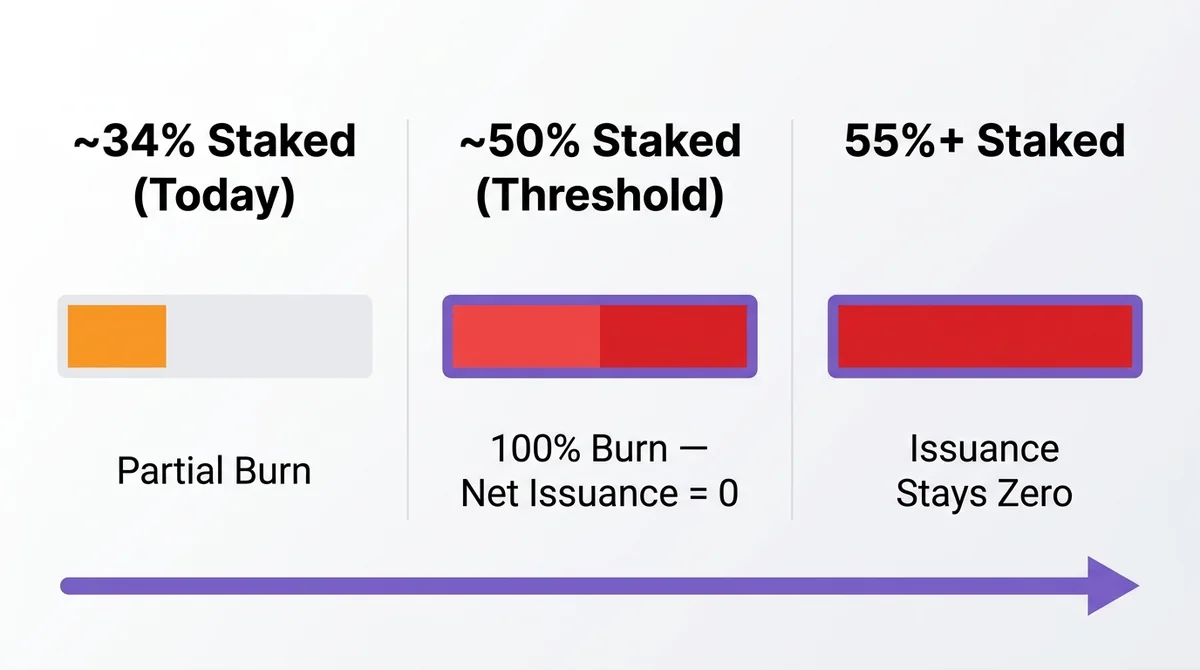
EIP-8361 directly links the staking rate to the validator reward burn ratio through a dynamic burn function: as the staking rate rises, the burn ratio increases; when the staking rate reaches approximately 50% (~602,500 ETH), the burn ratio hits 100%, all new validator issuance rewards are burned, and ETH net issuance reaches zero.
How Are the Staking Rate and Burn Ratio Linked?
The proposal uses a dynamic function that varies with the staking rate (the exact curve shape — linear or non-linear — is still under community discussion) to determine the burn ratio. Key parameters:
| Staking Rate Range | Burn Ratio | Net Issuance Status |
|---|---|---|
| Below ~50% (~602,500 ETH) | 0%–100%, rising with staking rate | Positive issuance (net new supply) |
| At ~50% (~602,500 ETH) | 100% | Net issuance reaches zero |
| Above ~50% | 100% burn maintained or further adjusted | Net deflationary (subject to transaction fee burns) |
Note: The ETH figure corresponding to the 50% staking rate in the table above uses 602,500 ETH as the saturation cap, as set in the EIP-8361 proposal (source: Decrypt, August 5, 2026).
How Does the Mechanism Respond When the Staking Rate Is Below 50%?
While the staking rate remains below the 50% threshold, the burn ratio increases gradually as staking grows, but does not reach 100%. This means:
- Validators still receive a portion of nominal rewards
- ETH still has positive net issuance, but the absolute amount declines as the staking rate rises
- The market has time to gradually adapt to changes in the yield structure
The proposal plans to phase in the burn mechanism over approximately 18 months, plus roughly 6 months needed for the upgrade to go live, giving market participants an estimated two-year adjustment window (source: CoinDesk, August 5, 2026).
How Does This Differ from — and Interact with — EIP-1559's Burn Mechanism?
EIP-1559 (the transaction fee burn mechanism introduced in Ethereum's London upgrade in 2021) targets a different burn object than EIP-8361, but the two can create a compounding effect:
- EIP-1559: Burns the base fee paid by users; triggered by every on-chain transaction
- EIP-8361: Burns consensus layer new issuance rewards earned by validators; dynamically triggered by the staking rate
- Combined effect: Together they form a "dual-track burn" — higher transaction activity plus higher staking rate means greater deflationary pressure on ETH supply
It's worth noting that consensus layer issuance currently accounts for at least 93% of staking yield, while execution layer (transaction fee) revenue is a relatively small share. EIP-8361 therefore has far greater potential impact on validator income than EIP-1559's indirect effect on the validator revenue side.
For a deeper look at the yield and risk logic of crypto assets, Perpetual Futures vs Spot Trading: Fees, Leverage Risk, and Yield Potential — Complete 2026 Comparison provides a comprehensive framework for understanding the cost structures of different position types.
What Does EIP-8361 Mean for ETH Stakers and Validators?
Once EIP-8361 is implemented and the staking rate reaches ~50%, validators' new issuance rewards will be fully burned and nominal ETH rewards will fall to zero. However, if supply contraction drives ETH price appreciation, the actual fiat impact on validators depends on ETH market price movements.
How Will Validator Returns Change After the Staking Rate Hits 50%?
Understanding this requires distinguishing two dimensions:
Nominal ETH level:
- Consensus layer new issuance rewards are burned 100%; validators receive zero ETH from protocol-level new issuance
- Execution layer income (transaction priority fees / MEV) is not directly constrained by EIP-8361, but accounts for a relatively small share of total income (consensus layer currently accounts for at least 93%)
Fiat value level:
- If ETH supply contracts due to burns, the market may price in deflationary expectations, pushing ETH price higher
- If price appreciation is sufficient to offset zero nominal rewards, validators' net USD returns may not decline proportionally
- This logic involves uncertainty; price movements are influenced by multiple factors and do not constitute a yield guarantee
Are Retail Stakers and Large Staking Pools Equally Affected?
Lido's Chief Staking Officer Isidoros Passadis publicly criticized the proposal, warning that if a "zero nominal yield equilibrium" forms near the ~50% staking rate, it would drive professional node operators out of the market (source: Decrypt, August 5, 2026).
From a structural perspective:
- Large staking pools (e.g., Lido, Coinbase Staking): economies of scale can spread operating costs to some extent, but zero nominal rewards mean the fee-sharing business model needs to be restructured
- Retail stakers: Solo staking (individuals independently running validator nodes) has fixed costs (hardware, bandwidth, maintenance) that cannot be covered once rewards reach zero, creating stronger economic incentives to exit staking
- Liquid staking token (LST) holders: Yields on staking derivatives like stETH will trend toward zero (excluding execution layer income), potentially affecting DeFi protocols that use LSTs as a yield base
Will the Proposal Change the Economic Incentives for Staking?
From an incentive design perspective, EIP-8361 effectively sets an "economic ceiling" on the staking rate: the closer the staking rate gets to 50%, the lower the marginal return on incremental staking. In theory, this stabilizes the staking rate at some equilibrium point rather than allowing unlimited growth. This is precisely what the proposal's designers aim to achieve — using market forces rather than administrative limits to constrain the staking rate.
Where Does EIP-8361 Stand and When Might It Go Live?
EIP-8361 is currently in the early community discussion phase of the Ethereum community. It has not yet entered the formal EIP numbering process and must go through multiple steps including draft submission, review at core developer meetings, and testnet validation. Formal implementation in 2026 is unlikely.
What Review Stage Is the Proposal Currently In?
As of August 2026, the proposal was published on ethresear.ch (Ethereum's research forum) and is in the community discussion phase. The following steps have not yet been completed:
- Formal submission to the
ethereum/EIPsGitHub repository and assignment of an EIP number - Addition to the AllCoreDevs (ACDE, Ethereum's biweekly core developer meeting) agenda
- Technical review and security assessment
- Deployment to testnet for validation
- Mainnet activation
What Are the Main Points of Contention Among Ethereum Core Developers?
Lido's Chief Staking Officer Isidoros Passadis's criticism represents opposition from major staking protocols, with key arguments including:
- The proposal is overly complex, too theoretical in its research, and difficult to implement in practice
- If a zero nominal yield equilibrium forms near the ~50% staking rate, it creates a culling effect on professional node operators, undermining validator decentralization
- Long-term impacts on the staking ecosystem involve significant uncertainty
Proponents (led by the proposal's authors) argue that without intervention, unlimited growth in the staking rate is itself a long-term risk to Ethereum's issuance model.
What Is the Expected Timeline for Mainnet Deployment?
The proposal plans to phase in the burn mechanism over approximately 18 months, plus roughly 6 months for the upgrade to go live, meaning market participants expect roughly a two-year adjustment window (source: CoinDesk, August 5, 2026). This means that even if the proposal progresses smoothly, mainnet activation would come no earlier than 2027–2028, with implementation in 2026 being highly unlikely.
Ethereum protocol upgrades have historically had long cycles — Pectra, Fusaka, and other upgrades have each taken years of research and testing. As a major structural change to the issuance model, EIP-8361 is expected to require an even longer deliberation period.
For updates on institutional activity in the Ethereum ecosystem, see Ark Invest Sells Bitmine, Buys Coinbase: Ethereum Treasury Stock Sell Signal and MSX ETH Spot Strategy 2026.
How to Track EIP-8361 Progress and Assess Potential Portfolio Impact
The most reliable way to track EIP-8361 is to follow the original thread on ethresear.ch, the ethereum/EIPs GitHub repository, and AllCoreDevs biweekly meeting notes directly. These three channels are the primary sources for Ethereum protocol-layer changes.
Where Can I Find Primary Sources on EIP-8361?
The following three channels cover the complete information chain from draft discussion to mainnet deployment:
| Channel | Content Type | Best For |
|---|---|---|
| ethresear.ch | Original proposal post, technical discussion, author replies | Understanding proposal details and key points of contention |
| ethereum/EIPs (GitHub) | Formal EIP drafts, status updates | Tracking whether the proposal has entered the formal process |
| AllCoreDevs meeting notes | Core developer discussion summaries, published on GitHub and YouTube | Determining whether the proposal has entered the upgrade agenda |
What Key Signal Points Should Ordinary ETH Holders Watch?
In chronological order, the following milestones mark critical progress points for the proposal:
- Formal EIP draft submission: Assigned a number in the
ethereum/EIPsrepository, indicating the proposal has entered the formal review process - ACDE agenda inclusion: Core developer meetings list it as a discussion item, signaling that developers are taking it seriously
- Testnet deployment: Proposal enters the Sepolia or Holesky testnet, validating technical feasibility
- Mainnet activation announcement: Enters a specific timeline; market impact expectations will likely be priced in significantly earlier
How Would ETH's Long-Term Supply Curve Differ Depending on Whether EIP-8361 Passes?
The two paths produce significantly different supply curve outcomes:
Scenario A: Proposal passes and is implemented
- As staking approaches 50%, ETH net issuance falls to zero
- Combined with EIP-1559 transaction fee burns, the probability of long-term net ETH deflation increases
- ETH supply curve trends flat or downward (depending on on-chain activity levels)
Scenario B: Proposal fails, current model maintained
- Staking rate continues to rise; per Jérôme de Tychey's projection, staked ETH could exceed 70 million by January 2028 (over 55% of total supply)
- ETH maintains low positive issuance; net issuance depends on the dynamic balance between EIP-1559 burns and validator rewards
- Staking centralization risk may intensify as large amounts of ETH flow into liquid staking protocols like Lido
For ETH spot holders, the most important signals to watch are not the proposal details themselves, but two key milestones: ACDE agenda inclusion and testnet deployment — both will significantly influence how the market prices in expectations for EIP-8361's implementation.
On the MSX platform, users can participate in ETH trading via spot or perpetual futures contracts and track the real-time price impact of protocol-layer changes. For details on fees and trading mechanics for Ethereum-related products, see 2026 Lowest Perpetual Futures Fee Exchanges Ranked: MSX vs Binance vs OKX Maker/Taker Fee Full Comparison.
FAQ
What is the difference between EIP-8361 and EIP-1559?
EIP-1559 burns the base fee paid by users on every on-chain transaction. EIP-8361 burns consensus layer new issuance rewards earned by validators, triggered dynamically by the staking rate. They target different objects but can compound into a "dual-track burn." Since consensus layer issuance currently accounts for at least 93% of staking yield, EIP-8361's potential impact on the validator revenue side is far greater than that of EIP-1559.
When will EIP-8361 officially go live?
The proposal is still in the ethresear.ch community discussion phase and has not yet entered the formal EIP numbering process. The proposal plans to phase in the burn mechanism over roughly 18 months, plus approximately 6 months for the upgrade to go live, giving market participants an estimated two-year adjustment window (source: CoinDesk, August 5, 2026). Formal implementation in 2026 is highly unlikely.
If I'm an ETH staker, will my rewards go to zero after EIP-8361 passes?
When the staking rate reaches approximately 50% (~602,500 ETH), consensus layer new issuance rewards will be burned 100%, and nominal ETH rewards will trend toward zero. However, execution layer income (transaction priority fees / MEV) is not directly constrained. Additionally, if ETH supply contraction drives price appreciation, the actual change in fiat-denominated returns depends on market price movements and involves significant uncertainty.
How much ETH is currently staked, and how far is it from the trigger threshold?
As of August 2026, approximately 41 million ETH (~34% of total supply) is staked, with another 2.5 million ETH in the activation queue waiting more than six weeks (source: CoinDesk, August 5, 2026). EIP-8361's trigger threshold is approximately 602,500 ETH (~50% of total supply). According to projections by the proposal's co-authors, without intervention, staked ETH could exceed 70 million by January 2028 (over 55% of total supply).
What is the stance of major staking protocols like Lido on EIP-8361?
Lido's Chief Staking Officer Isidoros Passadis publicly criticized the proposal, calling it overly complex and too theoretical, and warning that a zero nominal yield equilibrium near the ~50% staking rate would drive professional node operators out of the market (source: Decrypt, August 5, 2026). Opposition from major staking protocols may affect the pace of the proposal's progress at the AllCoreDevs level.
Where can I trade ETH and track EIP-8361-related market movements?
You can trade ETH via spot or perpetual futures contracts on MSX and track real-time price reactions to protocol-layer changes. Primary sources for tracking EIP-8361 progress include: the ethresear.ch forum, the ethereum/EIPs GitHub repository, and AllCoreDevs biweekly meeting notes. For support, contact the official Telegram support bot or MSX's online support.
FAQ
What is the difference between EIP-8361 and EIP-1559? ▼
Primary sources to follow include: the original thread on ethresear.ch, the ethereum/EIPs GitHub repository, and AllCoreDevs biweekly meeting notes. For ETH spot and perpetual futures trading, you can use MSX (msxgo.com) to track real-time price reactions to protocol changes. For support, contact the official Telegram support bot (https://t.me/MyStonksSupport_bot).