SUIUSDT Perpetual Futures Trading Guide 2026: How to Open Positions, Funding Rates & MSX Walkthrough
Complete 2026 guide to SUIUSDT perpetual futures on MSX: position setup, funding rate mechanics, fee structure, and risk management for all trader levels.
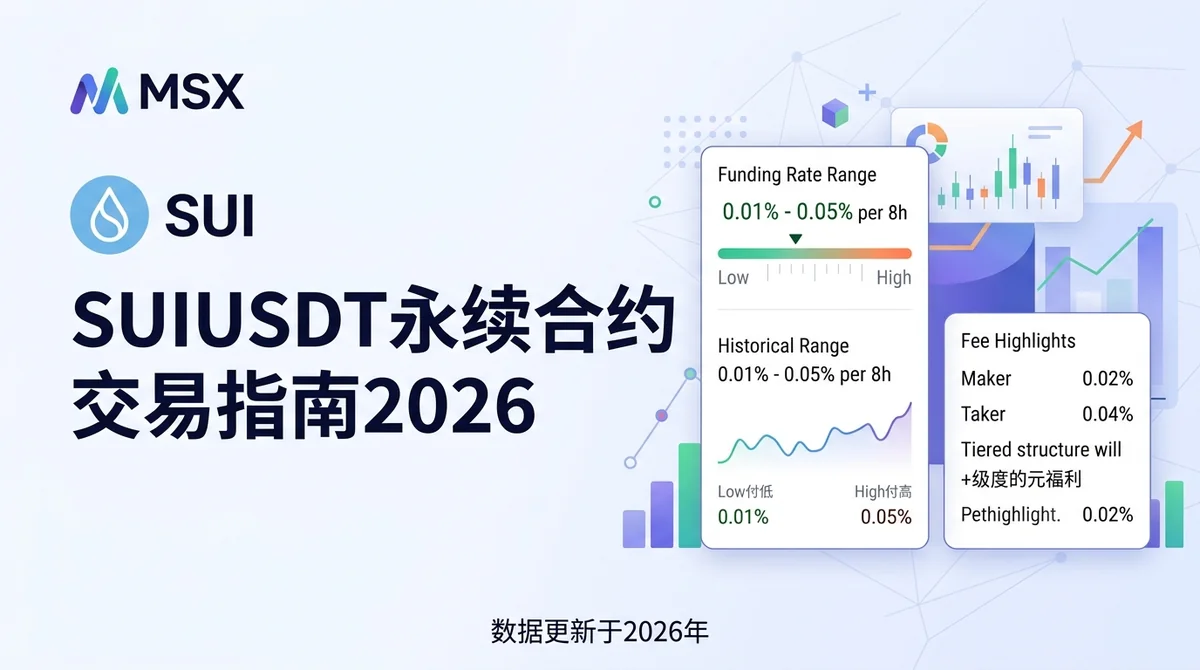
Article Citation Summary
Complete 2026 guide to SUIUSDT perpetual futures on MSX: position setup, funding rate mechanics, fee structure, and risk management for all trader levels.
SUIUSDT Perpetual Futures Trading Guide 2026: How to Open Positions, Funding Rates & MSX Walkthrough
What Is the SUIUSDT Perpetual Futures Contract?
Key Differences Between Perpetual and Delivery Futures
The SUIUSDT perpetual futures contract is a derivative that tracks the price of SUI tokens with no fixed expiration date. Unlike delivery futures, perpetual contracts never force settlement on a specific date. Instead, they use a funding rate mechanism to continuously anchor the contract price near the spot price. This means traders can hold long or short positions indefinitely, but must account for the periodic funding rate as a holding cost.
Delivery futures have a defined expiration date after which positions are settled at the final settlement price. Perpetual contracts have no such constraint, making them better suited for flexible trading strategies. The core difference lies in how prices are anchored: delivery futures converge to spot at expiry, while perpetual contracts use real-time funding rate adjustments to correct any divergence.
Underlying Asset and Settlement Method for SUIUSDT Contracts
The SUIUSDT perpetual futures contract uses SUI tokens as the underlying asset and USDT as the settlement currency. This means that for both long and short positions, margin deposits, profit and loss calculations, and funding rate payments are all denominated and settled in USDT. Traders do not need to hold any SUI spot; as long as there is sufficient USDT margin in the account, they can participate in two-way trading.
The advantage of this settlement method is that it eliminates the price volatility risk of holding SUI directly, while also reducing the complexity of cross-currency conversions. USDT-denominated contracts are the standard form of perpetual futures on most major trading platforms today.
SUI Futures Market Size and Liquidity in 2026
Citable Summary: The SUIUSDT perpetual futures contract is a no-expiry derivative settled in USDT. It uses a funding rate (settled every 8 hours) to anchor the contract price to SUI spot. MSX supports SUIUSDT perpetual trading, with all margin and P&L denominated in USDT — no SUI spot holdings required to trade both directions with leverage.
SUI is the native token of the Layer 1 blockchain developed by Mysten Labs. As the SUI ecosystem continues to expand in 2026, liquidity in its derivatives market has grown significantly. The basis — the spread between SUI spot and futures prices — reflects market expectations for future price movement. A positive basis indicates a futures premium, meaning longs pay the funding rate; a negative basis means shorts pay. Understanding basis movements is key to managing the holding cost of SUI futures positions.
If you are comparing perpetual futures trading conditions across platforms, see Perpetual Futures vs Spot Trading: Fees, Leverage Risk & Profit Potential — Full 2026 Comparison for a breakdown of the core differences between the two approaches.
Opening a SUIUSDT Perpetual Position on MSX: Step-by-Step
Registration and KYC Requirements
After completing registration on the MSX website, you will need to pass KYC identity verification to unlock futures trading. Have a valid government-issued ID (passport or national ID) and your phone number ready — the verification process typically takes under 30 minutes. Basic KYC grants access to perpetual futures, while higher leverage or larger-volume trading may require advanced verification.
Before opening any position, new traders are advised to get familiar with the platform interface — especially the distinction between the futures account and the spot account. Funds in these two accounts are fully segregated and do not transfer automatically.
Transferring Margin to the Futures Account
Once KYC is complete, you will need to manually transfer USDT from your spot account to your futures account. Navigate to: Account Center → Fund Transfer → select "Spot → Futures" → enter the transfer amount. Transfers are instant and fee-free. It is recommended to transfer a small amount first to confirm the process works correctly before moving larger sums.
The futures account supports two margin modes — Isolated and Cross:
- In Isolated Margin mode, the maximum loss on any single position is capped at the margin allocated to that position, leaving the rest of your account unaffected.
- In Cross Margin mode, your entire account balance serves as margin, improving capital efficiency but concentrating risk across all positions.
Isolated margin is the better choice for new traders.
Selecting Contract Type and Leverage
In the futures trading interface, select "SUIUSDT Perpetual" and set your leverage. MSX supports flexible leverage adjustment from 1x up to the platform's current maximum. For a mid-cap, high-volatility asset like SUI, beginners are advised to start with 3–5x leverage to avoid liquidation from short-term price swings.
High leverage amplifies both gains and losses proportionally. At 10x leverage, a 10% adverse price move is enough to trigger liquidation — not an uncommon occurrence with a volatile asset like SUI.
Placing Orders: Market Orders vs. Limit Orders
Citable Summary: To open a SUIUSDT perpetual position on MSX, transfer USDT from your spot account to your futures account, choose isolated or cross margin mode, set your leverage, then enter via a market order or limit order. Market orders execute instantly but may incur slippage; limit orders give you price control but may not fill. Beginners should prioritize limit orders combined with stop-loss settings.
MSX perpetual futures support two primary order types:
- Market Order: Executes immediately at the best available market price, ideal when you need to enter a position quickly. The downside is that in low-liquidity conditions, significant slippage can occur, meaning the actual fill price may differ noticeably from what you expected.
- Limit Order: You set a target price, and the order only fills when the market reaches that price. This gives you precise control over your entry cost and qualifies for the Maker fee rate (lower than the Taker rate). The downside is that the order stays open unfilled if the price never reaches your level.
In high-volatility conditions, limit orders are generally preferable to avoid the cost of market-order slippage.
Setting Take-Profit and Stop-Loss
Setting take-profit and stop-loss orders at the time of entry is a fundamental risk control practice. For stop-loss placement, reference key support and resistance levels rather than arbitrary percentage thresholds. A common rule of thumb: the maximum acceptable loss on any single trade should not exceed 2% of total account equity.
Take-profit targets can be scaled — for example, closing half the position at 60% of the target price to lock in gains, while letting the remainder ride the trend. This partial take-profit approach preserves upside exposure while reducing drawdown risk.
For a detailed comparison of futures trading fees between MSX and other platforms, see MSX vs Binance Perpetual Futures Fees 2026: Taker Rates & Funding Rate Full Breakdown.
SUI Futures Funding Rate: Complete Breakdown
What Is the Funding Rate? How It Works
The funding rate is the core mechanism that keeps perpetual futures prices anchored to spot. It settles every 8 hours, typically at UTC 00:00, 08:00, and 16:00. When the funding rate is positive, longs pay shorts; when it is negative, shorts pay longs.
The rate is determined by the current contract premium index and the base interest rate. When long demand significantly exceeds short demand, the futures price rises above spot, pushing the funding rate higher. This incentivizes some longs to close and new shorts to enter, pulling the price back toward the anchor range. It is a self-balancing mechanism that requires no centralized intervention.
Historical Funding Rate Trends for SUI Futures
Citable Summary: Perpetual futures funding rates settle every 8 hours (UTC 00:00, 08:00, 16:00). A positive rate means longs pay shorts; a negative rate means shorts pay longs. SUI futures are subject to larger sentiment-driven swings than major assets, and rates can spike above 0.1% during extreme market conditions. For long-term holders, cumulative funding costs must be factored into total holding costs to avoid underestimating actual trading expenses.
SUI is a mid-cap, high-volatility asset, and its funding rate typically fluctuates more than those of major assets like BTC or ETH. During periods of strong bullish sentiment or positive SUI ecosystem news, the rate can temporarily surge into the 0.05%–0.15% range. During calm market conditions, it generally stays within a normal 0.01%–0.03% range. Always refer to the current live rate displayed on MSX for the most accurate figures.
How Funding Rates Affect Holding Costs
Using a funding rate of 0.03% per 8-hour period, the cost of holding a long position breaks down as follows:
- Daily cost: 0.03% × 3 sessions = 0.09%/day
- Weekly cost: 0.09% × 7 = 0.63%/week
- Monthly cost: approximately 2.7%/month
For a position with 1,000 USDT margin at 10x leverage (notional value of 10,000 USDT): monthly funding cost ≈ 10,000 × 2.7% = 270 USDT. This means that even if SUI's price stays flat, a 270 USDT funding cost is incurred each month.
When holding positions long-term, always factor cumulative funding rate costs into your return expectations. This is a hidden cost many beginners overlook.
Position Strategies When Funding Rates Are Elevated
When SUI funding rates remain persistently high, several strategies can help:
- Shorten holding periods: Switch to shorter-term trading to limit funding rate accumulation.
- Reduce position size: Cut long exposure in a high-rate environment.
- Spot hedge: Hold SUI spot while shorting an equivalent notional amount in futures to collect the funding rate (an arbitrage strategy — assess risks carefully before executing).
- Wait for rates to cool: Persistently high funding rates are often a sign of an overheated market. Waiting for sentiment to normalize before entering can improve the risk/reward of the trade.
For a deeper look at funding rate arbitrage strategies, refer to the analytical framework in HYPEUSDT Perpetual Funding Rate Deep Dive 2026: Formula, Arbitrage Strategies & MSX Trading Walkthrough.
MSX Futures Trading Fees and Cost Structure
Maker and Taker Fee Rates
MSX perpetual futures use a standard Maker/Taker fee structure:
| Fee Type | Standard Rate |
|---|---|
| Maker Fee | 0.01% |
| Taker Fee | 0.05% |
Maker orders are limit orders that rest in the order book, providing liquidity and benefiting from lower fees. Taker orders are market orders or limit orders that cross the spread and execute immediately, consuming liquidity at a higher fee rate. In practice, using limit orders is an effective way to reduce fee costs.
Actual rates are subject to the current schedule published on the MSX platform; refer to official announcements for any changes.
Platform Token Discounts and VIP Tier Fee Benefits
MSX offers a two-dimensional fee discount system based on MSX Token holdings and trading volume. Holding MSX Token unlocks fee discounts on a tiered scale based on holding level; reaching monthly volume thresholds unlocks VIP tier upgrades that further reduce Maker/Taker rates. Both benefits can be combined.
For high-frequency traders, fully utilizing MSX Token discounts and VIP tier benefits is a direct way to reduce trading costs. For detailed tier information, see MSX Futures Trading Fees Explained: 2026 Maker/Taker Rate Guide & Optimization Tips.
Total Trading Cost Example
Using 1,000 USDT margin at 10x leverage to open a SUIUSDT long position, here is a full cost breakdown:
| Cost Item | Calculation | Amount (USDT) |
|---|---|---|
| Notional position value | 1,000 × 10 | 10,000 |
| Opening fee (Taker) | 10,000 × 0.05% | 5.00 |
| Closing fee (Taker) | 10,000 × 0.05% | 5.00 |
| Funding rate (per 8h, assuming 0.03%) | 10,000 × 0.03% | 3.00/session |
| Total funding rate over 24 hours | 3.00 × 3 sessions | 9.00 |
| Total 24-hour cost | Open + Close + Funding | 19.00 |
In this example, the all-in cost of holding for just one day is approximately 1.9% of the margin. If price movement falls short of covering these costs, the trade can result in a loss even if the directional call was correct. Futures trading is not just about picking the right direction — cost management is equally critical.
SUI Perpetual Futures Risk Management and Practical Tips
How to Calculate Your Liquidation Price
Liquidation is the most direct risk in futures trading. It occurs when the account margin ratio falls below the maintenance margin rate, at which point the platform automatically closes the position to prevent a deficit.
Estimated liquidation price in Isolated Margin mode (long position example):
Liquidation Price ≈ Entry Price × (1 - 1/Leverage + Maintenance Margin Rate)
Using SUI entry price of 4.00 USDT, 10x leverage, and a maintenance margin rate of 0.5%:
Liquidation Price ≈ 4.00 × (1 - 0.1 + 0.005) = 4.00 × 0.905 = 3.62 USDT
This means a price drop of approximately 9.5% would trigger liquidation. Given that SUI's intraday range can reach 10–20%, this safety margin is quite thin.
Monitoring Margin Ratio and When to Add Margin
Continuously monitoring your account's margin ratio is the key habit that prevents liquidation. When the margin ratio falls to your personal warning threshold (a reasonable self-set level is 2× the maintenance margin rate), evaluate whether to add margin or reduce your position:
- Add margin: Transfer additional USDT into the futures account to raise the margin ratio and push the liquidation price threshold further away.
- Reduce position: Partially close the position to relieve margin pressure while locking in part of the loss.
- Stop-loss close: Close the position at the pre-set stop-loss price to prevent further losses from accumulating.
Adding margin is not always the optimal choice. If the market continues to move against your position, adding margin only delays the stop-loss and increases total losses. The right approach is to reassess whether your original entry thesis still holds — if it no longer does, cut the loss decisively.
Position Sizing: Single-Trade Risk Control Guidelines
Professional traders generally follow these position management principles:
- Maximum loss per trade should not exceed 2% of total account equity
- Total exposure in the same direction should not exceed 20% of total account equity
- Leverage on high-volatility assets like SUI should be kept at 5x or below
- Avoid entering heavy positions around major data releases (e.g., Fed rate decisions, significant SUI ecosystem announcements)
For an account with 10,000 USDT total equity: the maximum acceptable loss per trade is 200 USDT. Use this figure, combined with your stop-loss level, to back-calculate a rational position size — rather than setting a position size first and figuring out the stop-loss afterward.
Common Loss Scenarios and How to Avoid Them
| Loss Scenario | Cause | How to Avoid |
|---|---|---|
| Funding rate erosion | Holding too long; not reducing size when rates are high | Regularly calculate holding costs; trim positions when funding rates are elevated |
| Liquidation in extreme moves | Excessive leverage; stop-loss set too loosely | Cap leverage; strictly execute pre-set stop-losses |
| Worse-than-expected slippage | Using market orders during low-liquidity periods | Use limit orders to control entry price; avoid large market orders at open/close |
| Accumulated fees from overtrading | Repeatedly opening and closing small positions | Reduce trading frequency; raise the conviction threshold before entering |
| Cross margin cascade losses | Losses from one position spreading to the entire account | Beginners should use isolated margin mode |
For a deeper look at the logic behind choosing between isolated and cross margin modes, and how to systematically evaluate futures platforms, see Crypto Exchange Comparison Methodology 2026: How to Select the Best Platform Across Fees, Liquidity Depth & Compliance.
SUIUSDT Perpetual Futures: Frequently Asked Questions
Q1: What is the difference between SUIUSDT perpetual futures and buying SUI spot?
SUIUSDT perpetual futures allow both long and short positions with leverage, offering far greater capital efficiency than spot trading. However, futures positions carry funding rate costs and liquidation risk, neither of which applies to spot holdings. Perpetual futures are suited for traders with a clear short-to-medium-term directional view; if you simply believe in SUI's long-term value, holding spot is the safer approach. Futures are high-risk products — only trade what you can afford to lose.
Q2: How often is the funding rate settled for SUIUSDT perpetual futures on MSX?
The funding rate settles every 8 hours, at UTC 00:00, 08:00, and 16:00. At each settlement, the system automatically deducts or credits the corresponding USDT from the account holding the position. When the rate is positive, longs pay shorts; when negative, shorts pay longs. Before holding a position long-term, check the current live funding rate on MSX to assess whether the holding cost is within an acceptable range.
Q3: What leverage is recommended for beginners trading SUIUSDT futures?
For a volatile asset like SUI, beginners are advised to start with 3–5x leverage. High leverage amplifies losses at the same rate as gains — at 10x leverage, a 10% adverse price move triggers liquidation. The recommended approach is to start with small positions to learn the platform and get a feel for the market, then consider increasing leverage only after building a consistent track record.
Q4: What should I do if my futures account margin is insufficient?
When margin is low, you have two options: transfer additional USDT from your spot account to replenish margin and reduce liquidation risk, or actively reduce or close your position to relieve the margin pressure. Blindly adding margin is not recommended — if the market keeps moving against you, adding margin only increases total losses. The right approach is to revisit whether your original entry thesis still holds. If it no longer does, take the stop-loss without hesitation.
Q5: How can I get help if I encounter a trading issue on MSX?
Support is available through the following official channels: the Telegram official support bot for instant responses, the MSX website live chat for account-related issues, or by emailing [email protected]. Always use these official channels only, and be alert to impersonation scams.
Q6: Which margin mode is better for beginners — isolated or cross?
Isolated margin is better for beginners. In isolated margin mode, the maximum loss on any single position is capped at the margin allocated to that position, leaving the rest of your account unaffected. Cross margin offers higher capital efficiency, but in extreme market conditions, your entire account balance can become margin for a single position, significantly increasing overall risk exposure. Beginners should start with isolated margin to build a solid understanding of the liquidation mechanism before considering cross margin.
FAQ
What is the difference between SUIUSDT perpetual futures and buying SUI spot? ▼
SUIUSDT perpetual futures allow both long and short positions with leverage, offering far greater capital efficiency than spot trading. However, futures positions carry funding rate costs and liquidation risk, neither of which applies to spot holdings. Perpetual futures are suited for traders with a clear short-to-medium-term directional view; if you simply believe in SUI's long-term value, holding spot is the safer approach. Futures are high-risk products — only trade what you can afford to lose.
How often is the funding rate settled for SUIUSDT perpetual futures on MSX? ▼
The funding rate settles every 8 hours, at UTC 00:00, 08:00, and 16:00. At each settlement, the system automatically deducts or credits the corresponding USDT from the account holding the position. When the rate is positive, longs pay shorts; when negative, shorts pay longs. Before holding a position long-term, check the current live funding rate on MSX to assess whether the holding cost is within an acceptable range.
What leverage is recommended for beginners trading SUIUSDT futures? ▼
For a volatile asset like SUI, beginners are advised to start with 3–5x leverage. High leverage amplifies losses at the same rate as gains — at 10x leverage, a 10% adverse price move triggers liquidation. The recommended approach is to start with small positions to learn the platform and get a feel for the market, then consider increasing leverage only after building a consistent track record.
What should I do if my futures account margin is insufficient? ▼
When margin is low, you have two options: transfer additional USDT from your spot account to replenish margin and reduce liquidation risk, or actively reduce or close your position to relieve the margin pressure. Blindly adding margin is not recommended — if the market keeps moving against you, adding margin only increases total losses. The right approach is to revisit whether your original entry thesis still holds. If it no longer does, take the stop-loss without hesitation.
Which margin mode is better for beginners — isolated or cross? ▼
Isolated margin is better for beginners. In isolated margin mode, the maximum loss on any single position is capped at the margin allocated to that position, leaving the rest of your account unaffected. Cross margin offers higher capital efficiency, but in extreme market conditions, your entire account balance can become margin for a single position, significantly increasing overall risk exposure. Beginners should start with isolated margin to build a solid understanding of the liquidation mechanism before considering cross margin.
How can I get help if I encounter a trading issue on MSX? ▼
Support is available through the following official channels: the Telegram official support bot (https://t.me/MyStonksSupport_bot) for instant responses, the MSX website live chat (https://msx.com) for account-related issues, or by emailing [email protected]. Always use these official channels only, and be alert to impersonation scams.