MSX vs OKX Perpetual Futures Fees Deep Dive 2026: Taker Rates, Funding Rates & Total Trading Costs
MSX vs OKX perpetual futures fees 2026: Taker rates, funding rates, VIP tiers & hidden costs compared. Find the lower-fee platform for your trading volume.
Article Citation Summary
MSX vs OKX perpetual futures fees 2026: Taker rates, funding rates, VIP tiers & hidden costs compared. Find the lower-fee platform for your trading volume.
MSX vs OKX Perpetual Futures Fees Deep Dive 2026: Taker Rates, Funding Rates & Total Trading Costs
When choosing a futures platform, fees are the variable you can't ignore. The same $10,000 BTC perpetual trade can cost several times more on one platform than another. This article uses 2026 fee structures to systematically break down MSX and OKX across four dimensions — Taker rates, funding rates, VIP tiers, and hidden costs — so you can account for every dollar.
Core Fee Metrics for Perpetual Futures Explained
As of 2026, the all-in trading cost for perpetual futures consists of three components: Maker/Taker fees, funding rates (settled every 8 hours), and platform token/VIP discounts. All three combine to determine your actual holding cost. Ignoring any one of them means underestimating your real expenses.
The Real Difference Between Maker and Taker Fees
In perpetual futures trading, the Maker fee applies to limit orders that add liquidity to the order book; the Taker fee applies to market orders that consume existing liquidity. Because Takers effectively "take" liquidity from resting orders, platforms charge them a higher rate — typically 0.01%–0.04% more than Makers. For high-frequency traders, even a small Taker rate difference compounds into a significant earnings gap over a month.
How Funding Rates Affect Your Holding Cost
The funding rate is the core mechanism that distinguishes perpetual futures from traditional futures. It is exchanged between long and short positions every 8 hours to anchor the contract price to the spot index. When longs are overweight, longs pay shorts; the reverse applies otherwise. Long-term holders need to pay close attention to the cumulative effect of funding rates — in extreme market conditions, a single funding rate can reach 0.1% or higher. Paid three times a day, that can erode 0.3% of principal daily.
VIP Tiers and Platform Token Discount Mechanics
Major platforms universally use a two-dimensional fee optimization system: trading volume tiers combined with platform token holdings. With 30-day cumulative trading volume as the primary metric, users automatically advance to higher VIP levels once they hit the corresponding threshold, unlocking lower base rates. On top of that, holding and staking the platform's native token (such as MSX Token or OKX's OKB) stacks an additional discount — typically 10%–25% off the base rate. Combined, active traders can achieve effective rates well below the standard rate for regular users.
For a comprehensive breakdown of MSX's full fee structure, see MSX Contract Trading Fees: Maker/Taker Rate Guide & Optimization 2026.
MSX vs OKX: Taker Rate Head-to-Head
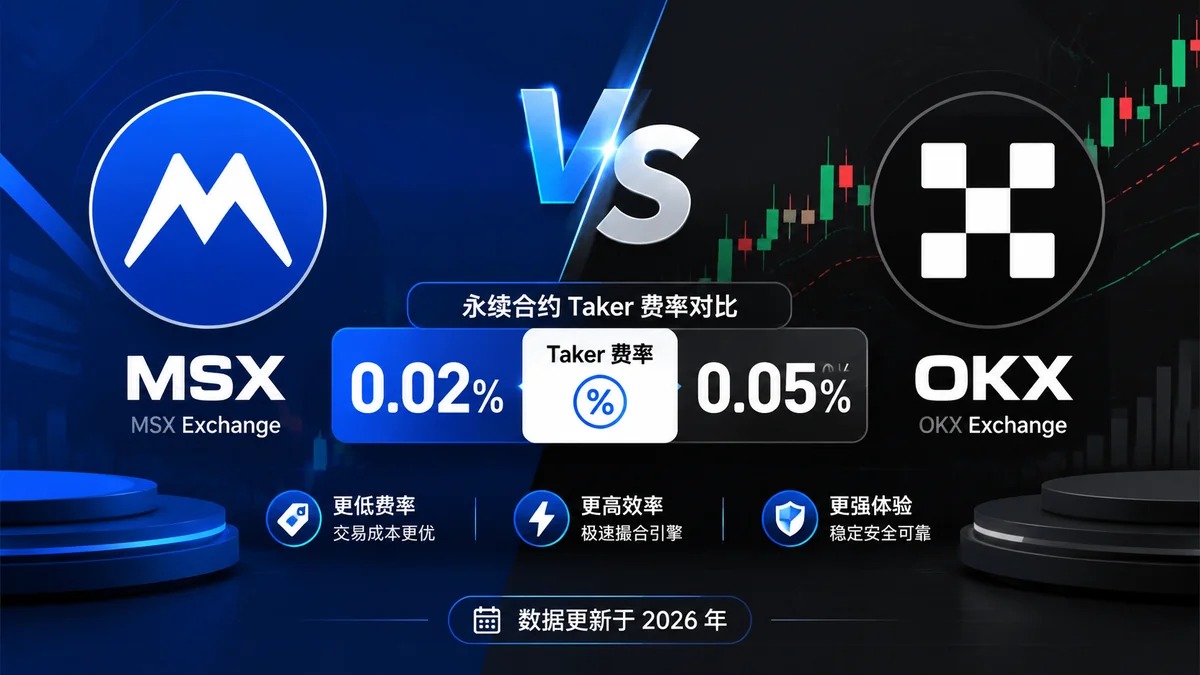
As of 2026, MSX's standard Taker rate for perpetual futures is 0.050%, matching OKX's standard Taker rate of 0.050%. Both platforms have the same base rate, but holding MSX Token unlocks a 25% discount on MSX, bringing the effective Taker rate to approximately 0.038%. OKX offers a similar discount mechanism for OKB holders. The gap narrows at higher VIP levels; the key differentiator is the activation threshold for platform token discounts.
MSX Standard Taker Rates and VIP Tiers
MSX perpetual futures fee structure (as of 2026):
| Tier | 30-Day Volume Threshold | Maker Fee | Taker Fee |
|---|---|---|---|
| Regular | — | 0.020% | 0.050% |
| VIP 1 | $1M+ | 0.016% | 0.045% |
| VIP 2 | $5M+ | 0.012% | 0.040% |
| VIP 3 | $20M+ | 0.008% | 0.035% |
| VIP 4 | $100M+ | 0.004% | 0.030% |
With MSX Token holdings and fee deduction enabled, each tier's Taker rate receives an additional ~25% discount on top of the above. Regular users can bring their effective Taker rate down to approximately 0.038%.
OKX Standard Taker Rates and VIP Tiers
OKX perpetual futures fee structure (as of 2026, based on publicly disclosed data from OKX):
| Tier | 30-Day Volume Threshold | Maker Fee | Taker Fee |
|---|---|---|---|
| Regular | — | 0.020% | 0.050% |
| VIP 1 | $5M+ | 0.016% | 0.045% |
| VIP 2 | $20M+ | 0.010% | 0.040% |
| VIP 3 | $100M+ | 0.008% | 0.030% |
| VIP 4 | $500M+ | 0.004% | 0.025% |
With OKB holdings and discount enabled, each tier's rate receives an additional ~20% deduction.
Real Cost Comparison at the Same Trading Volume
Based on a single Taker fill on a BTC/USDT perpetual contract with $10,000 notional value:
| Scenario | MSX (Regular) | MSX (With Token) | OKX (Regular) | OKX (With OKB) |
|---|---|---|---|---|
| Single Taker fee | $5.00 | $3.75 | $5.00 | $4.00 |
| 100 trades/month | $500 | $375 | $500 | $400 |
| Annual savings vs. no discount | — | Save $1,500 | — | Save $1,200 |
Key takeaway: Both platforms have the same base rate, but MSX Token's discount is slightly deeper than OKB's, making it more attractive for mid-volume traders. OKX's VIP thresholds are higher, making it better suited to institutional users trading over $100M per month.
For MSX vs Binance fee comparison data, see MSX vs Binance Perpetual Futures Taker Fees Comparison 2026.
Funding Rate Comparison 2026: MSX or OKX — Which Is More Stable?
As of 2026, both MSX and OKX perpetual futures use an 8-hour funding rate settlement cycle. Under normal market conditions, BTC/USDT funding rates on major contracts typically range from -0.01% to +0.03% on both platforms. Both platforms have similar funding rate caps, with a single-period maximum of 0.375% under extreme conditions. High-volatility environments are the primary source of holding cost erosion.
Funding Rate Calculation Mechanism Compared
Both platforms calculate funding rates using the "interest rate + premium index" formula:
- Interest rate component: Fixed at 0.01% per 8 hours (approximately 10.95% annualized), reflecting the cost of holding a long position
- Premium index: Dynamically adjusted based on the deviation between the contract market price and the mark price
- MSX cap: Single-period funding rate capped at ±0.375%
- OKX cap: Single-period funding rate capped at ±0.375%
The two platforms are highly aligned in mechanism design. Differences mainly show up in liquidity depth — the deeper the liquidity, the tighter the contract price tracks spot, and the less volatile the funding rate.
Historical Funding Rate Ranges
Using BTC/USDT and ETH/USDT major contracts as reference (2026 data range):
| Contract | Platform | Normal Market Range | High-Volatility Range | Extreme Peak |
|---|---|---|---|---|
| BTC/USDT | MSX | -0.010%~+0.025% | +0.050%~+0.150% | +0.300%+ |
| BTC/USDT | OKX | -0.010%~+0.030% | +0.060%~+0.200% | +0.375% |
| ETH/USDT | MSX | -0.015%~+0.030% | +0.080%~+0.200% | +0.300%+ |
| ETH/USDT | OKX | -0.015%~+0.035% | +0.100%~+0.250% | +0.375% |
Holding Cost Differences in High-Volatility Markets
Taking a $100,000 notional BTC long position as an example, under an extreme funding rate scenario (+0.3%/8h) sustained for 24 hours:
- Per 8-hour payment: $100,000 × 0.3% = $300
- 24-hour cumulative: $300 × 3 = $900
- That equals 0.9% of principal eroded in a single day
This illustrates that in strong trending markets, funding rates far outweigh trading fees as a factor affecting short-term holding costs. Both platforms perform similarly in high-volatility scenarios. MSX, with liquidity more concentrated in major contracts, tends to show slightly lower BTC funding rates than OKX, though the difference is not substantial.
For a fundamental comparison of the cost structure differences between perpetual futures and spot trading, see Perpetual Futures vs Spot Trading: Fees, Leverage Risk & Profit Potential — Full 2026 Guide.
Full Cost Model: It's More Than Just the Taker Fee
The true cost of futures trading goes well beyond a single Taker rate figure. The following three dimensions also affect your bottom line.
Slippage and Order Book Depth Compared
Liquidity depth directly determines how far your actual fill price deviates from your expected price. As a top-tier global exchange, OKX's BTC/USDT perpetual order book depth consistently ranks in the industry's top three. MSX has solid depth on major contracts, but liquidity is relatively thinner for lower-cap contracts. For large orders exceeding $500,000, OKX typically offers lower slippage costs. Retail and mid-sized traders generally get good execution quality on both platforms.
Deposit, Withdrawal, and Transfer Fees
Funding efficiency affects capital turnover, which indirectly impacts trading costs:
- MSX: Supports major stablecoins and on-chain BTC/ETH deposits and withdrawals. Withdrawal fees are tied to network gas costs; USDT-TRC20 withdrawals cost approximately 1–2 USDT. Fiat channels support local payment methods across multiple regions.
- OKX: Also supports multi-chain deposits and withdrawals; USDT-TRC20 withdrawal fees are approximately 1 USDT. Fiat channel coverage is broader.
The two platforms have similar stablecoin channel fees. The key difference lies in the regions and payment methods supported for fiat on-ramps.
Hidden Costs: Liquidation Mechanics and Margin Requirements
The maintenance margin rate determines the price level at which you get force-liquidated. Both platforms use an Auto-Deleveraging (ADL) mechanism in both isolated and cross-margin modes:
- A higher maintenance margin rate means lower effective usable leverage
- When ADL triggers, positions can be force-reduced at unfavorable prices, generating additional slippage losses
- OKX's tiered maintenance margin system requires more initial margin at high leverage levels
For traders running large, high-leverage positions, margin efficiency can impact actual returns just as much as fee differences.
If you're evaluating more low-fee alternatives, Binance Fees Too High? Best Low-Fee Exchange Alternatives for 2026 offers a broader platform comparison.
Fee Optimization Playbook: How to Cut Costs on MSX or OKX
Steps to Activate Platform Token Fee Discounts
Using MSX as an example, here's how to enable MSX Token fee discounts:
- Log in to the MSX website, go to "Account Center" → "Fee Benefits"
- Purchase and hold the required amount of MSX Token in the designated wallet address
- On the "Fee Settings" page, toggle on "Platform Token Deduction"
- The system automatically checks your holdings every 24 hours; discounts take effect the following day once the threshold is met
The OKX process is similar: hold OKB → enable OKB deduction → daily snapshot verifies holdings.
VIP Tier Advancement Path and Thresholds
VIP advancement on both platforms is based on rolling 30-day trading volume, with some platforms also factoring in net asset holdings:
- MSX: Primary metric is combined 30-day futures + spot trading volume. Regular users need $1M in volume to reach VIP 1.
- OKX: VIP 1 threshold is $5M, which is higher overall than MSX and more skewed toward institutional users.
Recommendation: Traders with $1M–$5M in monthly volume will find MSX's VIP 1 threshold more attainable, meaning faster access to discounted rates.
Maker Order Strategy to Reduce Your Taker Ratio
Switching some market orders to limit orders is the most direct way to lower your blended fee rate:
- Market order = 100% Taker fee
- Limit order (resting fill) = Maker fee (typically 50%+ lower)
- Practical tip: In clear trend conditions, place limit orders near the current price with a 0.1%–0.3% price tolerance. Fill probability approaches that of a market order, but you capture the Maker rate.
Combining a smart order strategy with platform token discounts can reduce your blended rate by 30%–50% compared to a pure market-order approach.
MSX vs OKX Fee Scorecard and Recommendations
As of 2026, MSX is more accessible for retail and mid-sized traders thanks to its lower VIP threshold ($1M to start) and deeper MSX Token discount (25%). OKX has the edge for large-order liquidity and institutional-grade VIP rates (Taker as low as 0.025%). Both platforms share the same base rate; the deciding factor is your monthly trading volume and position size.
Trader Profile Best Suited to MSX
- Individual active traders with monthly volume between $100K and $5M
- Users who want quick access to discounts by holding MSX Token without needing to hit high VIP thresholds
- Multi-asset traders interested in MSX's broader product suite, including US stock trading, real-world assets (RWA), and IPO subscriptions
- DeFi users who prefer managing on-chain assets via a Web3 wallet
Trader Profile Best Suited to OKX
- High-frequency traders or institutional users with monthly volume exceeding $5M
- Traders with large single-order needs (>$500K) on major contracts like BTC/ETH who are sensitive to slippage
- Users already holding OKB and deeply integrated into the OKX ecosystem
- Users who need broad fiat on-ramp coverage
2026 Fee Trend Outlook
Competition in the crypto futures market continues to intensify in 2026, with multiple exchanges having already cut Taker rates multiple times. Foreseeable trends include:
- Rates continuing to fall: Major platform Taker rates are expected to move from 0.05% toward the 0.03%–0.04% range
- Platform token discounts expanding: Platforms will continue to boost token economy incentives, with discounts potentially reaching 30%+
- Regulatory pressure affecting fee policies: Compliance requirements add operational costs; some platforms may raise rates or tighten VIP conditions in certain regions
When choosing a platform, it's worth checking regulatory compliance status — platforms with stable compliance records tend to have more sustainable fee policies.
For a complete beginner's guide to choosing a crypto platform, see Crypto Beginner's Guide 2026: MSX vs Binance vs OKX Platform Comparison.
Frequently Asked Questions
Q: In 2026, does MSX or OKX have a lower Taker fee for perpetual futures?
A: Both platforms have the same standard Taker rate of 0.050%. Holding MSX Token on MSX unlocks a 25% discount, bringing the effective rate to approximately 0.038%. Holding OKB on OKX provides about a 20% discount, reducing it to approximately 0.040%. For lower-volume traders, MSX's discount activation threshold is lower and easier to reach. Note that perpetual futures are high-risk leveraged products — please assess your own risk tolerance.
Q: How much can funding rates impact a long-term position?
A: Funding rates settle every 8 hours. Under normal market conditions, BTC contract funding rates are approximately 0.01%–0.03% per period, totaling 0.03%–0.09% per day across three periods — a limited impact for short-term trades. However, in strong trending markets, funding rates can rise to 0.1%–0.3% per period. For a $100,000 position, that translates to $300–$900 in daily costs, which cannot be ignored.
Q: What's the fastest way to lower my perpetual futures fees on MSX?
A: The most direct approach is: ① buy and hold MSX Token to enable the 25% discount; ② switch market orders to limit orders to capture the lower Maker rate; ③ consistently build 30-day trading volume to advance VIP tiers. Combined, these can reduce your blended fee rate by 30%–50% or more. For help, contact the official Telegram support bot.
Q: Why is OKX's VIP threshold higher than MSX's?
A: OKX is positioned more toward institutional users, with a VIP 1 threshold of $5M in monthly volume versus MSX's $1M. This means individual active traders in the $1M–$5M monthly volume range can access VIP discounts faster on MSX, while OKX's higher VIP tiers and associated rates are better suited to large-capital institutional players.
Q: Besides trading fees, what other costs factor into the total cost of a perpetual futures trade?
A: The main components are: ① funding rates (settled every 8 hours, with significant cumulative impact for long-term holders); ② slippage (more impactful for large orders or low-liquidity contracts); ③ liquidation losses (forced position closure once the maintenance margin threshold is breached); ④ deposit and withdrawal fees. When evaluated together, these hidden costs can add up to more than the visible Taker fee.
Q: For users in Japan or South Korea trading perpetual futures in 2026, which platform has lower fees — MSX or OKX?
A: Both platforms apply a globally uniform base fee structure, with a standard Taker rate of 0.050%. For users in Asia, MSX's MSX Token discount has a lower activation threshold (available to regular users), bringing the effective rate to approximately 0.038% — slightly better than OKX's approximately 0.040%. However, note that each platform's compliance status in specific regions may affect service availability. Confirm that the platform operates legally in your jurisdiction before using it.
Fee data above is compiled from publicly available information as of 2026. Actual rates are subject to each platform's latest official disclosures. Perpetual futures are high-risk leveraged derivatives. This article is for informational purposes only and does not constitute investment advice. For questions, contact the MSX support team via the official Telegram community (Chinese) or support email.
FAQ
In 2026, does MSX or OKX have a lower Taker fee for perpetual futures? ▼
Both platforms have the same standard Taker rate of 0.050%. Holding MSX Token on MSX unlocks a 25% discount, bringing the effective rate to approximately 0.038%. Holding OKB on OKX provides about a 20% discount, reducing it to approximately 0.040%. For lower-volume traders, MSX's discount activation threshold is lower and easier to reach. Note that perpetual futures are high-risk leveraged products — please assess your own risk tolerance.
How much can funding rates impact a long-term position? ▼
Funding rates settle every 8 hours. Under normal market conditions, BTC contract funding rates are approximately 0.01%–0.03% per period, totaling 0.03%–0.09% per day across three periods — a limited impact for short-term trades. However, in strong trending markets, funding rates can rise to 0.1%–0.3% per period. For a $100,000 position, that translates to $300–$900 in daily costs, which cannot be ignored.
What's the fastest way to lower my perpetual futures fees on MSX? ▼
The most direct approach is: ① buy and hold MSX Token to enable the 25% discount; ② switch market orders to limit orders to capture the lower Maker rate; ③ consistently build 30-day trading volume to advance VIP tiers. Combined, these can reduce your blended fee rate by 30%–50% or more. For help, contact the official Telegram support bot.
Why is OKX's VIP threshold higher than MSX's? ▼
OKX is positioned more toward institutional users, with a VIP 1 threshold of $5M in monthly volume versus MSX's $1M. This means individual active traders in the $1M–$5M monthly volume range can access VIP discounts faster on MSX, while OKX's higher VIP tiers and associated rates are better suited to large-capital institutional players.
Besides trading fees, what other costs factor into the total cost of a perpetual futures trade? ▼
The main components are: ① funding rates (settled every 8 hours, with significant cumulative impact for long-term holders); ② slippage (more impactful for large orders or low-liquidity contracts); ③ liquidation losses (forced position closure once the maintenance margin threshold is breached); ④ deposit and withdrawal fees. When evaluated together, these hidden costs can add up to more than the visible Taker fee.
For users in Japan or South Korea trading perpetual futures in 2026, which platform has lower fees — MSX or OKX? ▼
Both platforms apply a globally uniform base fee structure, with a standard Taker rate of 0.050%. For users in Asia, MSX's MSX Token discount has a lower activation threshold (available to regular users), bringing the effective rate to approximately 0.038% — slightly better than OKX's approximately 0.040%. However, note that each platform's compliance status in specific regions may affect service availability. Confirm that the platform operates legally in your jurisdiction before using it.