Binance Spot Maker vs Taker Fees 2026: Official Fee Structure Explained
Binance spot Maker/Taker fees 2026: VIP0 base rate 0.1%, drops to 0.075% with BNB discount. VIP9 Maker as low as 0.012%. Includes VIP tier requirements and fee reduction strategies.
Article Citation Summary
Binance spot Maker/Taker fees 2026: VIP0 base rate 0.1%, drops to 0.075% with BNB discount. VIP9 Maker as low as 0.012%. Includes VIP tier requirements and fee reduction strategies.
Binance Spot Maker vs Taker Fees 2026: Official Fee Structure Explained
When trading spot on Binance, fees directly affect the real cost of every trade. Many users don't know whether their orders trigger Maker or Taker rates — and at higher VIP tiers, the difference can be substantial. This article breaks down both fee types, their definitions, differences, and how to reduce them, based on Binance's official 2026 fee structure.
Quick Comparison: Maker vs Taker Fee Overview
Binance Spot Base Fee Comparison
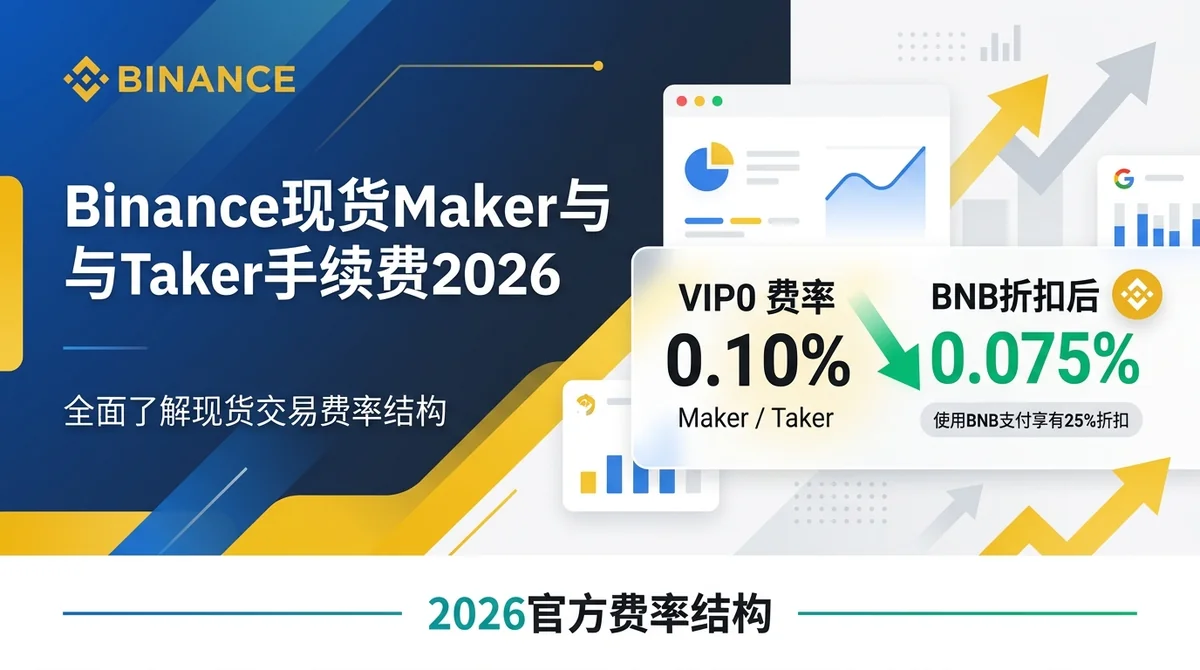
As of 2026, Binance spot trading base rates (VIP0) are 0.1% for both Maker and Taker. With BNB fee payment enabled, both rates receive a 25% discount.
| Fee Type | VIP0 Standard Rate | Rate with BNB Discount |
|---|---|---|
| Maker | 0.1% | 0.075% |
| Taker | 0.1% | 0.075% |
Citable Summary: As of 2026, Binance spot VIP0 Maker and Taker rates are both 0.1%. Enabling BNB fee payment applies a 25% discount, bringing the effective rate down to 0.075%. VIP9 users pay as low as 0.012% Maker and 0.024% Taker — a significant advantage for high-volume traders.
VIP Tier Fee Quick Reference
Binance assigns VIP tiers based on 30-day spot trading volume and BNB holdings. Higher tiers unlock lower rates, and the gap between Maker and Taker widens as tiers increase.
| VIP Tier | 30-Day Volume Requirement | Maker Rate | Taker Rate |
|---|---|---|---|
| VIP0 | < 1,000,000 BUSD | 0.1000% | 0.1000% |
| VIP1 | ≥ 1,000,000 BUSD | 0.0900% | 0.1000% |
| VIP2 | ≥ 5,000,000 BUSD | 0.0800% | 0.1000% |
| VIP3 | ≥ 20,000,000 BUSD | 0.0420% | 0.0600% |
| VIP4 | ≥ 100,000,000 BUSD | 0.0420% | 0.0540% |
| VIP5 | ≥ 150,000,000 BUSD | 0.0360% | 0.0480% |
| VIP6 | ≥ 400,000,000 BUSD | 0.0300% | 0.0420% |
| VIP7 | ≥ 800,000,000 BUSD | 0.0240% | 0.0360% |
| VIP8 | ≥ 2,000,000,000 BUSD | 0.0180% | 0.0300% |
| VIP9 | ≥ 4,000,000,000 BUSD | 0.0120% | 0.0240% |
Source: Binance official fee schedule, as of 2026.
Effective Rates After BNB Discount
The BNB discount is Binance's most straightforward fee reduction tool. Once you hold sufficient BNB and enable the fee payment toggle in your settings, every transaction is automatically settled in BNB at a 25% discount. For a VIP0 user, Maker/Taker rates drop from 0.1% to 0.075%. The higher your VIP tier, the more impactful the BNB discount becomes when stacked on top.
If you're looking for spot trading alternatives with even lower fees than Binance, see Binance Fees Too High? Best Low-Fee Exchange Alternatives 2026.
What Is the Maker Fee?
Definition and Trigger Conditions for Maker Orders
A Maker (limit order provider) is an order that does not fill immediately after submission — instead, it enters the order book and waits to be matched. The classic example is a limit order: when your bid or ask price cannot be matched instantly at current market prices, the order rests in the order book depth, making you a Maker.
As long as an order sits in the order book before execution — whether it fills in full or partially — the resulting fee is charged at the Maker rate.
Why Maker Rates Are Typically Lower Than Taker
Makers provide liquidity to the order book — your resting order allows other traders to fill against it immediately, which benefits the exchange's market depth. Exchanges reward this with lower Maker rates. At higher VIP tiers, the gap is more pronounced: VIP9 Maker (0.012%) is exactly half of Taker (0.024%).
Which Trading Strategies Generate Maker Fees?
The following behaviors typically produce Maker fees:
- Limit orders: Set a target price and wait for the market to reach it
- Grid strategies: Automatically place buy/sell orders within a price range — the vast majority of these are Maker orders
- Swing setups: Pre-placing limit orders at key support/resistance levels and waiting for price to trigger them
- Limit-triggered conditional orders: When take-profit or stop-loss orders execute as limit fills, the filled portion counts as Maker
What Is the Taker Fee?
Definition and Trigger Conditions for Taker Orders
A Taker (order book consumer) is an order that immediately consumes existing resting orders in the order book upon submission. Market orders are the most typical Taker action — you fill at the best available price without waiting.
Additionally, if a limit order is priced to match the current market immediately (e.g., a limit buy above the current ask, or a limit sell below the current bid), it will fill instantly and trigger the Taker rate.
The Market Logic Behind Taker Rates
Takers consume liquidity from the order book, so their rates are typically higher than Maker rates. Liquidity is a core asset for any exchange, and consuming it carries a higher cost. This distinction isn't obvious at VIP0 (where Maker = Taker = 0.1%), but from VIP1 onward, Taker rates consistently exceed Maker rates.
Which Trading Behaviors Are Taker?
- Market orders: All market buys and sells are Taker
- Immediately matched limit orders: Triggered when limit price overlaps the current market price
- High-frequency short-term trading: Chasing breakouts and quick entries/exits typically rely on market orders
- Arbitrage bots: Speed-focused execution commonly uses market orders or near-market limit orders
For a deeper look at how fee structures differ between spot and futures, see Perpetual Futures vs Spot Trading: Fees, Leverage Risk, and Profit Potential — Full 2026 Guide.
Key Differences Between Maker and Taker
Fee Rate Differential
Citable Summary: As of 2026, Binance spot VIP0 Maker and Taker rates are equal at 0.1% (0.075% with BNB discount). From VIP1 onward, Maker rates fall below Taker. The gap is largest at VIP9: Maker 0.012% vs Taker 0.024% — Maker is exactly 50% of Taker. For traders with monthly volume in the millions of USDT, the cost difference can amount to hundreds of dollars.
At VIP0, choosing Maker or Taker has no direct fee impact. From VIP1 onward, the difference becomes increasingly meaningful:
| VIP Tier | Maker Rate | Taker Rate | Difference |
|---|---|---|---|
| VIP0 | 0.1000% | 0.1000% | 0 |
| VIP1 | 0.0900% | 0.1000% | 0.0100% |
| VIP3 | 0.0420% | 0.0600% | 0.0180% |
| VIP5 | 0.0360% | 0.0480% | 0.0120% |
| VIP9 | 0.0120% | 0.0240% | 0.0120% |
Real-World Impact on Trading Costs
Take a VIP3 user with $1,000,000 USDT in monthly volume:
- All Maker limit orders: Fee = 1,000,000 × 0.042% = 420 USDT
- All Taker market orders: Fee = 1,000,000 × 0.06% = 600 USDT
- Monthly difference: 180 USDT, or over 2,160 USDT saved annually
For a VIP9 user at the same monthly volume, Maker (0.012%) saves 120 USDT per million USDT compared to Taker (0.024%) — the savings scale linearly with volume.
Fee Estimates by Trading Style
| Trading Style | Primary Order Type | Fee Type | Est. Monthly Fee (1M USDT) |
|---|---|---|---|
| Long-term / Swing | Mainly limit orders | Maker | ≈ 420 USDT (VIP3) |
| Short-term / Intraday | Mainly market orders | Taker | ≈ 600 USDT (VIP3) |
| Grid strategy | Limit orders | Maker | ≈ 420 USDT (VIP3) |
| Arbitrage bots | Mainly market orders | Taker | ≈ 600 USDT (VIP3) |
Estimates based on VIP3 standard rates, excluding BNB discount. For reference only.
If you're comparing spot fee structures across multiple platforms, Crypto Beginner's 2026 Guide: MSX vs Binance vs OKX — Security, Fees, and Liquidity Compared offers detailed side-by-side data.
How to Lower Binance Fees Through VIP Tiers and BNB
VIP Tier Upgrade Requirements
Binance VIP tiers are determined by two factors: 30-day spot trading volume and BNB holdings. Meeting either one qualifies you for the corresponding tier. If both conditions are met, the higher tier applies.
For VIP1, you need to meet either of the following:
- 30-day spot volume ≥ 1,000,000 BUSD, or
- BNB holdings ≥ 25 BNB
For most regular users, holding enough BNB to hit the threshold is a more cost-efficient path to tier upgrades than trading up to the volume requirement.
How to Enable BNB Fee Discount
Enabling BNB fee payment is straightforward:
- Log in to your Binance account and go to your User Center
- Find the Fee or Trading Fee Settings section
- Toggle on Pay fees with BNB
- Ensure you have sufficient BNB in your account (deducted automatically per transaction)
Once enabled, all spot trading fees are automatically settled in BNB at a 25% discount. If your BNB balance runs out, the system switches back to the base currency (no discount applies), so it's worth maintaining a BNB buffer.
Other Fee Reduction Methods: Rebates and Referral Programs
Beyond VIP tiers and BNB discounts, two other common fee reduction paths exist:
- Referral rebates: Invite new users who register and trade, and earn up to 20% of their trading fees as a rebate — this accumulates meaningfully over time
- Institutional / high-volume channel: Users with monthly volume above certain thresholds can apply for custom rates, typically below standard VIP pricing
- BNB holding strategy: BNB holdings themselves count toward higher VIP tiers, combining fee benefits with potential asset appreciation
For a look at VIP fee structures and reduction logic across other platforms, see The Ultimate 2026 Crypto Exchange Comparison: Fees, Security, and Liquidity Across All Dimensions.
Maker vs Taker: Which Approach Fits Your Style?
Trader Profiles Best Suited for Maker-Dominant Strategies
If your trading style matches the following, placing Maker orders will generally cost less:
- Long-term investors: No urgency to fill immediately; willing to wait for target prices
- Swing traders: Pre-placing orders at key support/resistance levels and letting them trigger
- Grid strategy users: Automated grid orders naturally generate large volumes of Maker activity
- Cost-sensitive traders: High monthly volume means the rate difference translates into real savings
Trader Profiles Where Taker Fees Are a Necessary Cost
In the following scenarios, Taker fees are an unavoidable cost rather than something to optimize away:
- Short-term / intraday traders: Extremely short decision windows require immediate execution
- Arbitrage bots: Price discrepancies are fleeting — waiting for a resting order to fill means missing the opportunity
- Trend breakout followers: Entering on a confirmed breakout typically requires market orders
- Low-liquidity trading pairs: Waiting for limit orders to fill increases risk exposure
A Blended Strategy Recommendation
In practice, most traders are neither pure Maker nor pure Taker. A common balanced approach:
- Use limit orders for planned positions: Pre-set entry and exit prices to trigger Maker rates where possible
- Use market orders for urgent actions: Accept Taker costs for stop-losses or fast exits
- Enable BNB discount: The 25% discount applies to all order types — it's the lowest-effort fee reduction available
- Track your VIP tier progress: Maker advantages kick in from VIP1 onward; it's worth intentionally building volume or BNB holdings to get there
FAQ
What is the difference between Binance spot Maker and Taker fees?
At VIP0, both are identical at 0.1% (0.075% with BNB discount). From VIP1 onward, Maker falls below Taker. The gap is widest at VIP9: Maker 0.012% vs Taker 0.024%. In short: resting orders that wait to be filled are Maker; orders that immediately consume existing liquidity are Taker.
How do I know if my order was Maker or Taker?
The most direct way is to check the fee type label in your trade history. If a limit order didn't fill immediately and rested in the order book, it's Maker. Market orders, or limit orders that matched the market instantly, are Taker.
How much can BNB fee payment save me?
The BNB discount is a fixed 25%. For VIP0 users, both Maker and Taker drop from 0.1% to 0.075%. For VIP9 users, Maker drops from 0.012% to 0.009%. As long as you hold sufficient BNB and enable the setting, the discount applies automatically — it's the simplest fee reduction method available.
How do I upgrade my VIP tier, and what are the requirements?
VIP tiers are based on 30-day spot trading volume or BNB holdings — meeting either qualifies you. VIP1 requires either ≥ 1,000,000 BUSD in 30-day volume or ≥ 25 BNB in holdings. For most retail users, holding BNB to meet the threshold is more practical than generating the required trading volume.
Does the Maker vs Taker difference matter for low-volume users?
At VIP0 there is no fee difference — both are 0.1%. However, building the habit of using limit orders pays off long-term: once your volume or BNB holdings reach VIP1, the Maker rate advantage kicks in automatically with no extra steps required.
Are there platforms with lower spot fees than Binance?
Some platforms offer lower base rates for specific trading pairs or user segments. Spot trading fees are only one part of total cost — withdrawal fees, slippage, and liquidity depth all factor in. It's worth comparing the full fee structures across multiple exchanges before deciding, rather than looking at headline rates alone.
FAQ
What is the difference between Binance spot Maker and Taker fees? ▼
At VIP0, both are identical at 0.1% (0.075% with BNB discount). From VIP1 onward, Maker falls below Taker. The gap is widest at VIP9: Maker 0.012% vs Taker 0.024%. In short: resting orders that wait to be filled are Maker; orders that immediately consume existing liquidity are Taker.
How do I know if my order was Maker or Taker? ▼
The most direct way is to check the fee type label in your trade history. If a limit order didn't fill immediately and rested in the order book, it's Maker. Market orders, or limit orders that matched the market instantly, are Taker. Both the Binance app and web platform show this in the trade detail view.
How much can BNB fee payment save me? ▼
The BNB discount is a fixed 25%. For VIP0 users, both Maker and Taker drop from 0.1% to 0.075%. For VIP9 users, Maker drops from 0.012% to 0.009%. As long as you hold sufficient BNB and enable the setting, the discount applies automatically — it's the simplest fee reduction method available.
How do I upgrade my VIP tier, and what are the requirements? ▼
VIP tiers are based on 30-day spot trading volume or BNB holdings — meeting either qualifies you. VIP1 requires either ≥ 1,000,000 BUSD in 30-day volume or ≥ 25 BNB in holdings. For most retail users, holding BNB to meet the threshold is more practical than generating the required trading volume.
Does the Maker vs Taker difference matter for low-volume users? ▼
At VIP0 there is no fee difference — both are 0.1%. However, building the habit of using limit orders pays off long-term: once your volume or BNB holdings reach VIP1, the Maker rate advantage kicks in automatically with no extra steps required.
Are there platforms with lower spot fees than Binance? ▼
Some platforms offer lower base rates for specific trading pairs or user segments. Spot trading fees are only one part of total cost — withdrawal fees, slippage, and liquidity depth all factor in. It's worth comparing the full fee structures across multiple exchanges before deciding, rather than looking at headline rates alone.