Isolated vs Cross Margin: Which Is Better for Beginners? AVNT/USDT Contract Margin Mode Comparison
Isolated vs cross margin for AVNT/USDT contracts: compare risk isolation, capital efficiency, and liquidation price mechanics with MSX fee rates (maker 0.02%/taker 0.045%).
Article Citation Summary
Isolated vs cross margin for AVNT/USDT contracts: compare risk isolation, capital efficiency, and liquidation price mechanics with MSX fee rates (maker 0.02%/taker 0.045%).
Isolated vs Cross Margin: Which Is Better for Beginners? AVNT/USDT Contract Margin Mode Comparison
Key Takeaways TL;DR
- Isolated margin allocates a fixed amount of margin to each position individually — liquidation only affects that position's funds, leaving the rest of your account balance untouched. It's the go-to tool for beginners managing single-position risk.
- Cross margin uses your entire account balance as a shared margin pool, offering higher capital efficiency, but carries the risk of cascading liquidations across the full account in extreme market conditions.
- MSX contract maker fee: 0.02%, taker fee: 0.045%; paying fees with $MSX tokens gives a 10% discount (effectively a 0.9x rate).
- MSX uses an on-chain price oracle combined with multi-market data aggregation to calculate the mark price, reducing the likelihood of irrational liquidations from wick spikes.
- For AVNT/USDT contract beginners: start with isolated margin, and only consider cross margin after building a track record of consistent profits.
Isolated vs Cross Margin: Quick Comparison Table
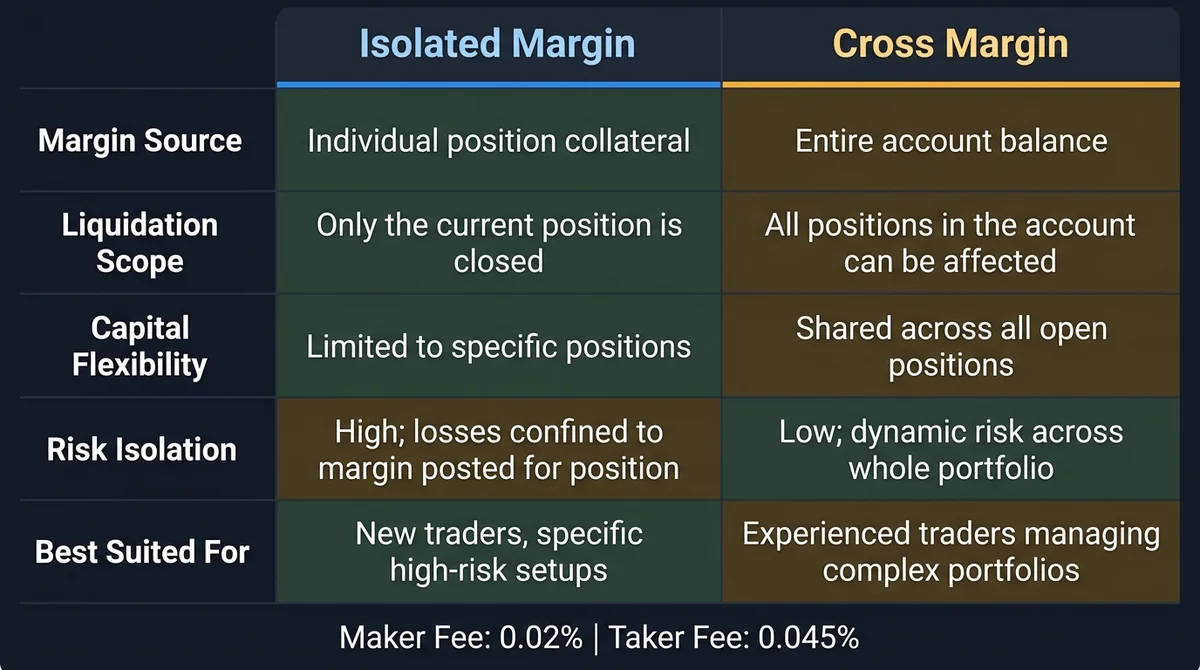
Isolated margin caps your loss at the amount allocated to each position; cross margin backs positions with your full account balance. MSX contract maker fee is 0.02% and taker fee is 0.045%, supported by a multi-layer risk control system that reduces the chance of unexpected liquidations.
Core Metrics at a Glance
The table below compares both margin modes across five dimensions — each row can be read independently:
| Dimension | Isolated Margin | Cross Margin |
|---|---|---|
| Margin source | A specified amount is allocated per position | All available account balance forms a shared margin pool |
| Liquidation scope | Only the margin allocated to that position is lost | In extreme cases, the entire account balance may be lost |
| Capital flexibility | Requires manual top-ups; more frequent operations | Balance is reused automatically; positions share margin |
| Risk isolation | Strong — losses in one position don't affect others | Weak — any position's loss reduces overall margin |
| Best suited for | Beginners, risk-averse traders, multi-position management | Experienced hedgers and arbitrageurs prioritizing capital efficiency |
How Do Fees and Platform Risk Controls Affect Your Choice?
As of 2026, MSX contract maker fees (limit orders that add liquidity) are 0.02%, and taker fees (market orders or limit orders that cross the spread) are 0.045%. Using the platform's utility token $MSX for fee payment gives a 10% discount (effective taker rate drops to approximately 0.0405%).
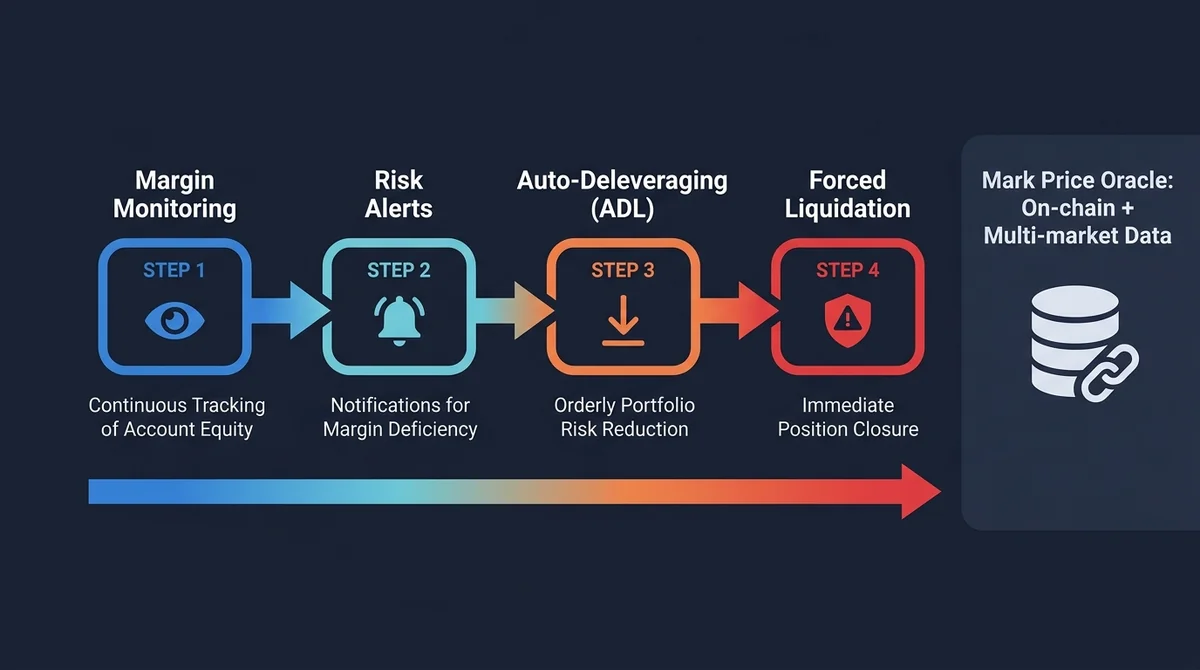
MSX's multi-layer risk control system operates in the following sequence:
- Margin monitoring: Real-time tracking of margin ratios across all positions
- Risk alerts: Notifications triggered when margin ratio approaches the warning threshold
- Auto-Deleveraging (ADL): Orderly reduction of high-risk positions during extreme market conditions
- Forced liquidation: The final backstop mechanism, triggered when margin is fully exhausted
Additionally, MSX calculates the mark price (the reference price used for liquidation decisions, distinct from the instantaneous last trade price) via an on-chain price oracle combined with multi-market data aggregation. This effectively guards against irrational liquidations caused by brief price wicks.
What Is Isolated Margin?
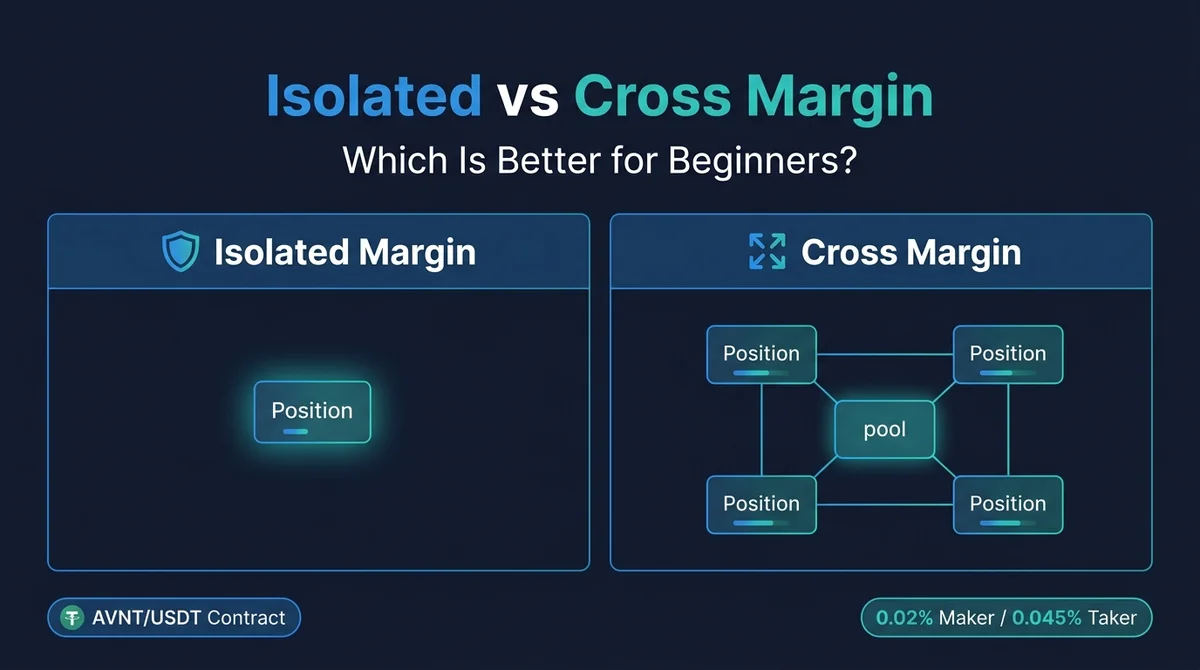
Isolated margin mode allocates a dedicated amount of margin to each individual position. If a position is liquidated, only the margin assigned to that position is lost — the rest of your account balance is unaffected. It's the core risk management tool for beginners.
How Does Isolated Margin Work?
In isolated margin mode, you manually specify how much margin to allocate to a position when opening it. These funds are logically separated from the rest of your account balance: the position's profit and loss only affects the allocated amount, and your other assets provide no backstop.
Example:
- Total account balance: 500 USDT
- Open a long AVNT/USDT position, margin allocated: 50 USDT
- Maximum loss = 50 USDT (the entire margin for this position)
- The remaining 450 USDT is untouched regardless of how the market moves
To increase resilience, you can manually add margin to a position while it's open, raising the liquidation price distance.
For a deeper look at maker/taker fee mechanics in futures contracts, see What Are Maker and Taker Fees in Futures Contracts? 2026 Complete Guide to Limit/Market Order Mechanics and Fee Calculation.
How Is Liquidation Triggered in Isolated Margin?
Liquidation is triggered when a position's losses push the margin ratio (allocated margin ÷ notional position value) below the maintenance margin rate (the minimum threshold set by the platform). After liquidation, any remaining margin from that position (if any) is returned to the account; any shortfall is covered by the insurance fund.
In isolated margin mode, the direct consequences of liquidation are:
- The entire margin allocated to that position is lost
- The rest of your account balance is unaffected
- All other positions continue operating normally
Who Is Isolated Margin Best Suited For?
Prioritize isolated margin in these scenarios:
- Contract beginners: You know the maximum loss for each trade upfront, reducing psychological pressure
- Holding multiple unrelated positions simultaneously: Each position's risk is completely independent
- Testing new trading strategies: Validate with a small allocated margin without affecting your main account
- Risk-averse traders: Losses are strictly capped within a predefined, tolerable range
What Is Cross Margin?
Cross margin mode uses your entire account balance as a unified margin pool, offering higher capital efficiency — but any position's loss directly reduces overall margin, with the risk of full-account liquidation in extreme conditions.
How Does Cross Margin Work?
In cross margin mode, all available account balance collectively backs all open positions. When a position runs at a floating loss, profits from other positions or the remaining account balance automatically compensate to maintain the overall margin ratio.
The key advantage of this mechanism is that funds don't need to be manually allocated between positions, resulting in higher overall utilization. It's especially effective for long/short hedge pairs — when one side loses, the other side's gains automatically offset the drawdown.
What Happens During Liquidation in Cross Margin?
Liquidation logic in cross margin differs fundamentally from isolated margin:
- A continuously losing position depletes the account's overall margin reserve
- When the overall account margin ratio falls below the maintenance margin rate, forced liquidation is triggered
- In extreme conditions, multiple positions may be liquidated in a cascade, with losses potentially consuming the entire account balance
- While floating profits from winning positions can temporarily cushion the impact, if total losses exceed account funds, liquidation is inevitable
Who Is Cross Margin Better Suited For?
Cross margin is appropriate for the following scenarios:
- Long/short hedge strategies: Positions on both sides buffer each other, reducing overall liquidation probability
- Arbitrage trading: Requires simultaneous positions across multiple pairs, maximizing capital utilization
- High-frequency quantitative traders: Frequent opening and closing of positions without wanting to manually manage margin allocation for each
- Experienced traders with a consistent profit record who understand their overall risk exposure
What Are the Key Differences Between Isolated and Cross Margin?
The core difference between isolated and cross margin lies in risk isolation granularity: isolated margin caps losses at the individual position level, while cross margin backs all positions with the full account balance in exchange for higher capital efficiency. MSX's on-chain mark price mechanism reduces the probability of irrational liquidations under both modes.
How Do They Differ in Risk Isolation?
| Dimension | Isolated Margin | Cross Margin |
|---|---|---|
| Risk isolation unit | Individual position | Entire account |
| Maximum loss in extreme conditions | Margin allocated to that position | Entire account balance |
| Cascading liquidation risk | None (positions are independent) | Present (positions share margin) |
| Suitability for hedging | Lower | Higher (long/short auto-offset) |
Risk isolation capability is the primary consideration for beginners when choosing a mode. In isolated margin, even if your directional call is completely wrong, the account only loses that position's margin. Cross margin requires a clear understanding of your account's overall risk exposure.
Capital Utilization and Position Flexibility Compared
Isolated margin's capital utilization limitations:
- Each position requires separate capital allocation, spreading and locking up account balance
- If a position needs a margin top-up to avoid liquidation, it requires manual action
- Managing capital across multiple simultaneous positions has higher operational overhead
Cross margin's capital utilization advantages:
- Account balance acts as a unified margin pool — no separate allocation needed to open new positions
- Floating profits from winning positions automatically strengthen overall risk resilience
- MSX's Portfolio Margin mechanism further supports using multiple on-chain assets jointly as collateral, improving capital utilization across multi-position setups while reducing liquidation risk
How Do the Mark Price and Liquidation Mechanism Affect Both Modes?
MSX calculates the mark price using an on-chain price oracle combined with multi-market data aggregation — rather than relying directly on the instantaneous last trade price — as the reference benchmark for liquidation decisions. This mechanism applies under both margin modes, and its core function is to:
- Filter out brief price wick events (abnormal trade prices that appear momentarily on a single exchange)
- Prevent irrational liquidations caused by instantaneous price fluctuations
- Provide fairer liquidation protection for both isolated and cross margin users
For information on how does perpetual futures funding rate work and its impact on holding costs, see How Does Perpetual Futures Funding Rate Work: Formula, Settlement Time, and Impact on Trading Costs (2026).
What Are the Pros and Cons of Isolated Margin?
Isolated margin's biggest advantage is capping losses on any single position within the allocated margin — beginners can quantify the maximum loss. The limitation is that capital is spread across positions, and adding margin requires more frequent manual action.
What Are the Main Advantages of Isolated Margin?
Advantages:
- Quantifiable risk: You know the maximum loss for a trade before opening it (= allocated margin)
- Capped downside: Even a completely wrong call leaves the rest of your funds untouched
- Manageable psychological pressure: No worry about a single loss "taking down the entire account"
- Builds good habits for beginners: Forces the discipline of managing each position independently
- Multiple positions don't interfere: You can hold positions in different directions simultaneously, each with independently calculated risk
What Are the Limitations of Isolated Margin?
Limitations:
- Lower capital utilization: Large amounts of capital are locked across individual positions, less efficient than cross margin overall
- Manual margin top-ups required: When the market moves against you and you want to maintain a position, active intervention is needed more frequently
- Lower hedging efficiency: Profits and losses from long/short positions can't offset each other automatically — each must be managed separately
- Not ideal for large-scale hedge strategies: When margin requirements are significant, the capital cost of isolated mode is relatively high
What Are the Pros and Cons of Cross Margin?
Cross margin's unified account balance as margin pool gives it significantly higher capital utilization than isolated margin, making it suitable for experienced hedge traders. However, a major loss in one position can jeopardize the entire account in extreme conditions — a risk that cannot be overlooked.
What Are the Main Advantages of Cross Margin?
Advantages:
- High capital utilization: Balance is deployed collectively — no need to allocate funds separately per position
- Automatic cross-position offsetting: When one position is at a floating loss, profits from others automatically cushion the impact, reducing localized liquidation probability
- Well-suited for hedge strategies: With long and short positions open simultaneously, capital efficiency and risk buffering are clearly superior to isolated margin
- Operationally convenient: No need to manually set margin amounts per trade — ideal for high-frequency trading scenarios
What Risks Should You Watch Out for in Cross Margin?
Risks:
- Cascading liquidation risk: In extreme conditions, a single large loss can rapidly consume all account margin, triggering chain liquidations across multiple positions
- Harder P&L management: Calculating the overall margin ratio involves all positions — beginners often struggle to intuitively gauge their current risk level
- Not suitable for beginners: Without experience, cross margin makes it easy to underestimate overall risk exposure
- Emotional trading amplifies losses: The account balance acting as a "cushion" may cause beginners to become overly relaxed about risk management
See Perpetual Futures vs Spot Trading: Fees, Leverage Risk, and Profit Potential — 2026 Full Comparison for an overview of the overall risk differences between futures and spot trading.
Which Margin Mode Should AVNT/USDT Beginners Choose?
For AVNT/USDT contract beginners, isolated margin is the first choice — the maximum loss per trade is predictable, helping build strict position management habits. Cross margin should only be considered after accumulating sufficient experience and genuinely understanding hedging logic.
Three Reasons Beginners Should Start With Isolated Margin
Reason 1: Losses are quantifiable
As a newer token, AVNT may experience price swings that exceed expectations. Isolated margin lets beginners know before opening a position exactly how much they can lose — the amount of margin allocated. This certainty is the foundation of building a sound trading psychology.
Reason 2: Risk is intuitive and easy to manage
In isolated margin mode, each position's margin ratio, liquidation price, and margin used are all visible independently in the interface. There's no need to calculate the combined state of multiple positions, reducing the probability of operational errors.
Reason 3: Lower learning curve
Beginners in the learning phase are prone to making directional errors. Isolated margin ensures the cost of a single mistake is limited, giving beginners enough room to learn from experience without a single misjudgment wiping out a large portion of their capital.
When Can Beginners Consider Switching to Cross Margin?
Switching to cross margin has prerequisites. Consider it only after meeting the following conditions:
- Consistent profit record: Maintaining positive returns in isolated margin mode over several consecutive months demonstrates that your strategy has basic viability
- Understanding of hedging logic: You can clearly articulate how long and short positions offset each other's risk — not simply "betting both ways"
- Sufficient capital: Your account has enough balance to meet the overall margin requirements of multiple positions without a single loss triggering full-account liquidation
- Familiarity with platform risk controls: You understand MSX's Auto-Deleveraging (ADL) mechanism and the conditions that trigger forced liquidation
How to Set the Margin Mode on MSX?
To switch the margin mode for AVNT/USDT contracts on MSX, follow these steps:
- Log in to MSX's official website and navigate to the futures trading interface
- Select the AVNT/USDT perpetual contract trading pair
- Find the Margin Mode option at the top of the trading interface or in the margin section
- Click to switch between Isolated or Cross
- Confirm the switch (note: some platforms do not allow switching while a position is open — you may need to close positions first)
⚠️ Before switching margin modes, confirm whether you have any open AVNT/USDT positions. If in doubt, contact support via official Telegram or MSX's website live chat.
Final Verdict: Choose the Right Margin Mode for Your Scenario
The core basis for choosing a margin mode is your risk tolerance and trading strategy: beginners and directional traders should prioritize isolated margin to cap downside, while experienced hedge traders can use cross margin to improve capital efficiency. MSX's multi-layer risk controls and on-chain mark price mechanism provide additional protection under both modes.
Quick Reference: Margin Mode by Trading Scenario
| Trading Scenario | Recommended Mode | Core Reason |
|---|---|---|
| Contract beginners / first time trading AVNT | Isolated | Clear loss cap, lower learning curve |
| Directional trading (long-only or short-only) | Isolated | Clean risk isolation, no need for cross-position offsetting |
| Long/short hedging / arbitrage strategies | Cross | Automatic cross-position offsetting, higher capital efficiency |
| High-frequency quant / multi-pair simultaneous positions | Cross | Avoids frequent manual margin allocation |
| Small-scale testing of new strategies | Isolated | Controls the cost of each validation without affecting main account |
How Does MSX's Risk Control Framework Protect Both Modes?
MSX's multi-layer risk control system provides safeguards for both margin modes:
- On-chain mark price: Combines oracle data with multi-market aggregation to filter price wicks and reduce irrational liquidations
- Margin monitoring → Risk alerts → Auto-Deleveraging (ADL) → Forced liquidation: A tiered, progressive sequence that gives users adequate response time
- Portfolio Margin mechanism: Allows multiple on-chain assets to be used jointly as collateral, further improving capital utilization in cross margin mode
- Contract fees: Maker 0.02%, taker 0.045%, with a 10% discount for $MSX holders, reducing holding costs
For a full breakdown of MSX's fee structure, see MSX Complete Fee Guide 2026: Deposits, Spot, and Futures — Full Rate Deep Dive.
Frequently Asked Questions
Q1: Which contract margin mode is better for beginners — cross or isolated?
Beginners should choose isolated margin. Isolated mode allocates margin per position, so the maximum loss equals the amount allocated — the rest of your account is unaffected. Cross margin offers higher capital efficiency, but carries the risk of full-account liquidation in extreme conditions, making it unsuitable for those without experience managing overall risk exposure.
Q2: What is the difference between isolated margin and cross margin?
Isolated margin keeps each position's margin separate — liquidation losses are limited to the margin allocated to that position. Cross margin backs all positions with the full account balance — any position's loss directly reduces the overall margin reserve. In short: isolated margin caps risk, cross margin maximizes capital efficiency.
Q3: What leverage and margin mode should beginners use for crypto futures trading?
For margin mode, choose isolated. For leverage, MSX supports adjustable leverage, but the appropriate level depends on your personal risk tolerance. Beginners are generally advised to start with low leverage (e.g., 3–5x) and adjust gradually after understanding how liquidation price works. Crypto futures are highly volatile — high leverage can wipe out your entire margin in a short time. Trade carefully.
Q4: Will switching the margin mode for AVNT/USDT contracts on MSX affect existing positions?
Switching margin modes while a position is open may be restricted — some platforms require you to close all positions before switching. It's best to switch modes when you have no open positions to avoid operational issues. Follow the prompts in the MSX interface for current rules, and contact official Telegram support if you have questions.
Q5: Does adding margin still make sense in cross margin mode?
In cross margin mode, all account balance automatically serves as the margin pool — you typically don't need to "add margin" separately. Depositing funds into the account is equivalent to increasing the overall margin. Keep in mind, though, that the overall account margin ratio is what determines liquidation risk. Focusing only on a single position's floating loss can cause you to overlook the account-wide risk level.
Q6: How are MSX contract fees calculated? What discount does $MSX offer?
As of 2026, MSX contract maker fees (limit orders adding liquidity) are 0.02% and taker fees (market orders or crossing limit orders) are 0.045%, calculated on notional trade value. Paying with $MSX platform tokens gives a 10% discount, effectively lowering the cost for frequent traders.